

More news on this day
Morning and evening rush hours on London’s Piccadilly line have descended into a familiar pattern of overcrowding, severe delays and frustrated passengers, as a mix of strike action, ageing trains and ongoing engineering work continues to disrupt one of the capital’s key east–west Underground arteries.
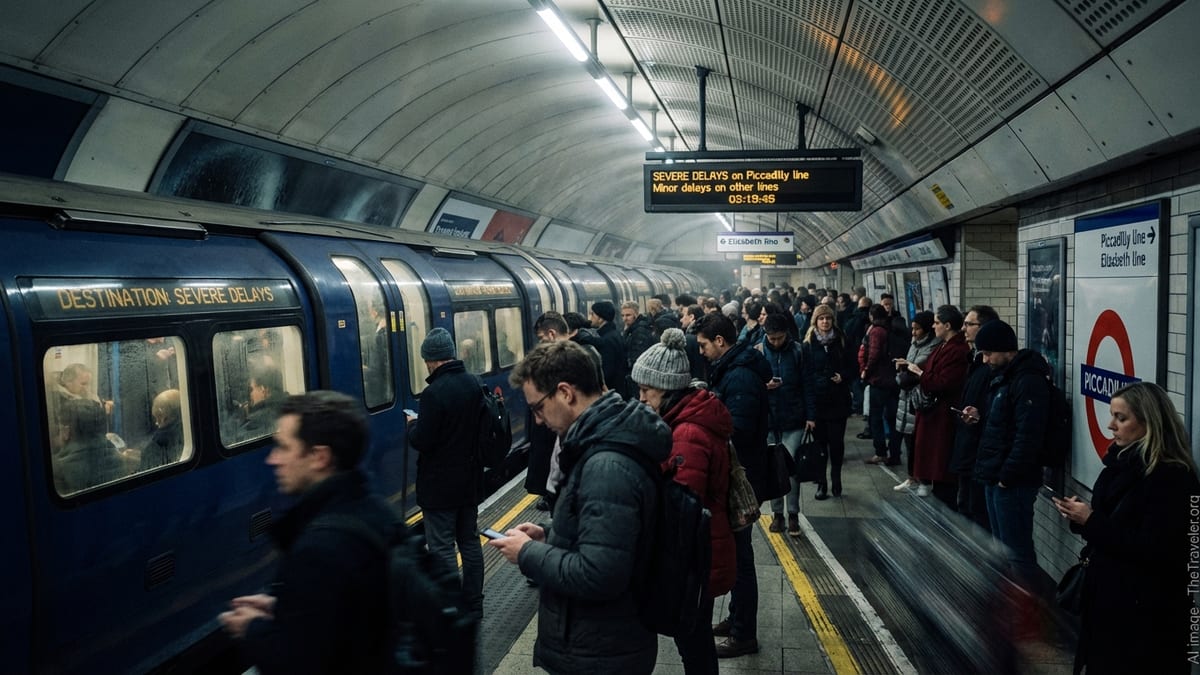
Rush Hour Brought to a Standstill
Commuters relying on the Piccadilly line in recent days have faced severe disruption during peak hours, with trains frequently delayed, stuck between stations or cancelled at short notice. Data tracking the line’s performance shows that on 17 February 2026 the Piccadilly line recorded barely more than two per cent of the day operating with a full “good service,” an extraordinarily poor score even by the standards of a network accustomed to disruption. That single-day figure contrasts sharply with a more typical recent daily reliability level above 60 per cent, underlining the extent of the current breakdown.
The impact has been felt most acutely during the morning and evening rush, when hundreds of thousands of journeys converge on the dark blue line that links north and west London to the West End, King’s Cross St Pancras and Heathrow Airport. By 8am on several recent weekdays, platforms at stations including Finsbury Park, King’s Cross St Pancras, Green Park and Hammersmith were reported to be at or near capacity, with station staff imposing crowd control measures, holding passengers at ticket barriers and advising them to seek alternative routes where possible.
Passengers described journeys that should take 25 minutes stretching to more than an hour, with long gaps between trains and repeated announcements of “severe delays.” Social media posts and independent status monitors highlighted trains being turned around short of their destinations to rebalance the service, leaving many travellers unexpectedly forced to change at interchange hubs such as Acton Town, Earls Court and Hammersmith.
For Transport for London, which operates the Underground, the latest wave of disruption has arrived at a sensitive moment. The line has been in the midst of a complex programme of weekend closures and night-time works linked to the introduction of a new train fleet, as well as coping with industrial action focused on the depots that keep the existing stock running. The combination has left the Piccadilly line especially vulnerable at the very times of day when Londoners most depend on it.
Strikes at Northfields Depot Add to Turmoil
Central to the present difficulties is industrial action at the Piccadilly line’s Northfields Depot in Ealing, where RMT union members have launched a series of strikes stretching across much of the week. The action, which began on Sunday evening and is due to continue until the morning of Saturday, targets maintenance and operational staff responsible for preparing trains for service, limiting the number of trains that can enter the line each day.
Although the strikes are technically confined to the depot rather than the line itself, the knock-on effect has been clear. Transport for London has warned for several days that Piccadilly line services are likely to start later than usual and remain susceptible to delays, particularly before 8am. In practice, those warnings have translated into patchy timetables in the early morning, with some first trains significantly delayed and a thin, irregular service persisting through the main rush hour.
Union representatives say the dispute centres on working conditions and safety concerns linked to the ageing fleet and the intensity of the timetable. They argue that staff shortages and pressure to keep trains in service have left depots overstretched, with too little time to complete essential checks and repairs. For passengers, the details of the negotiations are largely secondary to the immediate problem of getting to work, school or the airport, but the industrial action has further eroded confidence in a line already perceived as fragile.
Transport for London has insisted it is doing all it can to keep a service running despite the strikes, redeploying staff and adjusting schedules. However, the nature of the dispute means the organisation cannot simply draft in replacement teams. With fewer trains available and staff at key locations taking action, the Piccadilly line’s peak-hour capacity has diminished, forcing more passengers to seek alternatives across an already busy network.
Long-Running Reliability Problems Resurface
While the current disruption has been intensified by strikes and concentrated incidents, it also reflects deeper structural weaknesses on the Piccadilly line. Over the past year, the line has ranked near the bottom of the Underground for reliability, with independent analyses putting its overall performance at roughly two-thirds of operating hours recorded as “good service.” That leaves it trailing behind newer or recently upgraded lines such as the Jubilee and Victoria.
The Piccadilly line’s ageing train fleet, much of it dating back more than half a century, has been a persistent source of problems. In late 2024, a spate of incidents involving leaves on the track damaged the wheels of multiple trains, forcing their temporary withdrawal from service and leaving the remaining stock overcrowded and delayed. Previous winters and autumns have seen similar issues, as the older trains are more vulnerable to poor adhesion conditions and require intensive maintenance to remain operational.
Engineering work to prepare for the introduction of a new fleet has added another layer of disruption. Since early 2025, the line has endured closures on many weekends and overnight as track, signalling and power systems are upgraded to accommodate the forthcoming trains. While these works are designed to deliver a more reliable service in the long term, they have left the line operating with little margin for error when faults or staff shortages occur during the working week.
Recent data shows that even during relatively stable periods the Piccadilly line’s peak-hour reliability has hovered around the low 90 per cent mark, below what many commuters would expect for such a critical route. On days like 17 February, when cascading faults and industrial action collide, that underlying fragility becomes fully visible, with good service almost disappearing from the timetable.
Heathrow-Bound Travellers Scramble for Alternatives
The Piccadilly line’s strategic importance is heightened by its role as the main Tube link between central London and Heathrow Airport. On mornings when severe delays strike, the effect on air travellers can be immediate and severe. Passengers aiming to arrive at terminals two and three from the West End or King’s Cross in under an hour have reported journeys stretching well beyond 90 minutes, with some missing check-in cut-offs and being forced to rebook flights.
Airport staff say they have seen spikes in late arrivals at security and check-in, particularly during weekday mornings when business travellers and long-haul passengers converge. While most Heathrow-bound travellers are familiar with the alternative rail options from Paddington, including premium express services, those tickets are considerably more expensive than a standard Tube fare, and not all passengers are prepared for the extra cost.
Travel experts have recommended that, for as long as the Piccadilly line remains unreliable at peak times, passengers heading to Heathrow build in a significantly larger buffer than usual and consider routing via the Elizabeth line from stations such as Farringdon, Tottenham Court Road or Liverpool Street. Those travelling from west London have been advised to use National Rail services where possible, or local buses to connect with rail hubs, rather than relying solely on the Piccadilly line to deliver them to the airport on time.
The disruption has also reverberated through Heathrow’s staffing and logistics, as thousands of airport workers typically rely on the Piccadilly line for daily travel. With many forced onto slower bus routes or the already busy Elizabeth line, shift changes and staff availability have become more complex to manage, adding another layer of operational strain to one of the world’s busiest airports.
Central London Feels the Knock-On Effects
The Piccadilly line’s problems are not confined to airport routes. In central London, where the line calls at some of the capital’s busiest interchanges and tourist destinations, the disruption has spilled over onto other Underground and rail services. At King’s Cross St Pancras, Green Park and Leicester Square, passengers stepping off delayed Piccadilly line trains have crowded onto the Victoria, Jubilee, Northern and Bakerloo lines, as well as National Rail services, amplifying congestion on platforms and concourses.
Road traffic has also felt the strain. In areas such as Westminster, Kensington and Hammersmith, where key roads run roughly parallel to the Piccadilly line, transport authorities have reported heavier-than-usual congestion as commuters abandon the Tube in favour of buses, taxis or private cars. Works in the Piccadilly Underpass and along Cromwell Road have compounded these delays, with queues stretching back along major routes and adding considerable time to cross-city journeys.
Tourists have been among those most caught out by the irregular service. Many rely on the Piccadilly line to move directly between popular destinations such as Covent Garden, Piccadilly Circus, South Kensington’s museum district and Knightsbridge’s shopping streets. With trains running at unpredictable intervals and sudden gaps in the timetable, visitors unfamiliar with London’s transport alternatives have found themselves stranded on platforms or diverted onto crowded buses without clear guidance.
Retailers, theatres and hospitality venues in the West End report that some evening audiences have been delayed or reduced as potential customers opt to avoid central London during periods of severe Underground disruption. While the economic impact is difficult to quantify, business groups have warned that persistent transport unreliability risks undermining the capital’s appeal to both domestic and international visitors.
Alternative Routes: Buses, Elizabeth Line and Other Tubes
With the Piccadilly line so frequently disrupted, attention has turned to the network’s alternative routes. Transport watchers and travel advisors have highlighted a series of practical options for commuters and visitors seeking to avoid the worst of the delays. For journeys between Heathrow and central London, the Elizabeth line has emerged as the most straightforward substitute, offering direct, step-free services into Paddington, Tottenham Court Road, Farringdon and Liverpool Street. Although often busier during disruption, its newer trains and more resilient signalling have generally coped better with surges in demand.
Within inner London, several other Tube lines can be used to bypass sections of the Piccadilly. From west London, travellers at Hammersmith and Barons Court can switch to the District line, which runs parallel towards Earls Court and into central London, while the Circle and Hammersmith & City lines offer alternative east–west routes via Paddington and the City. In north London, interchanges at Finsbury Park and King’s Cross St Pancras allow passengers to switch to the Victoria line, which provides fast connections through the West End and down to south London.
Buses have also played a critical role, particularly where the Piccadilly line runs in deep-level tunnels with fewer nearby Tube alternatives. High-frequency routes along the Uxbridge Road corridor, around Hounslow and through central London’s Piccadilly and Knightsbridge areas have carried extra passengers, though journey times are often significantly longer during peak-hour traffic. Transport authorities have encouraged travellers to use contactless and Oyster pay-as-you-go options and to check real-time bus arrival boards when re-planning their trips.
National Rail services from stations such as Ealing Broadway, Acton Main Line and Finsbury Park have provided another release valve, connecting into the Elizabeth line, Great Northern and other suburban routes. However, these services too have finite capacity, and during the most severe Piccadilly line delays, they have been pushed close to their limits, with passengers left standing in vestibules and on platforms as trains depart full.
Technology, Communication and Passenger Frustration
As disruption has intensified, the quality of information reaching passengers has become a point of contention. Travellers have complained of inconsistent or outdated announcements on platforms and trains, with some reporting that electronic displays still show “good service” even as repeated public address messages refer to severe delays. Others have noted that Transport for London’s main site and app can be slow to reflect rapid changes, forcing them to rely on third-party status monitors and social media for more timely updates.
Independent tools that track Underground performance using Transport for London’s open data feeds have highlighted the pattern of failures, publishing statistics that show just how far the Piccadilly line’s reliability has fallen on the worst days. For commuters, such services offer some reassurance that their experiences are not isolated, but they also reinforce a sense that official information is lagging behind lived reality. Some apps have reported that they are seeing unprecedented levels of demand for disruption alerts focused specifically on the Piccadilly line during traditional commute windows.
The communication challenge is particularly acute when services are being turned around short of their advertised destination. Passengers on westbound trains, for example, have described being told only at the last moment that a service will terminate at Acton Town or Northfields, leaving them scrambling to re-plan complex journeys to Heathrow or Uxbridge. Similar issues have been reported at the eastern end of the line, where late-notice terminations have affected those heading towards Cockfosters and Arnos Grove.
Transport for London has apologised for the disruption and insisted that staff are working to keep passengers informed as circumstances change. Nonetheless, the perception among many travellers is that they are being left to navigate an increasingly fragmented network with limited guidance, feeding a broader sense of frustration and fatigue with the state of London’s transport infrastructure.
Calls for Faster Upgrades and Long-Term Fixes
The latest bout of rush-hour chaos has renewed calls for a more rapid overhaul of the Piccadilly line. Business groups, local councils and passenger advocates argue that the combination of ageing trains, ongoing engineering works and industrial unrest is no longer sustainable on a route of such strategic importance. They are pushing for clearer timelines on the introduction of new trains, upgraded signalling and improved depot capacity to reduce the risk of cascading delays.
Advocacy organisations have also urged Transport for London and central government to cooperate on long-term funding settlements that would allow planners to accelerate modernisation work without relying on stop-start weekend closures and short-term cuts. They warn that without stable investment, the Piccadilly line could remain stuck in a cycle where maintenance struggles to keep pace with demand, and minor issues regularly tip into major disruption.
For their part, union representatives maintain that depot staff and drivers are being asked to operate an increasingly fragile system without adequate resources. They say any lasting solution must address staffing levels, safety concerns and the pressure to keep ageing stock in front-line service. In their view, industrial action is a symptom rather than a cause of the line’s underlying problems.
For now, travellers are left to piece together journeys day by day, checking live status reports and juggling alternative routes in the hope of avoiding the worst of the delays. With no quick fix in sight, the Piccadilly line’s current troubles offer a stark illustration of the challenges facing a capital city whose growth has outpaced the renewal of its core transport networks.