

More news on this day
Russia has declared an emergency regime in Makhachkala, the capital of Dagestan on the Caspian Sea, after days of intense rainfall left streets submerged, districts cut off and residents facing mounting disruption across this key southern gateway.
Get the latest news straight to your inbox!
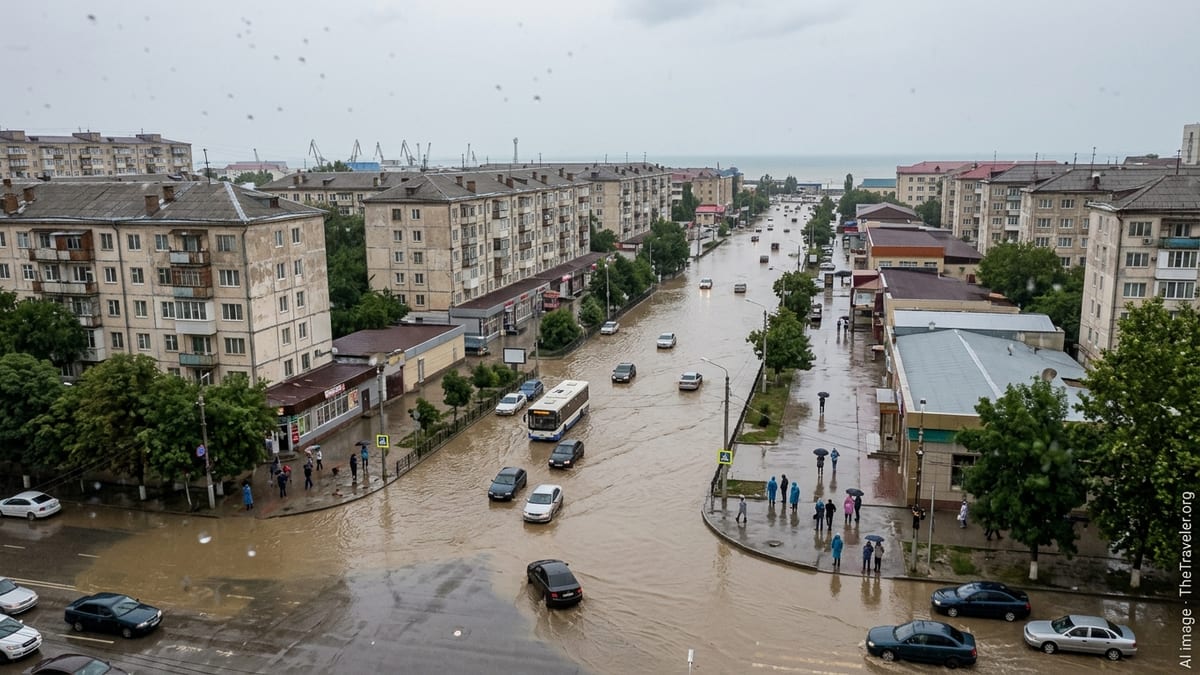
Heavy Rains Swamp Coastal Districts and City Center
Reports from Dagestan indicate that sustained heavy rains over several days have overwhelmed drainage systems in Makhachkala, turning key roads into rivers and inundating low-lying neighborhoods. Video and imagery shared by regional media show vehicles struggling through knee-deep water, flooded courtyards and ground-floor shops partially submerged.
The emergency declaration enables regional services to mobilize additional equipment and funding to tackle the flooding. Publicly available information shows that the worst-affected areas include coastal districts close to the Caspian shoreline and older residential zones with aging infrastructure, where runoff has nowhere to go once storm drains reach capacity.
Hydrologists quoted in Russian-language coverage note that intense short-duration rainfall is particularly challenging for fast-growing cities like Makhachkala, where rapid urbanization has replaced permeable land with concrete and asphalt. As water collects on sealed surfaces, it flows quickly downhill, concentrating in underpasses, intersections and basements.
While initial attention is focused on residential damage and the protection of critical facilities, local observers caution that saturated ground and overflowing streams may continue to pose risks across the urban area as new bands of rain pass over the Caspian coast.
Transport Disruptions Hit Daily Life and Visitor Plans
The flooding has had an immediate impact on mobility in and around the Dagestani capital, complicating both commuter travel and visitor itineraries. Regional outlets describe gridlocked traffic along several of Makhachkala’s main arteries where standing water has reduced two or three lanes to a single navigable channel.
Bus services have been rerouted or delayed as drivers avoid the deepest flooded sections. Some suburban routes connecting nearby coastal towns have experienced temporary suspensions when water levels surge, leaving commuters and domestic tourists waiting for conditions to ease before travel can resume.
Rail and air links, crucial for long-distance arrivals to Dagestan, have remained largely operational according to published coverage, but travelers are being advised to allow extra time for transfers between Makhachkala’s airport or railway station and the city center. Taxi operators are selectively declining pickups in streets where floodwaters are high, further complicating onward journeys.
For tour groups and independent travelers, the transport disruption has translated into late check-ins, rescheduled excursions and, in some cases, postponed departures from the capital to mountain resorts and other attractions deeper in the North Caucasus.
Impact on Tourism Along the Caspian Coast
Makhachkala serves as the primary entry point for visitors exploring Dagestan’s coastline, mountain villages and cultural sites. The flooding emergency therefore carries significance beyond the immediate urban footprint, as it shapes perceptions of safety, reliability and comfort for both domestic and international tourists considering the region.
Travel-industry commentary in Russian media suggests that short-term visitor numbers may soften as images of submerged streets circulate on social platforms, particularly among travelers weighing multiple Black Sea and Caspian destinations. Some tour operators are reportedly offering flexible rebooking options for trips starting in the coming days, allowing clients to delay until conditions stabilize.
Hotels in elevated parts of the city and in nearby hillside districts appear to be operating normally, though staff are adapting by arranging alternative routes for guest transfers and adjusting tour schedules away from the most affected low-lying areas. Coastal promenades and beach zones near Makhachkala have seen water pooling and localized damage, but early indications point to mostly superficial impacts rather than large-scale structural losses.
For the wider Dagestan tourism sector, the key questions will center on how quickly drainage, cleaning and repairs can restore the capital’s streetscapes, and whether the emergency period remains relatively short. A swift and visible recovery would help reassure visitors planning summer and autumn trips to the republic.
Safety Guidance for Current and Prospective Travelers
Travelers already in Makhachkala are being encouraged, through public notices and media reports, to exercise caution around flooded underpasses, riverbanks and seafront zones where water levels and currents can change rapidly. Standing water may conceal potholes, open manholes or loose paving stones, making it hazardous to wade or drive through unfamiliar streets.
Publicly available information highlights the importance of monitoring local news, municipal social media channels and transport operator updates for real-time changes in road closures and service suspensions. Visitors with limited Russian language skills may find it useful to rely on hotel reception desks or established tour agencies to interpret advisories and recommend safer routes.
For those planning upcoming trips, experts interviewed in national outlets advise maintaining flexible itineraries and confirming cancellation or change policies with airlines, rail operators and accommodation providers. Purchasing travel insurance that covers weather-related disruption can provide added protection in the event of extended flooding or knock-on delays.
Given the dynamic nature of the situation, travelers are also encouraged to check the status of attractions outside Makhachkala, particularly rural routes where minor roads and bridges may be more vulnerable to runoff and landslides during and after heavy rains.
Infrastructure Challenges and Adaptation Measures
The emergency in Makhachkala has renewed debate inside Russia over the resilience of urban infrastructure in southern regions facing more frequent episodes of intense precipitation. Analysts in Russian press coverage point to long-standing investment gaps in drainage networks, culverts and stormwater retention systems, especially in fast-growing cities along river valleys and coastlines.
In Dagestan, previous flood events in both rural and urban areas prompted calls for better mapping of high-risk zones and for stricter controls on construction in natural floodplains. Observers now argue that the latest flooding in the capital underscores the urgency of turning those recommendations into funded projects, from expanding storm drains and pumping capacity to creating additional green spaces that can absorb runoff.
Urban planners and environmental specialists quoted in open-source analyses also emphasize the role of nature-based solutions, such as restoring wetlands near the Caspian shore and preserving vegetated slopes above the city, to slow water flow during heavy rain. Such measures can complement engineering works, reducing peak loads on drainage infrastructure and lowering the risk of sudden, damaging inundations.
For residents and visitors alike, the current emergency illustrates how closely travel, daily life and long-term planning are intertwined in coastal cities exposed to evolving climate and weather patterns. How Makhachkala responds in the coming days and months will influence not only immediate recovery, but also the future attractiveness of Dagestan as a safe and resilient travel destination on Russia’s southern frontier.