

More news on this day
Ryanair is accelerating its next phase of European expansion, combining a flurry of new digital booking alliances with a significant engineering and maintenance buildout in Madrid that aims to lock in long-term growth and resilience across its network.
Get the latest news straight to your inbox!
Digital Alliances Redefine How Europe Books Low-Cost Flights
Publicly available information shows that Ryanair has shifted decisively from years of confrontation with online travel agencies to a controlled partnership model built around so-called “Approved OTA” agreements. Over the past two years, the carrier has added a growing roster of intermediaries that can sell its fares under clear data-sharing and pricing rules, moving distribution beyond its own website and app while retaining tight oversight.
Reports indicate that this strategy gathered new momentum in 2025 with a landmark deal between Ryanair and Booking Holdings, the owner of Booking.com, Kayak, Priceline and Agoda. Coverage of the agreement notes that these platforms now have authorised access to Ryanair’s full network, integrating real-time inventory, transparent fare breakdowns and ancillary products within their booking flows.
Industry analysis suggests that this marks a notable strategic turn for Europe’s largest low-cost airline, which previously relied heavily on direct sales and pursued legal action against several OTAs over issues such as screenscraping, hidden fees and limited access to passenger contact data. By formally licensing select partners, Ryanair is seeking to capture incremental demand from travellers who prefer multi-airline search tools, while reinforcing its control over pricing, customer information and post-booking communication.
Travel technology commentary points out that the carrier is also working with specialist aggregators and tour operators under similar frameworks, broadening its reach into package holidays and corporate channels. Together, these distribution moves are reshaping how millions of Europeans encounter Ryanair fares, bringing the airline deeper into mainstream travel-shopping ecosystems without abandoning its low-cost DNA.
Seamless Digital Booking Meets Back-End Engineering Scale-Up
The ramp-up in digital partnerships is closely linked to Ryanair’s internal investment in technology and operations. Company filings highlight ongoing work to streamline the booking journey, automate account creation and embed ancillary services such as seat selection, priority boarding and additional baggage into third-party transactions as well as direct channels.
According to publicly available corporate reports, the airline’s MyRyanair ecosystem is central to this approach. Membership is increasingly automatic for bookings, whether made directly or via authorised partners, allowing the airline to consolidate customer profiles, manage ancillary offers and coordinate operational messaging across platforms. Travel-industry observers note that this unified digital spine is intended to reduce friction at every step, from first search to boarding gate.
At the same time, Ryanair is scaling up its in-house engineering capacity to support a growing fleet and schedule. Technical disclosures describe multiyear recruitment programmes for maintenance and engineering roles and reference plans for new or expanded hangars at bases across Europe. The aim is to perform more heavy checks and modifications within the group, reinforcing aircraft availability and helping stabilise schedules during peak seasons.
The coupling of distribution innovation with engineering expansion suggests a holistic growth strategy. As more travellers find Ryanair through approved digital partners, the airline is working to ensure that its physical infrastructure, from maintenance bays to parts logistics, can absorb higher utilisation while maintaining the operational punctuality that underpins the low-cost model.
Madrid Becomes a Flagship Engineering Hub
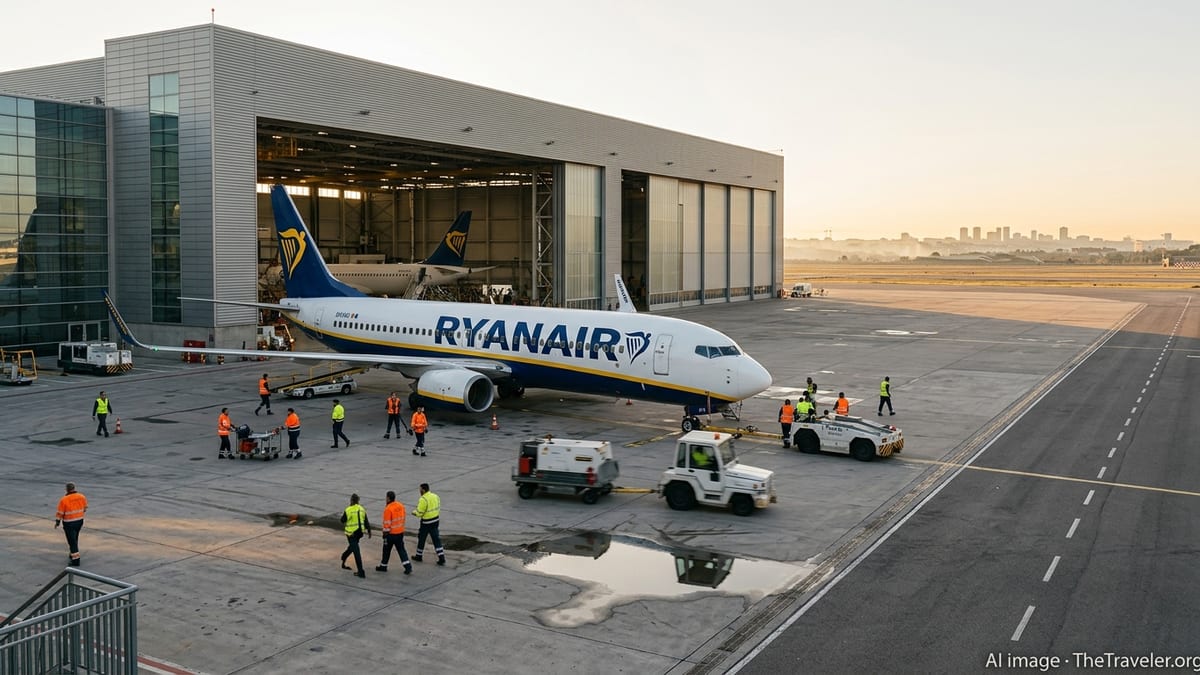
The most visible symbol of this infrastructure push is emerging in Spain. Recent Spanish business coverage reports that Ryanair has opened its largest maintenance hangar in Madrid following a multi-million-euro investment. The facility, located at Adolfo Suárez Madrid-Barajas Airport, adds substantial new capacity for heavy checks and longer-duration engineering work on the airline’s Boeing 737 fleet.
Regional investment documents and company disclosures indicate that this Madrid project forms part of a broader plan to create a multi-bay maintenance complex in the Spanish capital, with several additional bays expected as the programme matures. The new hangar is described as a cornerstone in that roadmap, designed to handle an intensive flow of aircraft during off-peak periods and winter seasons.
Local economic analyses highlight the potential impact for Madrid’s aviation cluster. The enlarged engineering footprint is expected to support hundreds of specialised roles over time, from licensed engineers and technicians to planning, materials and support staff. For the airport itself, the added maintenance capability reinforces its status as one of Spain’s key long-haul and short-haul hubs, anchoring more of Ryanair’s operational activity in the region.
Aviation observers also point out that Madrid complements Ryanair’s existing maintenance network in cities such as Seville, Kaunas, Wroclaw and Prestwick. By spreading critical hangar capacity across multiple bases, the airline can rotate aircraft more efficiently for scheduled checks, reduce positioning flights and respond faster to unplanned engineering events.
Implications for European Routes, Fares and Passenger Experience
For travellers, the combination of digital alliances and a reinforced maintenance backbone is likely to manifest in several ways. First, more consumers will encounter Ryanair flights inside familiar search environments like major hotel and flight comparison platforms, where they can evaluate low fares alongside competing carriers and bundled products. This visibility could stimulate competition on key leisure and city-break routes as more travellers weigh schedule, price and add-ons in a single view.
Analysts note that the Madrid engineering investment, together with other announced maintenance projects in Spain, is designed to underpin the airline’s medium-term capacity targets across Southern and Western Europe. With additional hangar slots available, Ryanair can plan heavier maintenance without curtailing peak-season flying as sharply, potentially supporting denser schedules on popular corridors in and out of Spain, Italy, Portugal and France.
In terms of passenger experience, the approved-OTA model is intended to reduce disputes over pricing and booking ownership by ensuring that authorised partners pass through full fare details and accurate customer contact information. Public commentary following the recent partnership announcements suggests that travellers booking via these channels should face fewer surprises over extras and be better integrated into the airline’s own notification systems.
However, market watchers also stress that Ryanair continues to emphasise its direct channels as the reference point for lowest fares and the most flexible management of bookings. The emerging landscape is therefore one of hybrid distribution, where digitally savvy travellers move between the airline’s app and large global platforms, while a reinforced engineering and maintenance network in Madrid and beyond works in the background to keep utilisation high and aircraft on schedule across Europe.