

More news on this day
Ryanair is expanding its Milan Malpensa network by launching a new route from Tirana, adding the Albanian capital to a roster of European cities including Copenhagen, Athens, Bilbao, London, Paris and Kraków that connect directly to the northern Italian hub.
Get the latest news straight to your inbox!
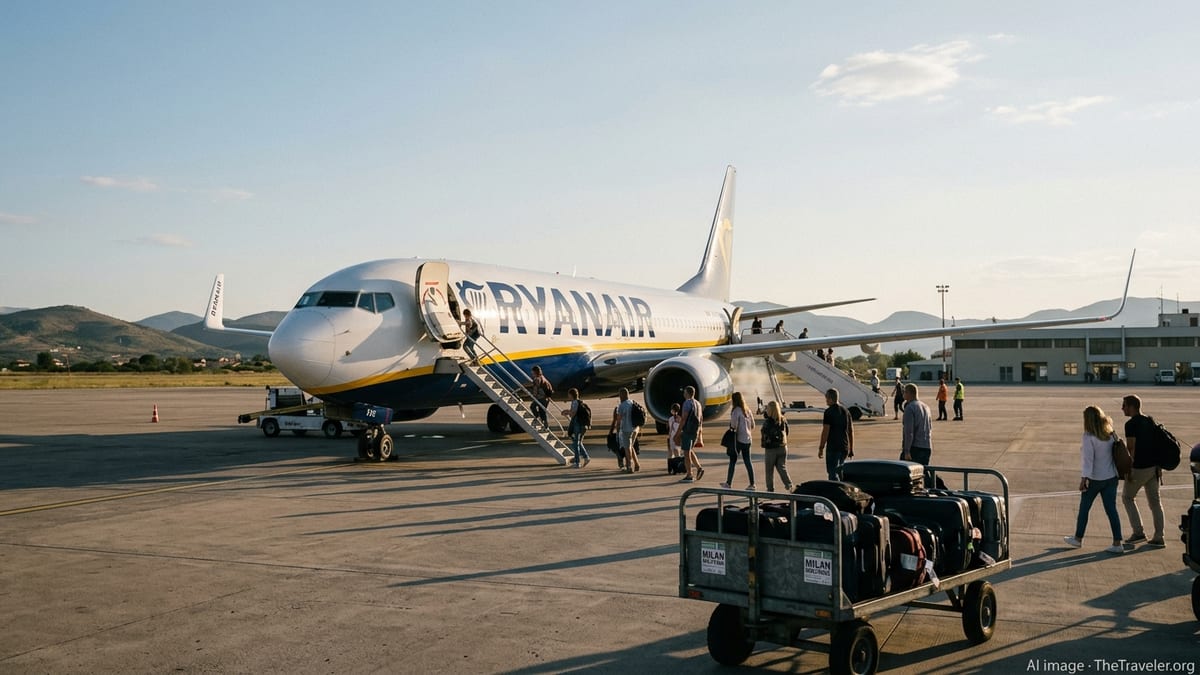
New Link Between Albania and Northern Italy
The new Tirana to Milan Malpensa connection places Albania’s fast-growing capital firmly on Ryanair’s map of key European city links into one of Italy’s busiest airports. Publicly available schedule data indicates that the service is being added into a network already covering major cities such as Copenhagen, Athens, Bilbao, London, Paris and Kraków from Malpensa, reinforcing the airport’s role as a low-cost gateway for both leisure and business travel across the continent.
The move comes as demand for connectivity between the Western Balkans and Italy continues to increase, with Albanian outbound travel and diaspora traffic supporting steady growth. The non-stop route offers passengers from Tirana direct access to northern Italy’s economic heartland, while travellers from Italy gain a new low-cost option to explore Albania’s capital and nearby Adriatic coastline.
Industry timetable information suggests the flights are scheduled to begin in time for the peak summer travel period of 2026, positioning the new link to capture both city-break and VFR (visiting friends and relatives) markets. The routing also provides a strategic alternative to existing services between Tirana and the wider Milan area operated by other carriers.
Part of a Broader Milan Malpensa Network Build-Up
According to published coverage and schedule aggregators, Ryanair has been steadily building its presence at Milan Malpensa in recent years, using the airport as a launch point for a pan-European network that combines domestic Italian routes with connections to Spain, Greece, Central and Eastern Europe. The addition of Tirana further diversifies that portfolio and underlines Malpensa’s position as a key base for the carrier.
By joining cities such as Copenhagen, Athens, Bilbao, London, Paris and Kraków on the Malpensa network, Tirana slots into a pattern of routes that connect major capitals and regional centres with northern Italy. This growing set of destinations allows passengers to use Malpensa as a convenient transfer point, even on self-connected itineraries, widening the practical catchment of the new service beyond point-to-point traffic.
Airport data for Malpensa highlights Ryanair among the leading operators by seat capacity, a trend that industry analysts suggest is likely to continue as additional routes and frequencies are layered in. The Tirana launch fits that trajectory, indicating the airline’s intent to deepen its footprint in the Lombardy region alongside other Italian bases.
Boeing 737-800 and 737-8 at the Core of the Operation
The Tirana to Milan Malpensa flights are expected to be operated using Ryanair’s standard narrowbody fleet of Boeing 737-800 and the newer Boeing 737-8 variant, as reflected in current fleet and route deployment information for the group. These aircraft have become the backbone of the airline’s short- and medium-haul network, balancing capacity, range and operating efficiency.
The Boeing 737-800 typically seats around 189 passengers in Ryanair’s single-class configuration, while the 737-8 High Capacity variant accommodates close to 200 passengers, supporting lower unit costs and competitive fares. Aviation fleet records show that Ryanair is among the largest global operators of the 737-800, and has been progressively introducing 737-8 aircraft across its European bases to support growth and renew the fleet.
On the Tirana route, the use of these aircraft types is expected to provide consistent onboard product and operational reliability in line with the carrier’s standard offering elsewhere in its network. For Malpensa, the deployment adds further volume to peak-time movements, reinforcing the airport’s position as a major Boeing 737 hub in continental Europe.
Implications for Travelers and Regional Tourism
The new connection is set to strengthen tourism flows in both directions. Travellers from Italy gain easier access to Tirana’s rapidly developing urban scene, historic districts and nearby coastal resorts, while Albanian passengers benefit from direct links to the Milan metropolitan area, the lakes region and onward rail connections into Switzerland and the wider Alpine arc.
Travel industry observers note that low-cost city pairs often stimulate first-time travel and short-break visits by reducing overall trip costs and simplifying weekend itineraries. With Tirana now positioned alongside long-established European destinations such as London, Paris and Copenhagen on Ryanair’s Malpensa map, the route is likely to appeal to price-sensitive city-break travellers as well as to those visiting friends and relatives.
For the wider region, the route adds another layer of connectivity between the Western Balkans and the European Union’s core economic centres. This aligns with broader patterns of air travel development in southeastern Europe, where new routes and capacity increases have been reshaping travel habits and opening previously under-served markets.
Competitive Context on the Tirana–Milan Corridor
Independent route trackers and booking platforms already list multiple carriers operating between Tirana and the Milan area, primarily to Malpensa, reflecting the corridor’s importance. The entry of a major low-cost operator with a substantial 737 fleet is expected to intensify competition on fares and schedules, potentially leading to more choice and improved frequencies for passengers.
Analysts following European aviation trends suggest that the combination of Ryanair’s scale, cost base and network breadth can have a noticeable impact on pricing dynamics when the carrier launches new routes. On the Tirana–Malpensa sector, this may translate into a wider range of fare options, from basic hand luggage-only tickets to products with added services, as the airline seeks to capture different segments of demand.
At the same time, the new route is likely to support both airports’ strategic goals of consolidating their roles as regional gateways. For Tirana, the service enhances links to northern Italy and, by extension, to a large onward travel market. For Malpensa, it adds another spoke in a growing web of intra-European routes connecting key urban centres to Lombardy’s primary international hub.