

More news on this day
Ryanair is preparing a major pullback from parts of its Spanish network in 2026, scrapping routes, closing bases and trimming flights from regional airports as its long-running dispute over airport charges with Aena, Spain’s state-controlled airport operator, escalates and reshapes options for budget-conscious travelers.
How Many Flights Spain Is Losing in 2026
For summer 2026, Ryanair plans to cut around 1.2 million seats from its Spanish schedule, a reduction of roughly 10 percent in capacity from regional airports. The move follows earlier cuts for winter 2025, bringing the total reduction in seats across the 2025 to 2026 seasons close to two million, according to industry estimates. The airline, Spain’s largest by passenger numbers, is not abandoning the country, but it is clearly rebalancing where and how it flies.
The impact will be felt unevenly. Major hubs such as Madrid and Barcelona are expected to remain central to Ryanair’s strategy, and some airports, like Murcia, are even gaining flights in summer 2026. But secondary and regional airports that once relied on year-round or seasonal low-cost links will see fewer frequencies, cancelled routes and in some cases the end of Ryanair service altogether. For travelers, this will translate into fewer departure-time choices and, on some city pairs, the need to connect via larger airports instead of flying direct.
The timing of the cuts is tied to the start of the IATA summer 2026 season, which begins in late March, and to schedule changes planned around October 2025. Many of the changes are already visible in airline booking systems, and travel agencies report that some routes that previously operated into 2026 simply no longer appear for sale beyond late March or early winter timetable dates.
While Ryanair has warned it could reduce capacity further if costs rise again, it has also signaled that it will redeploy aircraft to markets it views as more supportive of low-cost growth, including Italy, the United Kingdom and parts of Eastern Europe. That means aircraft leaving smaller Spanish airports are likely to be flying other European routes rather than sitting idle.
Airports and Routes Most Affected Across Spain
The sharpest cuts in Spain are concentrated at smaller regional airports. Ryanair has confirmed that all flights to and from Asturias will cease in 2026, effectively withdrawing from the airport once existing commitments expire. Schedules published by the airport and independent timetable data show that services from Asturias to Brussels Charleroi, Düsseldorf Weeze and Rome Fiumicino will end in late March 2026, with no replacement Ryanair routes currently listed beyond those dates.
In Galicia, Santiago de Compostela is losing its Ryanair base, which previously hosted two aircraft. That closure has already triggered an estimated 80 percent reduction in flights and the cancellation of several international routes. Nearby Vigo is facing an even tougher outcome, with Ryanair flights reported to stop entirely from early 2026, leaving the airport without any Ryanair service for the foreseeable future.
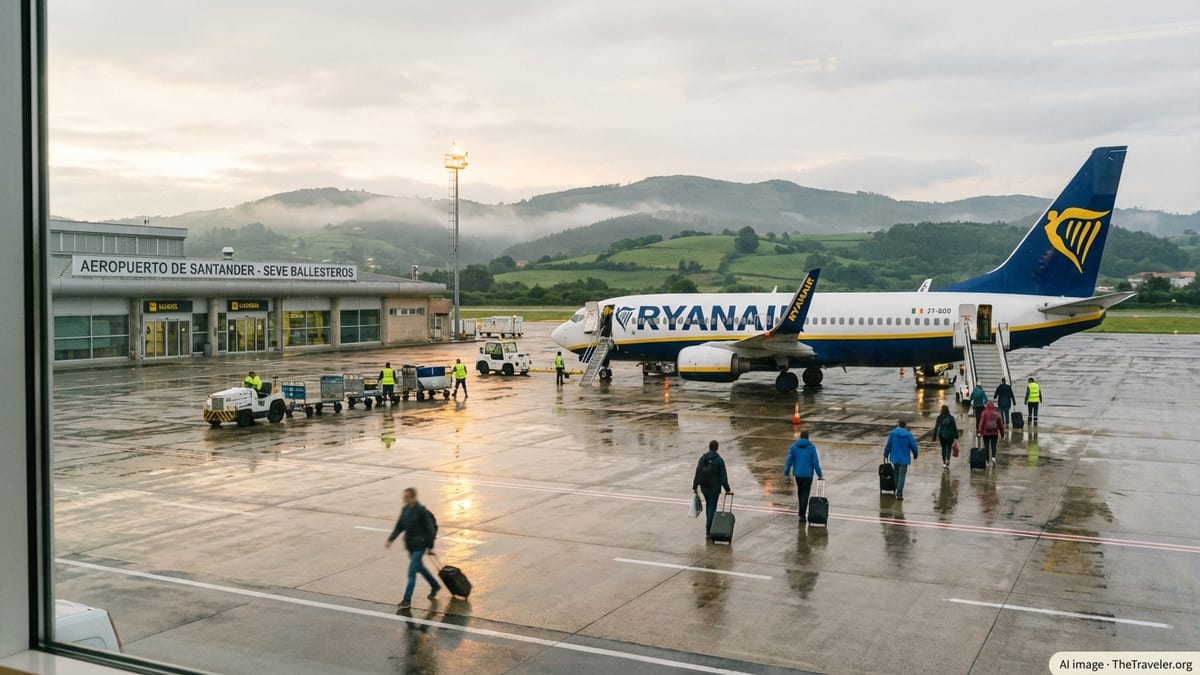
Other regional airports, including Jerez and Valladolid, have seen base closures and continue into 2026 with no regular Ryanair operations. Similar patterns are evident at Zaragoza, Santander and Vitoria, where capacity is being cut deeply rather than removed outright. In Zaragoza, reductions of around 45 percent from prior levels are expected to affect links to cities such as London Stansted, Milan Bergamo and Brussels Charleroi, while Santander faces a loss of some UK and Irish routes and fewer flights to Spanish coastal destinations.
The Canary Islands, a crucial destination for northern European sunseekers, will also feel the effect. Industry briefings suggest that about 400,000 seats will be removed from routes linking mainland Spain to airports across the archipelago, with around three dozen direct regional-to-Canaries connections axed. While the islands will remain heavily served by Ryanair and other carriers from major European cities, travelers coming from smaller Spanish regions may lose their direct flights and be forced to connect via Madrid, Barcelona or foreign hubs.
Why Ryanair Is Cutting Back: The Aena Fee Dispute
Ryanair has framed its Spanish reductions as a direct response to rising airport charges rather than weak demand. The carrier argues that fees set by Aena make it uneconomical to maintain low-fare routes at many regional airports, especially those with seasonal peaks and quieter off-peak periods. The airline has repeatedly criticized what it describes as a monopoly position and “uncompetitive” pricing by the airport group.
At the heart of the dispute is Aena’s plan to increase regulated airport charges from 2026. Industry documents indicate that this would lift average fees per departing passenger, a change Ryanair says is particularly damaging for thinner regional routes where each euro in cost has an immediate impact on ticket prices. The airline contends that higher charges push it to redeploy aircraft to countries where governments and airport operators are more aggressive in using discounts and incentives to grow traffic.
Ryanair has also linked its cuts to a broader political and regulatory dispute in Spain, including the government’s stance on luggage pricing and consumer rules affecting low-cost carriers. The airline claims that new regulatory measures, combined with higher airport fees, undermine the economics of offering very low headline fares in secondary markets. Spanish authorities and Aena, for their part, point to the need for investment in airport infrastructure, technology and sustainability projects and argue that current and planned fees remain reasonable by European standards.
The tension over charges has spilled into the wider aviation debate. The International Air Transport Association and Spain’s main airline association recently called for airport fees to fall over the coming regulatory period, not rise, arguing that lower charges would better support passenger growth and tourism. The clash between airlines, regulators and Aena over how to share the cost of future investments will be a central factor in whether Ryanair’s Spanish capacity can grow again beyond 2026.
What This Means If You Are Flying To or Within Spain
For leisure travelers, the most immediate impact will be on choice and convenience, especially outside major cities. If you are accustomed to flying directly from a smaller airport in northern or northwestern Spain to the Canary Islands or popular European city breaks, you may find that the direct Ryanair option disappears from 2026 schedules. Instead, you may need to drive to a larger airport, connect via another hub, or switch to a different airline offering a less frequent or more expensive service.
Fares on remaining direct routes could rise, particularly at times of peak demand such as school holidays and summer weekends. With fewer low-cost seats in the market, other carriers may see less pressure to match Ryanair’s lowest promotional fares. On the other hand, where airlines like Vueling, Iberia Express, Binter or Volotea are stepping in to fill gaps, competition could remain relatively robust on certain domestic and island routes.
Business travelers and residents in affected regions will face a different set of trade-offs. Reduced frequencies can make same-day trips harder and limit flexibility when meetings overrun or plans change at short notice. For export-oriented regions and tourism-dependent areas, the loss of direct connections can also have wider economic consequences, making it marginally harder for companies to attract visitors and investors who rely on quick, inexpensive access.
Travelers planning trips for late 2025 or 2026 should pay close attention to which routes are still on sale, and avoid assuming that flights which operated in previous years will automatically return. Many of the cuts are already reflected in booking systems, so what you see now for travel after late March or the start of the winter 2025 to 2026 season is a good guide to what will be available, barring further changes.
How Other Airlines Are Responding in the Spanish Market
Ryanair’s retreat from some regional airports is opening space for competitors. Spanish low-cost carriers and regional airlines have been quick to add capacity on selected routes where they see sustainable demand and airport support. Vueling and Iberia Express have both announced additional seats on domestic and island routes, while Binter has been strengthening its presence on links between the Canary Islands and mainland Spain.
Volotea, which has cultivated a network focused on mid-sized European cities and secondary airports, has also moved to expand in some of the regions affected by Ryanair’s cuts. In northern Spain, for example, Volotea has been adding links from Asturias and other airports to major Spanish cities and holiday destinations, looking to capture passengers who previously would have chosen Ryanair. Wizz Air and other pan-European low-cost brands are monitoring the situation, with an eye on potentially adding point-to-point routes where they can secure competitive terms.
However, it is unlikely that every route Ryanair drops will be replaced one-for-one. Some of the previously operated services depended on the airline’s ability to spread aircraft and crew costs across a very large network and to leverage aggressive promotional pricing that rivals may be unwilling or unable to match. For travelers, this means that while there may still be options, they could involve different airports, different days of operation or more seasonal patterns than in the past.
At the same time, Ryanair itself is not shrinking overall. The airline is growing in other European markets where it sees more favorable cost structures and supportive airport policies. Aircraft moved away from Spain are expected to turn up in expanded schedules from Italy, the United Kingdom, central and eastern Europe, and non-Spanish Mediterranean destinations, potentially offering new alternatives for travelers willing to route their trips differently.
Where Ryanair Is Still Growing in Spain
Despite the headline cuts, Ryanair continues to invest in certain Spanish airports. In the southeast, Murcia is set to see a busier summer 2026 schedule, with the airline increasing the number of weekly flights on routes to the United Kingdom and Ireland. Additional frequencies to Birmingham, East Midlands, Glasgow Prestwick and Manchester are among the planned changes, while existing links to London Stansted, London Luton, Bournemouth and Dublin remain core to the airport’s low-cost offering.
Major tourist gateways on the Mediterranean and in the Canary Islands also remain important to Ryanair’s network. Airports such as Alicante, Málaga, Valencia, Fuerteventura and Lanzarote continue to benefit from strong flows of inbound tourism from northern Europe, and current schedules suggest that these hubs will see more modest adjustments rather than deep cuts. In some cases, regional reductions on mainland-to-islands routes are being offset by extra capacity from bigger foreign markets such as the United Kingdom and Germany.
Madrid and Barcelona, as Spain’s principal international hubs, are also positioned to retain or grow Ryanair capacity, particularly on routes where the airline can compete directly with legacy carriers and high-speed rail. For travelers willing to route their journeys through these large airports, the impact of regional cuts may be less severe, although it can still involve longer ground transfers at the start or end of a trip.
For tourism boards and local governments, the mixed picture is a reminder of how sensitive low-cost capacity is to policy decisions. Regions that maintain or improve airport competitiveness through incentives, efficient operations and supportive tourism strategies are more likely to keep or win Ryanair flights, even as other parts of Spain face reductions.
Practical Advice for Booking Spain Trips in 2026
Travelers planning 2026 trips involving Spain should build a little extra caution into their booking strategies. First, check whether your preferred route operates year-round or seasonally, and verify that flights are available in the months you need before committing to nonrefundable accommodation or ground arrangements. If you are flying from or to a smaller Spanish airport that has been mentioned in connection with Ryanair cuts, consider researching alternative airports within driving distance.
Second, pay attention to schedule changes and airline notifications in the months before departure. When airlines restructure networks, they sometimes adjust frequencies or flight times multiple times as they fine-tune aircraft rotations. Make sure your contact details are correctly entered in your booking so you receive alerts about any cancellations or significant time shifts, and reconfirm your itinerary periodically, especially if you booked far in advance.
Third, think about flexibility. Selecting tickets that allow date or route changes for a modest fee can provide valuable breathing room if your chosen flight disappears from the schedule or is retimed in a way that no longer works. Travel insurance that covers schedule changes and missed connections can also be worth considering, although policies vary and the small print matters.
Finally, compare fares across airlines and airports rather than assuming that the lowest advertised price with Ryanair will always be the cheapest or most convenient overall. With competitors adding capacity on some routes and with high-speed rail continuing to compete effectively on certain domestic corridors, the best value option in 2026 may look different from the patterns frequent Spain travelers have grown used to over the past decade.