

More news on this day
Hundreds of travellers departing from and transiting through Ireland have been left stranded this weekend after Ryanair racked up 754 delays and 11 cancellations across its European network, snarling flights to and from Vienna, Helsinki, Milan, Madrid and a string of other major hubs amid a renewed blast of severe winter weather.
Storm-Fuelled Disruption Ripples Out From Ireland
The latest wave of disruption began building late in the week as a deep winter weather system swept across much of northern and central Europe, bringing heavy snow, freezing rain and low visibility to key aviation corridors. By Saturday 21 February, Ryanair, Europe’s largest low cost carrier, had logged 754 delayed services and 11 outright cancellations across its schedule, according to rolling industry tallies, with Ireland featuring prominently among affected departure points.
While Ireland’s main airports remained technically open, the knock-on effect of weather bottlenecks at continental hubs meant that flights originating in Dublin, Cork and Shannon faced mounting delays as they waited for arriving aircraft, crew and new departure slots. Passengers bound for city breaks, ski holidays and business meetings found their itineraries collapsing in real time as departure estimates were pushed back hour by hour.
The impact was particularly acute on routes linking Ireland with Austria, Spain, Italy and the Nordic region, where airports were contending with runway de-icing operations, reduced take-off and landing rates and crew duty-time constraints. With Ryanair operating a tightly wound point-to-point network that leaves limited slack for disruption, even a relatively small cluster of cancellations created outsized ripple effects across the day’s schedule.
Vienna Hit Hard As Snowstorm Freezes Operations
Vienna International Airport emerged as one of the epicentres of the crisis on Saturday. Local authorities reported hundreds of delays and dozens of cancellations across all carriers as persistent snowfall and gusting winds repeatedly forced runway sweeps, restricted visibility and slowed ground handling. Flights operated by Ryanair and its Vienna-based subsidiary Lauda Europe were among those most heavily affected.
Routes connecting Vienna with Barcelona, Istanbul, Brussels, Krakow and Manchester suffered some of the worst disruption, with entire rotations scrubbed or pushed back by several hours. Travellers connecting through Vienna on multi-leg Ryanair itineraries found themselves stranded as missed onward connections could not be re-protected in time on later services already operating near full capacity.
For Ireland-based passengers, the Vienna bottleneck was particularly painful on leisure-heavy links between Dublin and the Austrian capital, often used as a gateway to Alpine ski resorts and Central European city breaks. With inbound aircraft from Vienna arriving late or not at all, knock-on delays cascaded through later departures from Dublin and other Irish airports, forcing last-minute overnight stays and rebookings.
Airport staff in Vienna struggled to keep up with the volume of displaced passengers, as queues formed at airline service desks and information screens cycled through long lists of red-coded flights. Even as some services eventually departed, rotation imbalances left aircraft and crews out of position for their next scheduled sectors.
Helsinki, Milan and Madrid Join the Delay Hotspots
Further north, Helsinki-Vantaa also recorded mounting disruption as part of the wider winter pattern sweeping Scandinavia and the Baltic region. Ryanair operations on the Vienna to Helsinki corridor faced repeated delays as weather and air-traffic control constraints converged, leaving passengers pacing departure gates and scrambling to rearrange tight onward connections to regional Finnish and Baltic airports.
In southern Europe, Milan’s Malpensa and Linate airports, along with Madrid-Barajas, grappled with their own weather and capacity-related challenges. While conditions were generally less severe than in Austria, the combination of earlier storm impacts, congested airspace and ground handling backlogs produced a steady stream of late-running Ryanair flights, particularly on routes linking these hubs with Ireland, the UK and northern Europe.
Short-haul services to and from Milan, often favoured by weekend city-break travellers from Dublin and other Irish cities, became a lottery of rolling estimated departure times. In Madrid, the aftershocks of earlier Europe-wide disruption persisted in the form of late inbound aircraft, meaning that even as the weather marginally improved, the schedule remained fragile and prone to further slippage.
Airports in Spain and Italy were also contending with elevated seasonal demand as travellers sought midwinter sun or ski slopes, leaving little spare capacity in airport infrastructure or airline fleets to absorb the shock. For Ryanair, which leans on rapid turnarounds and tight scheduling to maintain low fares, these structural pressures translated into extensive knock-on delays.
Hundreds Stranded in Ireland as Knock-On Effects Mount
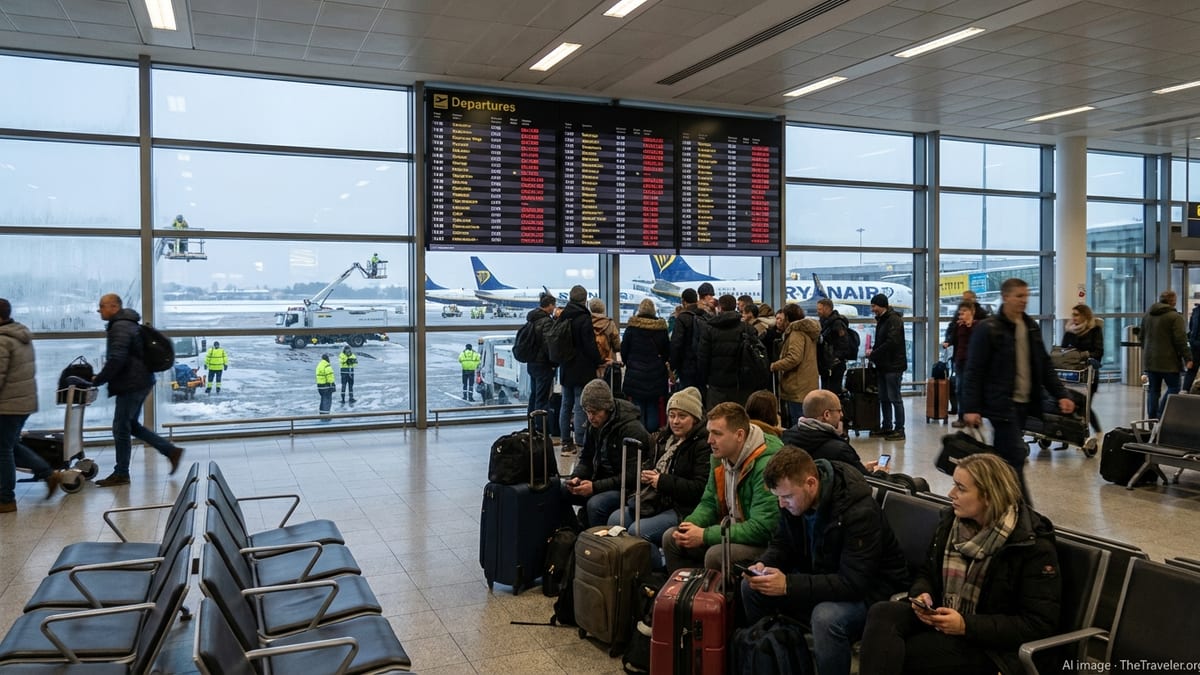
Back in Ireland, the cumulative effect of disrupted European rotations became starkly visible in crowded terminals at Dublin, Cork and Shannon. With aircraft and crews trapped in weather-hit airports on the continent, departure boards at home began to fill with delayed and cancelled Ryanair services, many of them linking Ireland to Vienna, Helsinki, Milan, Madrid, Barcelona and other affected hubs.
Families heading off for mid-term breaks, groups travelling for sporting events and business travellers aiming to reach Monday meetings were left sitting on terminal floors amid piles of luggage, or lined up at customer-service counters in scenes reminiscent of previous winter aviation meltdowns. Some reported waiting several hours just to speak with an airline representative or secure meal vouchers and hotel accommodation.
Budget-conscious travellers who had not built in extra buffer days before onward connections found themselves particularly exposed. A missed evening departure from Dublin could translate into the loss of a pre-paid ski pass in Austria or a non-refundable local flight from Madrid to the Canary Islands. With 11 Ryanair cancellations compounding the 754 delays, there were simply not enough spare seats across the network to accommodate everyone on the same day.
Irish consumer advocates noted that while safety must remain paramount during adverse weather, the latest chaos underscores how quickly low-cost, high-frequency networks can seize up when multiple hubs are simultaneously constrained. The relatively small number of outright cancellations masked a far larger pool of passengers effectively stranded by lengthy delays and missed connections.
Weather, Air Traffic Control and Operational Strain Collide
Behind the headline numbers sits a complex tangle of factors that extend beyond a single airline. The winter storm system affecting large swathes of Europe has forced air-traffic authorities to reduce flow rates on key routes, while airports grapple with de-icing bottlenecks, staff shortages and limited snow-clearing resources. Each reduction in runway capacity or departure slot availability reverberates through airlines that rely on tight scheduling.
Ryanair’s business model, which emphasises high aircraft utilisation and short ground times to keep fares low, leaves limited headroom when even one part of the system slows down. A single delayed inbound aircraft can cascade through multiple outward sectors over the course of a day, especially when adverse weather impacts both the origin and destination airports or forces re-routing around congested airspace.
Industry data for the past several days highlight how widespread the disruption has become, with thousands of delayed flights recorded across the continent and major hubs like Amsterdam, London, Munich, Madrid, Milan and Vienna all reporting significant operational challenges. Ryanair, as one of Europe’s largest short-haul operators by flight volume, has inevitably featured prominently in those statistics, particularly on mid-distance links popular with leisure travellers from Ireland.
Airlines and airports alike are also managing the lingering effects of structural strains that have persisted since the pandemic, including tight staffing in air-traffic control, ground handling and security. When combined with a surge in demand for winter travel and an intense weather system, those vulnerabilities quickly translate into the sort of rolling disruption now being experienced by Ryanair passengers across Ireland and the wider region.
Passenger Rights and Ryanair’s Response Under Scrutiny
As queues lengthened and tempers frayed in Irish and European terminals, attention turned to how effectively Ryanair was handling customer care obligations. Under EU regulations, passengers whose flights are heavily delayed or cancelled are entitled to assistance in the form of meals, refreshments and, where necessary, overnight accommodation. Compensation payments may also be due in some circumstances, though extreme weather events can exempt airlines from certain financial liabilities.
Travellers reported a mixed experience. Some said they received timely text messages or app notifications from Ryanair warning of impending delays, along with automated rebooking options. Others, particularly those already at the airport when schedules began to unravel, described confusion about voucher eligibility, limited on-the-ground staffing and difficulty accessing updated information when departure times repeatedly changed.
Consumer groups in Ireland urged affected passengers to carefully document their experiences, retain receipts for any out-of-pocket expenses and pursue formal complaints if they believed their rights were not upheld. They also called on airlines, including Ryanair, to invest further in contingency planning, digital communication tools and surge customer-service capacity during known high-risk periods such as winter storm seasons.
Ryanair has previously argued that Europe’s fragmented air-traffic control system and chronic understaffing in some control centres frequently impose delays outside airline control, and has pressed regulators and governments to accelerate reforms. The current episode is likely to intensify the debate over where responsibility lies when weather, infrastructure limits and carrier scheduling choices collide to produce mass disruption.
Airports and Airlines Race to Clear the Backlog
With forecasts suggesting a gradual easing of the most severe weather conditions over the coming days, attention is now turning to the challenge of restoring normal operations across the Ryanair network. In practical terms, that means repositioning aircraft and crews, reinstating cancelled rotations where possible and working through waitlists of stranded passengers seeking the first available seats to their original destinations.
Airports in Vienna, Helsinki, Milan and Madrid have all signalled that they are working closely with airlines to extend operating hours where feasible, add extra staff in critical ground-handling roles and prioritise flights with large numbers of connecting passengers. However, aviation insiders caution that backlogs of this scale can take several days to fully unwind, particularly when aircraft are out of position and some crews have reached their regulatory duty limits.
In Ireland, airport authorities are advising passengers booked on Ryanair services over the next 24 to 48 hours to monitor their flight status closely, arrive earlier than usual and, where possible, travel with carry-on luggage only to reduce pressure on baggage systems. Travel agents and tour operators are also scrambling to rearrange ground arrangements for customers whose arrival times have been dramatically shifted.
For many travellers, the practical reality will be a shortened holiday, a missed event or a hastily rebooked return journey. For Ryanair and the wider European aviation sector, the episode serves as a fresh reminder of how vulnerable tightly optimised networks remain to sudden weather shocks, and how quickly disruption in a handful of hubs can strand hundreds of passengers far from home, from Ireland to the fringes of northern and southern Europe.