

More news on this day
A Ryanair flight linking Tours in central France with Morocco departed without 24 ticketed passengers after prolonged border control delays, according to French regional media reports, reigniting debate over who is responsible when strict checks collide with tight low-cost boarding timelines.
Get the latest news straight to your inbox!
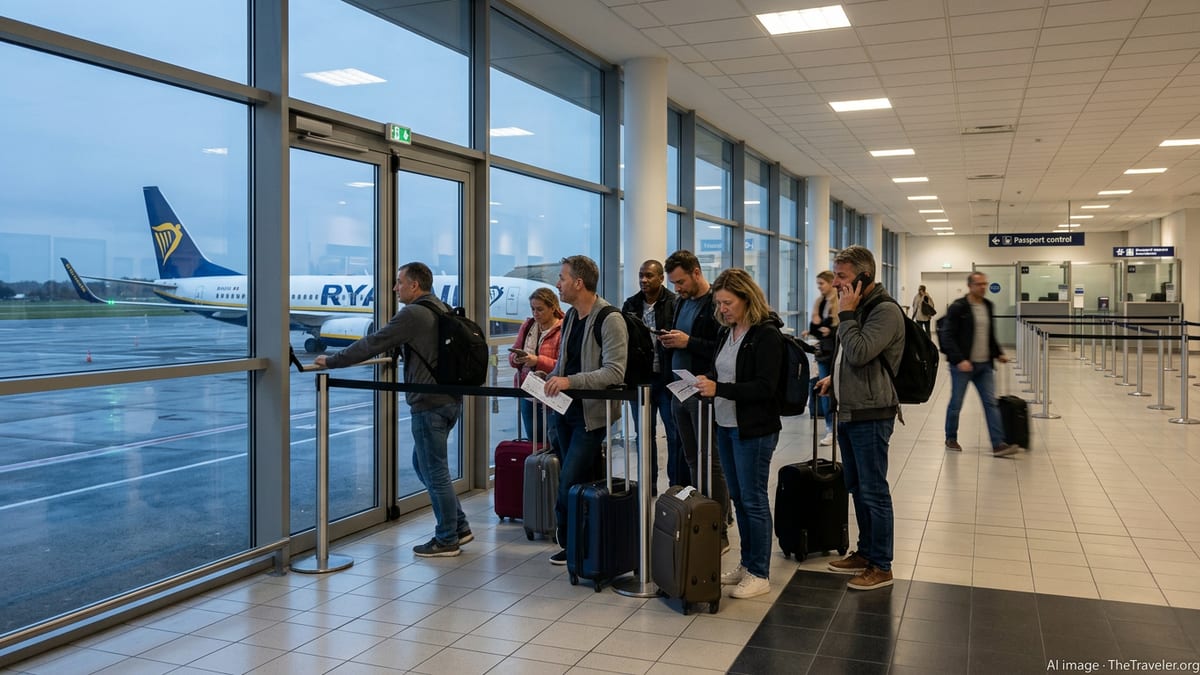
Delayed at Border Control as Boarding Time Ran Out
Local coverage from the Tours area indicates that the incident occurred on a Ryanair service from Tours Val de Loire Airport bound for Morocco, when passengers found themselves caught in slow-moving border checks as the scheduled departure time approached. While the aircraft ultimately left close to its planned slot, two dozen travelers were still being processed when the gate closed.
Accounts reported in regional outlets describe long queues at passport control, where outbound passengers to a non-Schengen destination must undergo systematic checks. Those caught in the bottleneck reportedly watched the departure time draw near while the line barely advanced, leaving them unable to reach the gate before the final boarding cut-off imposed by the airline.
By the time some of the passengers reached the boarding area, staff were reported to have already closed the flight, with the aircraft pushing back from the stand with empty seats still available. For the 24 travelers left behind, that combination of strict procedures and rigid boarding rules translated into missed holidays, family visits and business trips.
Ryanair and the airport operator had not published detailed, incident-specific explanations at the time of writing. Publicly available information and passenger accounts nevertheless point to a familiar pattern in European travel, in which state-run border checks and commercial airline schedules intersect in ways that can leave travelers stranded.
France–Morocco Routes Under Scrutiny
The Tours episode adds to a series of disruptions on France–Morocco routes that have kept this corridor under scrutiny from travelers and consumer groups. Previous operational incidents, including diversions and substantial delays between French regional cities and Moroccan destinations, have already raised awareness of the complexity of flying between the European Union and a non-Schengen country.
Flights linking France and Morocco are subject to full passport checks on departure and arrival. The process is mandatory even for European Union nationals, and it is often intensified during peak holiday periods when traffic to Moroccan cities such as Marrakech, Fez and Agadir increases sharply. As a result, any shortage of staff or surge in passenger numbers can quickly create long lines at control points.
On low-cost carriers, where quick aircraft turnaround is central to the business model, the margin for accommodating such delays is especially thin. Published guidance for several airlines highlights firm gate closure times, often 20 to 30 minutes before departure, regardless of whether passengers were held up by security screening or border formalities elsewhere in the terminal.
For travelers on routes between France and Morocco, the risk is heightened by additional document checks, including scrutiny of visas, return tickets and accommodation details. While these verifications are designed to comply with immigration and security rules, they can lengthen processing times and contribute to last-minute congestion when many flights depart in a short window.
Who Is Responsible When Border Delays Cause Missed Flights?
The Tours case underscores a recurrent question in European air travel: where does responsibility lie when border control delays prevent passengers from reaching the gate in time, yet the flight itself departs punctually? European passenger rights rules provide compensation and care in cases of denied boarding, long delays or cancellations attributable to the carrier, but the application is less clear when state-run checks are at the heart of the disruption.
Guidance from European institutions notes that passengers can in some circumstances be protected even if boarding is refused over documentation issues. However, airlines frequently argue that long queues at security or passport control constitute airport or governmental operations that fall outside their direct control. In such cases, they may treat the situation as a no-show under standard conditions of carriage, offering limited or no compensation.
Passengers affected by incidents like the one in Tours often find themselves directed between the airline and airport operator, each pointing to different parts of the travel chain. While public information on this specific flight remains limited, similar disputes across Europe show that travelers frequently contest the outcome, especially when they arrived at the airport well in advance but were delayed at controls they could not bypass.
Consumer advocates regularly encourage travelers in these situations to document their arrival time at the airport, queue lengths and any available announcements. In some cases, complaints escalated to national enforcement bodies or small-claims procedures have led to rulings that favor passengers when evidence suggests that procedural bottlenecks, rather than late arrival at the terminal, caused the missed flight.
Practical Lessons for Passengers Flying Between France and Morocco
For travelers on Ryanair and other carriers linking French cities with Moroccan destinations, the Tours incident offers several practical lessons. First, experts commonly recommend arriving at the airport even earlier than usual for non-Schengen flights, particularly during school holidays and weekend peaks, to allow for extended border checks and potential staff shortages.
Second, passengers are advised to pay close attention to the specific check-in and boarding deadlines set out in the airline’s terms. Ryanair’s published procedures emphasize that airport check-in and gate closure times are strict, and that boarding can be refused once those limits are reached, even if passengers are physically close to the gate or can see the aircraft still on stand.
Third, travelers heading to Morocco should verify in advance whether a printed boarding pass is required and whether any additional document verification steps apply, as these can add further time at airport desks and control points. Several airlines operating to Moroccan airports still rely on paper passes for outbound checks, which can come as a surprise to passengers accustomed to digital-only travel within Europe.
Finally, the Tours case highlights the importance of contingency planning. Travel specialists often suggest booking longer connection times when self-connecting, choosing earlier flights in the day when possible, and considering travel insurance that explicitly covers missed departures caused by security or border delays. These measures cannot eliminate the risk of disruption, but they can soften the impact when strict control regimes and punctual flight operations collide.
Calls for Better Coordination at Regional Airports
The events at Tours Val de Loire Airport are contributing to broader discussions about how regional airports manage cross-border traffic. While major hubs typically have larger pools of border officers and more flexible staffing, smaller facilities can struggle during sudden peaks, particularly when several non-Schengen departures are scheduled close together.
Industry observers note that improved planning between airlines, airport operators and border services could help anticipate busy periods and adjust staffing or queuing systems. Some airports in Europe have experimented with dedicated fast-track lanes for imminent departures, as well as real-time information screens warning passengers of long waits at control points so they can adjust their route through the terminal.
At the same time, low-cost carriers are under pressure to maintain tight schedules in order to keep fares low. Any systematic extension of boarding windows or frequent delays to accommodate late-arriving passengers can disrupt aircraft rotations across the network. The Tours incident illustrates how this tension plays out on the ground, with travelers caught at the intersection of operational efficiency and procedural rigor.
For now, passengers using regional French airports for flights to Morocco are being reminded, through media coverage and travel forums, that they bear much of the practical risk when state border controls and airline punctuality collide. Until more robust coordination mechanisms are in place, similar disputes over missed flights and denied boarding are likely to continue surfacing across the busy France–Morocco corridor.