

More news on this day
Ryanair is facing a fresh public relations storm after a passenger alleged that a customer service agent at London Stansted Airport wore a political badge linked to Hamas, triggering a heated confrontation that has quickly broadened into a wider debate about airline staff neutrality, passenger safety perceptions and the limits of personal expression in highly sensitive public spaces.
The Incident That Sparked a Storm
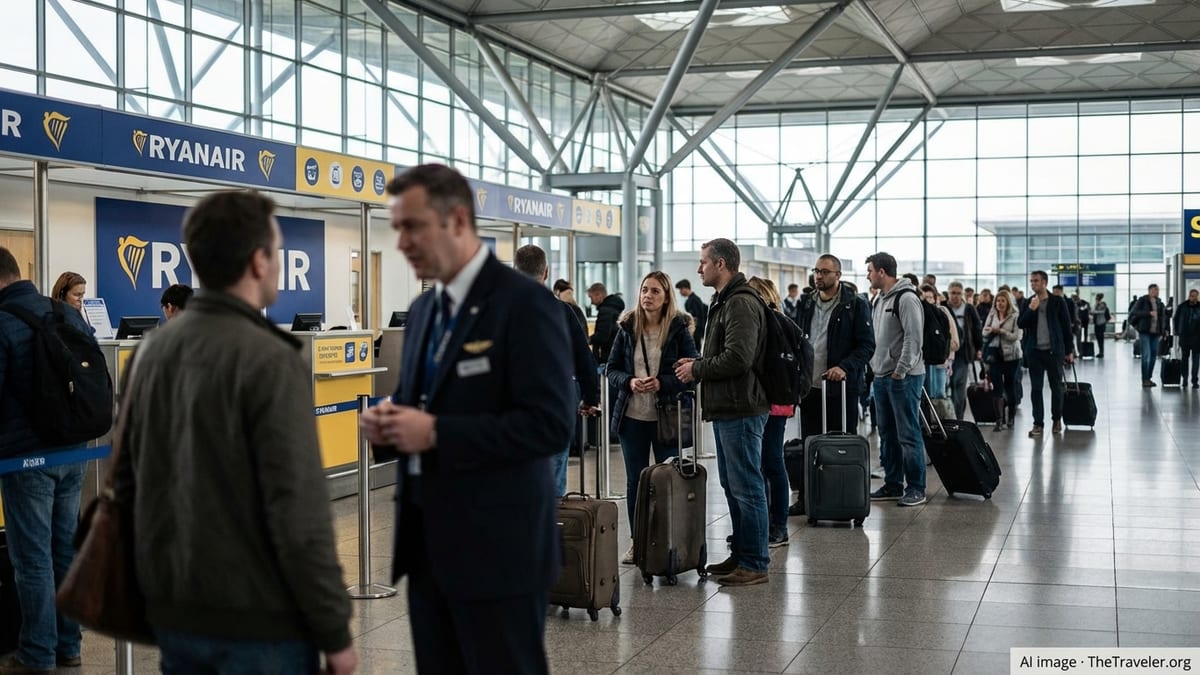
The controversy emerged after barrister Adrian Yalland, an Anglo-Irish passenger, complained publicly that a Ryanair customer service agent at Stansted was working in uniform while wearing what he described as a pro-Hamas or intifada badge. According to his account, shared on social media over the weekend of February 21, 2026, he raised the issue with the staff member, arguing that such a symbol could make Jewish travelers feel unsafe or unwelcome at the airport.
Yalland alleged that the exchange quickly escalated. He said the staffer reacted with hostility, accused him of being racist and, in a move that shocked many who later read his account online, threatened to have him removed from his flight. The post rapidly gained traction, amplified by political commentators and frequent flyers, and catapulted what might have been a local customer service dispute into an international talking point.
Ryanair has not yet issued a detailed public statement addressing the specific badge or the individual employee involved, but the episode comes at a time when airlines worldwide are grappling with how to balance staff rights with rising demands for visible neutrality on politically charged issues. For many observers, the fact that the encounter unfolded at a major London hub only sharpened the focus on how such incidents are handled in front of diverse, global audiences.
What Is Alleged About the Badge
Central to the dispute is the nature of the badge itself. Yalland described it as a pro-Hamas or intifada emblem, suggesting not merely solidarity with Palestinians but an association with a proscribed terrorist organization in the United Kingdom. That distinction is critical in a legal and ethical sense, and it has framed much of the subsequent commentary around the incident.
The line between a symbol of political support and one that is interpreted as endorsement of extremism is often highly contested. Campaigners for Palestinian rights argue that flags and solidarity pins should not be automatically equated with antisemitism or support for terrorism. Jewish community groups and many security specialists counter that some imagery linked to Hamas, or slogans invoking armed intifada, are inherently threatening, especially to passengers with direct personal or family ties to Israeli communities targeted by violence.
In the absence of publicly released photos that can be independently verified, the exact design of the badge remains a point of dispute. Nonetheless, perception is everything in an airport terminal, where passengers are already alert to security concerns. The idea that an on-duty staff member might appear to endorse a group listed as a terrorist organization has unsettled many travelers, regardless of their politics.
Ryanair’s Uniform Policy Under Scrutiny
The incident has thrown a spotlight on Ryanair’s long-standing uniform rules, which, like those of many airlines, are designed to project a standardized, neutral corporate image. Historically, Ryanair has been strict about unauthorized symbols on uniforms, having previously clashed with pilots and crew who displayed union insignia or unofficial logos on lanyards and badges. Those internal disputes have typically been framed as labor relations issues rather than questions of political speech.
Yet this latest row raises a different set of questions. If union badges are banned in the name of uniformity, how was a politically sensitive badge allegedly allowed to be worn in a customer-facing role at one of Ryanair’s key UK bases? Was this a case of local management oversight, inconsistent enforcement or a gap in training about symbols that may be innocuous to some employees but highly provocative to others?
Industry sources note that most large airlines now maintain exhaustive grooming and uniform manuals, specifying everything from tie colors to acceptable jewelry. Political symbols, especially those touching on conflicts in the Middle East, are typically forbidden precisely because they can be interpreted as the company taking sides. The Stansted dispute suggests Ryanair may need to re-examine how well its policies are communicated and enforced across outsourced ground-handling teams and directly employed staff.
Passenger Perceptions and the Politics of the Airport
Airports are among the most regulated and security-conscious public environments, and passengers often assume that everyone in uniform speaks for the airline, if not for the state itself. When a staff member is perceived as endorsing a divisive political cause, it can shatter that sense of neutral professionalism and heighten passengers’ emotional responses, particularly for those who feel personally targeted by the symbol in question.
Travelers from Jewish and Israeli backgrounds have repeatedly raised concerns in recent years about the display of certain badges and flags by airport and airline staff in Europe and North America. Even when such symbols are not outlawed, they can generate complaints that passengers feel intimidated, profiled or singled out. The Ryanair row at Stansted fits squarely into this pattern, illustrating how a single lapel pin can destabilize the fragile trust that underpins the airport experience.
Social media reactions to Yalland’s account have been sharply polarized. Some commentators argued that he was right to challenge the badge and condemned Ryanair for not appearing to intervene more swiftly. Others accused him of overreacting or of policing workers’ personal views. The rapid spread of the story once again shows how disputes in airport queues now unfold under the scrutiny of online audiences, where partial accounts can define a narrative long before companies release any formal response.
Global Trend: Airlines Tighten Rules on Political Symbols
The Stansted controversy comes against a backdrop of increasing tension across the global aviation industry about political expression on uniforms. Over the past two years, several major airlines in the United States have moved to restrict or ban pins and badges related to the Israel–Palestine conflict after facing accusations of antisemitism or bias when crew members wore Palestine flag symbols on flights.
In some cases, airlines that once allowed staff to display flags representing nationalities, languages or personal heritage have quietly tightened their rules, limiting visible symbols to company-issued insignia or home-country flags. Publicly, these carriers frame such changes as efforts to maintain uniformity and avoid passenger discomfort. Privately, managers acknowledge they are also trying to minimize the risk of viral controversies like the one now engulfing Ryanair.
European airport operators have confronted similar dilemmas. At major hubs, including London Heathrow, security staff wearing pins linked to the Palestinian cause have drawn complaints from Jewish advocacy groups. These organizations argue that while political badges may be permitted in other workplaces, they are inappropriate for personnel who exercise significant power over travelers, from security screening to boarding decisions.
Employee Rights, Free Expression and Corporate Liability
Beneath the immediate uproar lies a deeper policy question: how far can companies go in curtailing staff expression before they infringe on workers’ rights? Labor lawyers point out that employees do not check their political identities at the door, and that they may seek to express solidarity with causes they regard as human rights issues rather than partisan politics.
At the same time, airlines operate under complex safety, security and anti-discrimination obligations. If a badge is reasonably interpreted as support for a proscribed organization or as hostility toward a protected group, the legal and reputational risks for the company can be severe. Regulators, insurers and shareholder groups are all sensitive to anything that suggests an airline is failing to keep its front-line environment neutral, safe and welcoming.
Ryanair, which has a history of hard-edged internal discipline and has often faced union criticism over working conditions, is now being evaluated through a different lens: whether it can manage politically sensitive staff conduct without appearing either indifferent to discrimination or heavy-handed toward individual employees. How it navigates this balance in the Stansted case may set expectations for similar incidents across its network.
Union and Community Responses
Trade unions representing aviation workers in Britain and Europe have been quick to note that front-line staff are increasingly caught at the intersection of passenger anger and highly polarizing global conflicts. While unions typically defend their members’ rights to dignity and due process in disciplinary cases, they also recognize that overt political messaging on the job can expose workers to hostility from travelers and management alike.
Jewish community organizations and antisemitism watchdog groups, meanwhile, are likely to scrutinize both Ryanair’s response and any investigation undertaken by airport authorities. For such groups, the Stansted episode is not an isolated incident but part of a broader pattern in which symbols associated with Hamas and related slogans appear more frequently in public workplaces, prompting concerns about the normalisation of rhetoric they regard as threatening.
Passenger-rights advocates argue that transparent, consistent rules are in everyone’s interest. If airlines and airports clearly prohibit all political or conflict-related symbols on uniforms, they say, staff are less likely to be singled out for disciplinary action based on the specific cause they support, and passengers of all backgrounds can travel with greater confidence that they will not be confronted by messaging that feels accusatory or exclusionary.
What This Means for Travelers at Stansted and Beyond
For passengers using London Stansted, the Ryanair dispute is a reminder that air travel has become a stage on which broader cultural and political battles are increasingly played out. Travelers who once worried mainly about luggage fees and departure times now find themselves navigating a landscape where a staff member’s lapel pin can trigger debates about terrorism, racism and free speech before they even reach the gate.
In practical terms, frequent flyers are watching closely to see whether Ryanair revises or reaffirms its uniform and conduct policies in the wake of the incident. Clearer guidelines, better training on sensitive symbols and visible, even-handed enforcement could help reassure passengers that the airline understands the stakes and is prepared to act when staff behavior crosses agreed lines.
More broadly, the Stansted row illustrates how airlines must increasingly manage not just the movement of people but the politics that travel with them. As conflicts abroad reverberate through airport terminals, the pressure on carriers to maintain a visibly neutral, professionally focused workforce is only likely to intensify. For Ryanair, a low-cost giant whose brand is built on speed and simplicity, that may be one of the most complex challenges it now faces.