

More news on this day
Ryanair has updated its hand luggage policy across its European network, widening the size of the free underseat bag while reiterating strict rules on extra cabin bags, liquids and restricted items that passengers can bring on board.
Get the latest news straight to your inbox!
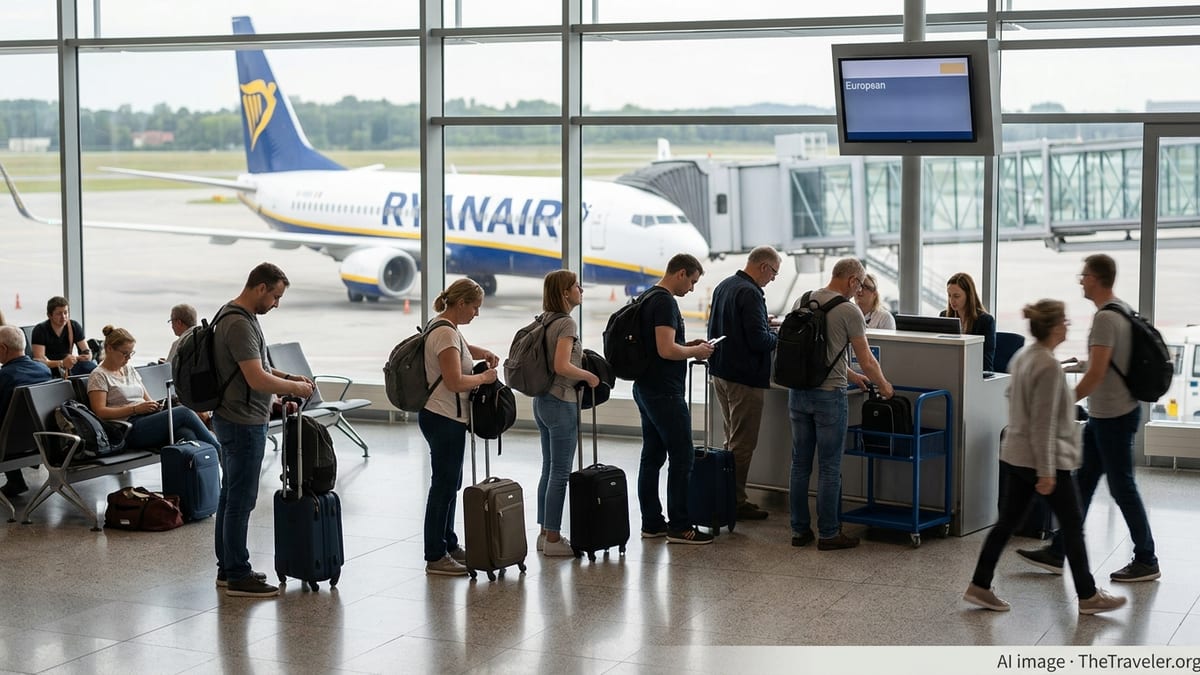
What Has Changed in Ryanair’s Hand Luggage Policy
Publicly available information from Ryanair’s help centre and recent travel industry coverage indicates that the airline has expanded the maximum size of its free underseat bag, refining rules that were already among the most closely watched in Europe. Reports show that from 2025 the standard “small personal bag” allowance has been aligned at around 40 x 30 x 20 centimetres, a 20 percent increase in volume compared with earlier limits that were closer to 40 x 25 x 20 centimetres.
This small personal bag remains the only item included in Ryanair’s basic fares, and it must fit entirely under the seat in front of the passenger. The airline emphasises that handles, wheels and external pockets all count towards the overall measurements, and that compliance will be checked using metal bag sizers at boarding gates.
Travel analysts note that the tweak to the free bag dimensions places Ryanair roughly in line with several European competitors and reflects wider moves in the European Union to standardise cabin baggage allowances. At the same time, the carrier has left in place separate paid options for larger cabin bags and checked luggage, meaning most of the policy structure around hand luggage remains unchanged.
Free Underseat Bag: What You Can Bring
Under the updated rules, every Ryanair passenger is entitled to one small personal bag at no additional cost. According to guidance published on the airline’s help pages, examples include a compact backpack, handbag, laptop bag or small duffel so long as it does not exceed the stated dimensions and can slide under the seat without forcing it open or blocking the aisle.
There is typically no specific weight limit advertised for this underseat item, but travellers are advised that they must still be able to lift and handle the bag safely themselves. Soft-sided bags that can compress slightly tend to be favoured by frequent flyers, as they are easier to fit into the sizer frames used at gates, particularly on busy departures where checks may be rigorous.
Parents travelling with infants are subject to separate provisions. Public documents from Ryanair indicate that infants seated on an adult’s lap do not receive their own cabin bag allowance, but one small baby bag of up to around 5 kilograms may be permitted in addition to the adult’s personal item. Two larger pieces of baby equipment, such as a foldable stroller and car seat, can normally be checked in free of charge.
Priority & 2 Cabin Bags: Bringing a Larger Carry-on
Passengers who wish to bring a wheeled suitcase or larger backpack into the cabin must purchase a Priority & 2 Cabin Bags product or a similar add-on during booking or check-in. According to Ryanair’s stated bag policy, this upgrade allows travellers to carry both the free small personal bag and an additional 10 kilogram cabin bag, typically up to 55 x 40 x 20 centimetres, which is designed for the overhead lockers.
Travel reports note that this option also grants access to a priority boarding lane at many airports, which can be particularly valuable on busy leisure routes where overhead space fills quickly. However, the upgrade is capacity controlled and may be more expensive if added late in the booking process or at the airport.
Ryanair’s guidance stresses that the larger cabin bag must fit into the sizer and be light enough to stow safely in the overhead bin. If either the underseat bag or the larger cabin bag is found to exceed permitted dimensions at the gate, it may be tagged and placed in the aircraft hold, usually with a gate bag fee that can be significantly higher than pre-booked hold luggage.
Liquids, Electronics and Prohibited Items in Hand Luggage
Beyond bag dimensions, passengers must comply with standard aviation security restrictions on what can and cannot be carried in cabin baggage. Ryanair directs travellers to airport and national security rules, which still generally limit liquids, gels and aerosols in hand luggage to containers of up to 100 millilitres, all of which must fit inside a single resealable transparent bag of about one litre.
Everyday items such as smartphones, laptops, tablets, cameras and power banks are allowed in hand luggage, but must be removed from bags and screened separately at security checkpoints where instructed. Some airports are gradually introducing upgraded scanners that relax these requirements, yet travellers are advised to prepare for traditional screening procedures to avoid delays.
Sharp objects, large tools and sporting equipment that could be used as weapons are generally prohibited from the cabin. This includes knives with blades above small incidental lengths, most multi-tools, full-size scissors, metal tent pegs, certain types of walking sticks and many forms of sporting gear such as bats or golf clubs. Passengers who need to travel with such items are typically required to place them in their checked baggage rather than cabin bags.
How Strictly the Rules Are Enforced at the Gate
Although the written policy is uniform, recent traveller accounts suggest that enforcement can vary between airports and even between flights. On heavily booked services from major hubs, gate staff are often described as particularly strict, asking passengers to place their bags in the sizer and charging on-the-spot fees when items do not fit. On quieter flights, checks may appear more relaxed, though there is no guarantee of leniency.
Ryanair’s guidance notes that if a bag is too large for the sizer, it may be placed in the hold with a gate bag charge that is usually higher than the cost of pre-booked luggage. Travel commentators point out that this can quickly turn a low headline fare into a more expensive journey, especially for travellers who assumed a borderline bag would be accepted without issue.
Frequent flyers therefore advise choosing a bag that is clearly within the published limits, allowing extra centimetres of margin, and packing in a way that avoids bulging corners. Compression straps, careful use of exterior pockets and avoiding rigid boxes at the edges of a bag can all make the difference between passing or failing a last-minute size check.
Tips for Staying Within Ryanair’s Updated Limits
Travel industry guides recommend that passengers planning to fly Ryanair measure their luggage carefully, including protruding handles, wheels and straps, before leaving home. Buying bags specifically marketed as compliant with Ryanair’s latest underseat or cabin dimensions can reduce uncertainty, but it is still important to confirm the stated size against the airline’s most recent published policy.
Packing light remains the most straightforward strategy. Rolling clothes, using packing cubes that fit the bag footprint and choosing multipurpose garments can help keep volume down. Bulkiest items such as coats and heavier shoes are usually best worn rather than packed, freeing up space inside the bag and keeping it closer to the underseat size limit.
Finally, travellers are encouraged to check Ryanair’s baggage pages shortly before departure, as the carrier has shown a willingness to adjust allowances in response to regulatory changes and competitive pressure. With hand luggage rules now a central part of how low-cost airlines structure fares, understanding exactly what is and is not allowed in a Ryanair cabin bag has become an essential step in trip planning.