

More news on this day
Spain’s aviation sector has received a major boost with the inauguration of a new €25 million Ryanair maintenance hangar at Madrid’s Adolfo Suárez Madrid-Barajas Airport, a flagship project that reinforces the country’s role as a strategic hub for aircraft upkeep and airline growth in Europe.
Get the latest news straight to your inbox!
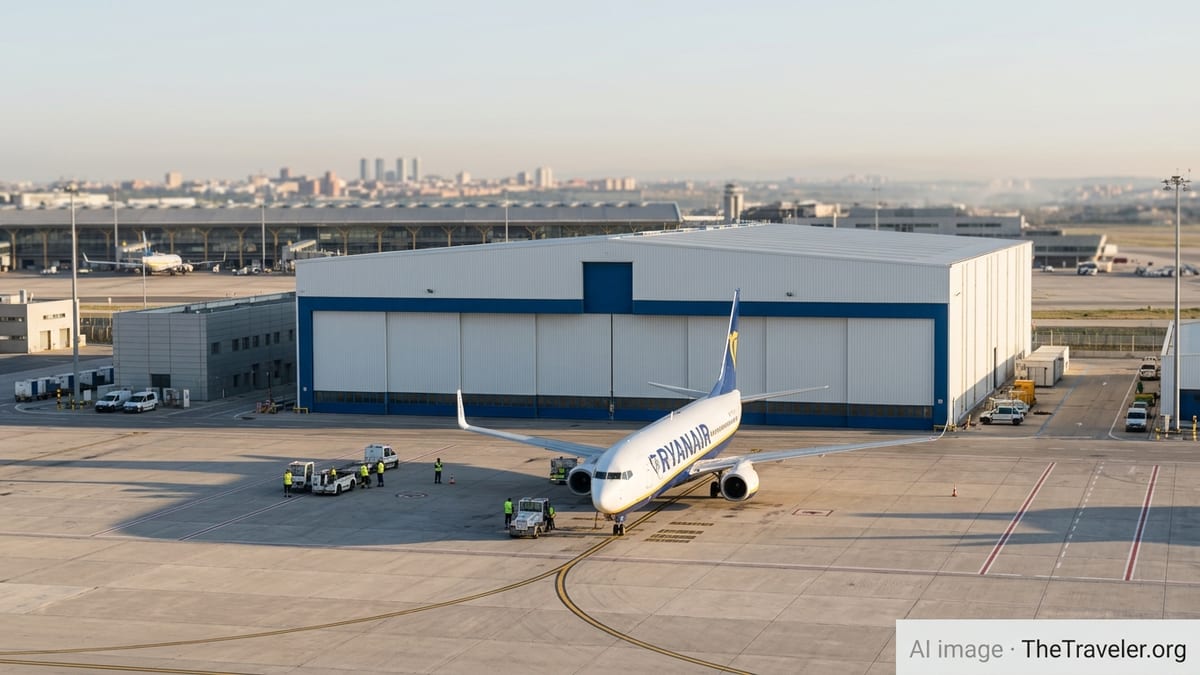
A Landmark Investment at Madrid-Barajas
Publicly available information shows that Ryanair has opened what is described as its largest maintenance hangar in its network at the industrial area of Madrid-Barajas. The facility covers around 22,000 square meters and can accommodate up to seven aircraft simultaneously, significantly expanding the airline’s capacity for heavy and line maintenance in Spain.
Reports indicate that the new hangar represents a capital outlay of approximately €25 million, following an earlier long-term lease agreement for one of the airport’s biggest hangar spaces. The facility sits within the airport’s developing “airport city” zone, where unused land is being repurposed for logistics, industrial and aeronautical activities linked to the main hub.
The inauguration in mid-March 2026 positions Madrid as a central maintenance base within Ryanair’s European network. Company disclosures and local coverage describe the complex as a next-generation center designed to support the airline’s growing Boeing 737 fleet as it targets higher traffic volumes across the continent.
Jobs, Skills and Economic Impact for Spain
According to published coverage, the new maintenance hub in Madrid is expected to create around 700 direct positions once fully ramped up, including aircraft engineers, mechanics, technicians and support staff. These roles add to thousands of aviation-related jobs that Ryanair already supports in Spain through its bases, maintenance sites and training centers.
The development comes as Spain continues to compete aggressively for high-value aeronautical and engineering investments. Regional investment agencies have highlighted aviation maintenance, repair and overhaul as a strategic growth sector, given the combination of well-established airports, competitive costs and an existing pool of technical talent.
Local reports also note that Ryanair is working with aviation schools and training providers in the Madrid region to build a pipeline of licensed engineers and mechanics. The hangar therefore functions not only as an operational asset but also as a magnet for specialized training programs and long-term career opportunities for younger technical workers.
Strengthening Ryanair’s Pan-European Maintenance Network
Ryanair’s corporate filings in recent years have pointed to a deliberate strategy of expanding in-house maintenance capabilities across Europe. The airline already operates major facilities in locations such as Seville, Wroclaw, Kaunas and Prestwick, and has been adding new hangar capacity in Dublin and other bases to support its fleet plans.
Publicly available documents describe Madrid as a key node within this network, envisioned as a seven-bay complex integrated into Ryanair’s broader engineering operations. The expanded footprint at Barajas allows the carrier to schedule more heavy checks within its own facilities, which can help with cost control, operational reliability and turnaround times compared with relying solely on third-party providers.
Industry observers view the Madrid investment as part of a wider trend among large low-cost carriers to internalize more maintenance work. By concentrating activity at a small number of highly specialized hubs, airlines aim to gain economies of scale while ensuring that technical standards remain closely aligned with fleet growth and new aircraft deliveries.
Madrid-Barajas as a Rising Maintenance and Innovation Hub
The new hangar also aligns with broader efforts to position Adolfo Suárez Madrid-Barajas as more than a traditional passenger gateway. Strategic planning documents for the airport refer to a multi-year program to develop surrounding land into an integrated airport city, bringing together logistics, cargo, industrial and aeronautical services.
Within this context, Ryanair’s project is one of the most visible examples of how maintenance activities can anchor long-term aeronautical clusters. The scale of the Madrid hangar, combined with the airline’s plans for training and engineering functions in the region, supports the narrative of Madrid as a center for aviation innovation and technical expertise in southern Europe.
Spain already hosts other major maintenance and storage operations in cities such as Seville and Teruel, and the addition of a large-scale facility in the capital deepens the national ecosystem. Analysts note that clustering activity around major hubs can attract related businesses, from component suppliers to specialized engineering consultancies, generating additional economic spillovers.
Balancing Growth Ambitions and Cost Pressures
While the new hangar underscores Ryanair’s long-term commitment to Spain, the investment comes amid ongoing debate about airport charges and the cost of expanding capacity. Recent media coverage highlights concerns from airline executives about planned increases in Spanish airport tariffs over the coming regulatory period, which some industry voices argue could weigh on growth.
Ryanair has repeatedly outlined ambitious targets, including a larger fleet and substantial passenger growth by the early 2030s. In this context, the Madrid maintenance hub is portrayed as a critical enabler of those plans, ensuring that aircraft can be serviced efficiently as schedules expand across Spain and the wider European network.
For Spain, the challenge will be to maintain an environment that continues to attract large-scale aviation projects while funding necessary infrastructure upgrades at major airports such as Madrid-Barajas. The completion of Ryanair’s €25 million hangar, and the jobs and capabilities it brings, illustrates both the potential and the tensions inherent in managing the next phase of the country’s aviation future.