


From 10 November 2026, Ryanair passengers who check a suitcase will need to be at the airport earlier than before. The airline is moving its airport check in and baggage drop deadline from 40 minutes to 60 minutes before scheduled departure on all routes, a change that affects millions of budget travelers across Europe. Understanding how this new 60 minute rule fits with online check in, airport arrival times and boarding gate cut offs is now essential if you want to avoid an expensive missed flight.
Get the latest updates straight to your inbox!
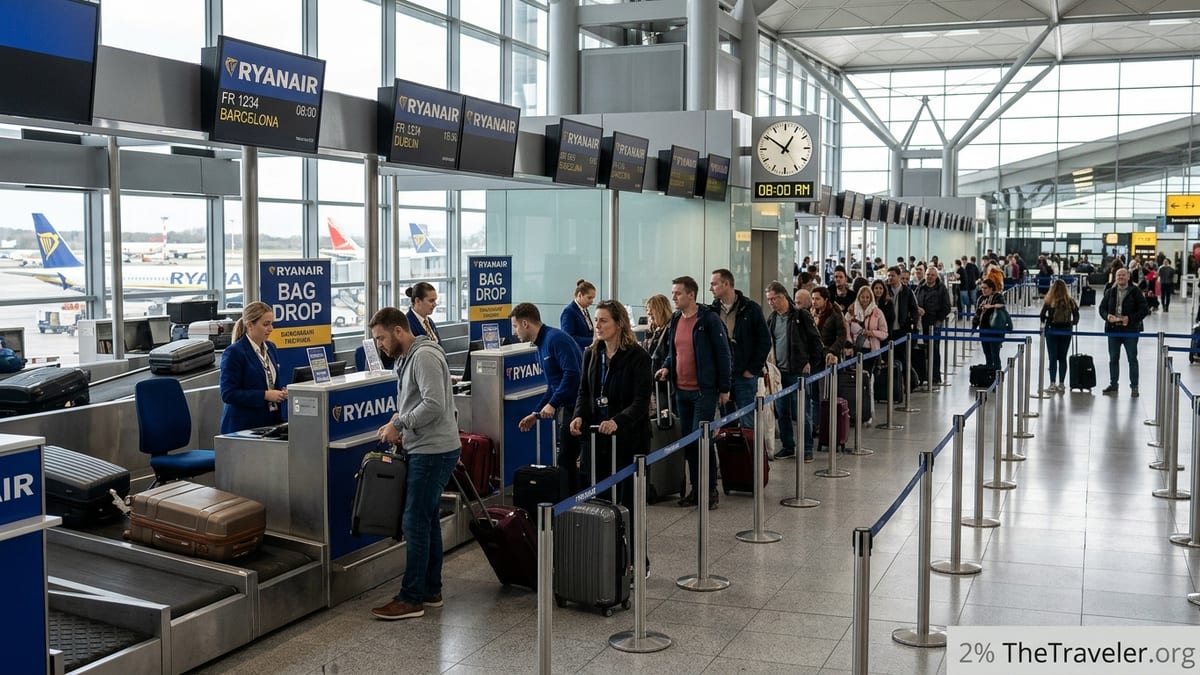
What exactly changes from 10 November 2026
Ryanair has confirmed that from Tuesday 10 November 2026, airport check in and bag drop desks will close 60 minutes before the scheduled departure time, instead of the current 40 minute cut off. The airline’s own help center explains that the aim is to give passengers more time to clear increasingly busy security and passport queues before reaching the gate, reducing the number of people who miss flights after queuing for too long at the airport.
Until this change takes effect, Ryanair desks generally open about two hours before departure and close 40 minutes beforehand. From 10 November, the opening time will remain broadly similar, but the closing time will move to one hour before take off. National media in countries where Ryanair is a key player, such as Spain, France and Italy, have already highlighted that this means passengers who usually arrived at the airport 90 minutes before a flight, with a bag to check in, are now cutting it fine.
The new deadline applies whenever you need to deal with a human or self service desk at the airport for checked baggage or airport check in. It does not, by itself, change Ryanair’s online check in window or the boarding gate closing time, both of which remain governed by separate rules. This distinction is important, because many passengers confuse the final moment to drop a suitcase with the final moment to board the aircraft.
Ryanair says the policy will be standard across its network. However, the airline and airport handling agents sometimes send emails with even earlier local deadlines for specific flights or congested airports. Travelers should treat any earlier time in their booking confirmation, app notifications or airport screens as the rule for that particular journey.
How the new 60 minute rule affects when you should reach the airport
In practical terms, the earlier bag drop cut off means passengers with checked luggage should now aim to arrive at the terminal well before the one hour mark. If bag drop closes 60 minutes before departure and you only walk into the terminal at that time, a minor delay at ticket checks, a queue at the scales, or confusion about your documents could leave you stuck on the wrong side of the desk when it closes.
Consider a common example: a London Stansted to Barcelona flight at 09:00. Under the old rules, many regulars with a single checked suitcase would plan to enter the terminal around 07:20 or 07:30, giving them 10 to 20 minutes to queue for bag drop before the 08:20 deadline, and then 40 minutes to clear security and walk to the gate. Once the 60 minute rule starts, the bag drop deadline for that flight moves to 08:00. Arriving at 07:20 now leaves just 40 minutes for any check in or bag drop queue plus potential issues with documents.
Airport experience across Europe suggests that queues for low cost carrier bag drop can easily stretch to 20 or 30 minutes at busy times, particularly at bases such as Dublin, London Stansted, Milan Bergamo or Barcelona El Prat during school holidays. With that in mind, a safer pattern from 10 November is for passengers with hold luggage to enter the terminal roughly two and a half hours before departure, and to be physically at the Ryanair bag drop area no later than 90 minutes before their flight is due to leave.
For shorter queues and smaller airports, such as regional fields like Beauvais near Paris or Treviso near Venice, these buffers may feel generous. Yet late running buses, city traffic, or a longer walk from car parks can quickly eat away at your margin. Because Ryanair places the responsibility on passengers to reach bag drop before it closes, the cost of missing the 60 minute deadline will almost always fall on the traveler, not the airline.
Online check in windows versus airport deadlines
Ryanair encourages most customers to check in online through its website or app. The airline’s conditions explain that online check in usually opens 24 hours before departure if you have not purchased a seat, and up to 60 days in advance for passengers who pay to reserve a specific seat. In both cases, online check in typically closes two hours before the scheduled departure time, meaning that by two hours out you should already have your boarding pass saved or printed.
This online window is separate from the new 60 minute airport cut off. If you only try to check in at the airport, either because you forgot to do so online or because your booking requires document checks in person, you will be subject to Ryanair’s airport check in fees as well as the earlier closing time. Under the new rule, having your boarding pass on your phone will not help if your suitcase still needs to cross the bag drop scales after the desks have closed.
A typical scenario illustrates how these pieces fit together. Imagine a family flying from Madrid to Rome with a 14:00 departure, one shared 20 kg checked suitcase and no reserved seats. They can check in online and obtain boarding passes any time from 24 hours before departure until 12:00 on the day of travel. However, they must drop their shared suitcase at the Ryanair desk before 13:00 once the new rule is in force. Arriving at the terminal at 12:45, even with boarding passes already on their phones, would leave them relying on there being no queue and no issues with the bag.
Some travelers use Ryanair’s self service bag drop kiosks, which are rolling out at larger bases. These machines allow you to scan a boarding pass, weigh your bag and print a tag without speaking to staff. Yet they are tied to the same airport deadlines as staffed desks. A kiosk will stop accepting new baggage transactions at the same 60 minute mark, sometimes a few minutes earlier to avoid disputes, so travelers can not rely on machines to bypass the new cut off.
What happens if you miss the 60 minute bag drop deadline
Ryanair’s terms and public guidance are clear that once check in and bag drop close, staff may refuse to process further passengers, even if a queue remains. With the switch to a 60 minute cut off, travelers who reach the desk late with a suitcase should expect to be denied checked baggage and, in most cases, denied boarding entirely on that flight.
Airport handling staff do have some limited discretion, particularly if delays are clearly the airline’s fault, but reports from frequent flyers show that Ryanair usually applies its rules strictly. Travelers who miss the bag drop deadline are typically told to rebook on a later flight at their own expense or to contact customer service to discuss any available “missed departure” options, which may still involve significant extra cost and are not guaranteed.
Consider a passenger traveling from Brussels Charleroi to Marrakech for a long weekend, carrying a 20 kg suitcase packed with clothes and toiletries. Their flight is at 16:30, and they arrive at the terminal at 15:40, ten minutes before the new 60 minute cut off, only to find a long snaking queue at the Ryanair desks. If they still have not reached the front by 16:00, staff can close the desks at that time and refuse to accept any more bags. Even if the aircraft later departs late due to unrelated reasons, the passenger’s failure to meet the original bag drop deadline will almost certainly be treated as their responsibility.
By contrast, a traveler who has checked in online and is traveling cabin baggage only avoids the bag drop deadline entirely. If they arrive late at the airport but still manage to clear security and reach the gate before final boarding, they may still be allowed to board. This is one reason the airline promotes priority boarding plus a larger cabin bag as an alternative to checked luggage on many routes, especially for short breaks.
How boarding gate closure differs from the 60 minute rule
The new 60 minute rule can easily be confused with the time at which boarding finishes at the gate, but they are not the same. Ryanair’s standard practice is that boarding gates close 30 minutes before the scheduled departure time. This means the airline usually expects all passengers to have passed security, walked to the gate area, and had their boarding passes scanned at least half an hour before take off.
Using the earlier London Stansted to Barcelona example with a 09:00 departure, the new timeline becomes three distinct steps. Online check in closes at 07:00, airport check in and bag drop close at 08:00, and the boarding gate closes at 08:30. A passenger traveling with only a small cabin bag can technically arrive at the airport later than someone with a checked suitcase, as long as they still clear security and reach the gate before 08:30. However, they are still taking a risk if queues are long or if gate changes occur.
Travelers sometimes assume that once they have dropped their bag and passed security, they can relax until the printed departure time. In busy Ryanair bases such as Dublin or Bergamo, gates may open and close briskly to keep tight turnaround schedules. Announcements typically stress that boarding will not wait for late passengers, even if they are only a few minutes away. Missing the gate deadline, like missing the bag drop cut off, usually results in denied boarding without refund.
Another important distinction is that airports can change gate closing times for operational reasons, sometimes closing earlier than the standard 30 minutes. For example, on a full Friday evening flight from Milan to London, ground staff may begin final boarding earlier to deal with larger passenger volumes and to complete security checks at the foot of the aircraft steps. Travelers should therefore treat any time shown on airport screens or mentioned in announcements as the binding instruction for that particular flight.
Real world timing examples across popular Ryanair routes
To see how the new 60 minute rule plays out day to day, it helps to look at specific departures. Take a typical early morning leisure flight, such as a 06:35 departure from Manchester to Faro in Portugal. With the new policy, bag drop will now close at 05:35. Many airport hotels and parking shuttles start running from around 04:00, so a traveler with a checked suitcase would be wise to reach the terminal between 04:15 and 04:30, giving them at least an hour to check the bag and still have time for security.
On a mid morning business heavy route, like a 10:15 Brussels Charleroi to Milan Bergamo service, commuter traffic and longer queues at airport security lanes can cause extra delays. Here, aiming to be at the airport around 08:15 to 08:30 gives a useful cushion: online check in should already be complete by 08:15, bag drop must be done by 09:15, and boarding will probably close at 09:45. This pattern allows nearly an hour between dropping the suitcase and the gate cut off, even if queues grow unexpectedly.
For a popular city break itinerary such as Rome Ciampino to London Stansted departing at 19:55 on a Sunday, local public transport and evening rush hour can be unpredictable. The one hour bag drop deadline of 18:55 means that an arrival at the terminal at 18:10 leaves little room for a long queue or any confusion over documents. Many seasoned travelers on such routes now plan to reach the airport three hours before departure to allow for traffic, check in, security and time to find food or shops near the departure gate.
These examples show that while the formal change is only 20 minutes on paper, the impact on planning is greater. Passengers who previously cut it close may need to shift their entire timetable, booking earlier airport buses or adjusting hotel check out times. Those who rely on very tight connections between separate tickets, such as a train arriving only an hour and a half before a Ryanair flight, may also need to rethink their plans.
Strategies to avoid problems under the new rules
With stricter bag drop timings, small changes in behavior can make the difference between a relaxed departure and an expensive rebooking. The most obvious step is to complete online check in at the earliest reasonable opportunity within your window, especially if you have reserved seats. Doing this several days or even weeks in advance means that if the Ryanair app requests additional information or travel document scans, you have time to resolve any issues before the day of travel.
For those who need to check luggage, planning your journey to the airport backwards from the 60 minute mark is helpful. If you know that bus services into a major airport like Barcelona El Prat are frequently delayed, choose an earlier bus than you would have taken under the 40 minute rule. If you are driving and using long stay parking, factor in the time to park and catch a shuttle to the terminal. Local advice often suggests arriving two hours before a short haul European flight; with Ryanair’s new policy, travelers with hold luggage may now feel more comfortable aiming for two and a half hours.
Another strategy is to travel with cabin baggage only when possible. Ryanair sells priority boarding with a larger cabin bag on many routes, which can be cheaper in total than paying for a checked suitcase, especially if you book well in advance. By avoiding hold luggage, you remove the risk associated with the 60 minute bag drop deadline altogether and only need to focus on security queues and reaching the gate in time.
Finally, stay alert for communications from the airline and local airport. Ryanair sometimes sends emails or app notifications with airport specific advice, for example warning of long queues at passport control at certain times of day. Airport websites and departure boards also highlight when airlines are operating under special rules or extended security checks. Building in flexibility, especially during school holidays or around major events, will remain essential even after you have accounted for the new rule.
What this means for future Ryanair trips
The move from a 40 minute to a 60 minute bag drop deadline reflects a wider trend in European air travel, where airlines balance tight aircraft turnarounds with the reality of busier security lines and border checks. For travelers, the headline message is simple. From 10 November 2026, if you plan to check a suitcase on a Ryanair flight, think in terms of being fully done with bag drop at least one hour before departure, not halfway through that final hour.
In day to day planning, that means booking earlier airport transfers, allowing more time between a hotel check out and departure, and being stricter with yourself about when you aim to reach the terminal. The penalty for missing the new cut off is severe: in most cases, you will lose your seat on that flight and have to pay again for a new ticket, often at higher same day prices.
On the positive side, passengers who adapt quickly may find their airport days less stressful. Arriving earlier, checking in online in advance and moving through security without rushing can make even the most crowded Ryanair base feel more manageable. For routes where priority cabin baggage offers enough capacity, leaving the checked suitcase at home can also simplify the experience and remove the main deadline that is changing in November.
As the new rules bed in, the most important habit for Ryanair passengers will be to check the specific times printed on their boarding passes, shown in the airline’s app and displayed on airport screens. Those times, not old memories of the 40 minute rule, will determine whether you and your luggage make it onto the aircraft.