

More news on this day
South African Tourism has issued a critical travel update as escalating conflict in the Middle East triggers mass airspace closures, leaving South African travellers stranded at key Gulf transit hubs and disrupting global connections to and from the country.
Middle East Conflict Paralyzes Key Air Corridors
The latest wave of hostilities involving the United States, Israel and Iran has plunged Middle Eastern airspace into turmoil, forcing authorities in the United Arab Emirates, Qatar and several neighbouring states to shut down key aviation corridors. The closures have halted much of the long-haul traffic that typically threads through Dubai and Doha, vital hubs for South Africans heading to Europe, Asia and North America.
Authorities confirmed that multiple Gulf airspaces, including those over the UAE and Qatar, remain closed or severely restricted, making it impossible for commercial airlines to operate normally. Major carriers that connect South Africa with the rest of the world via the Middle East have responded with sweeping flight cancellations, diversions and schedule suspensions.
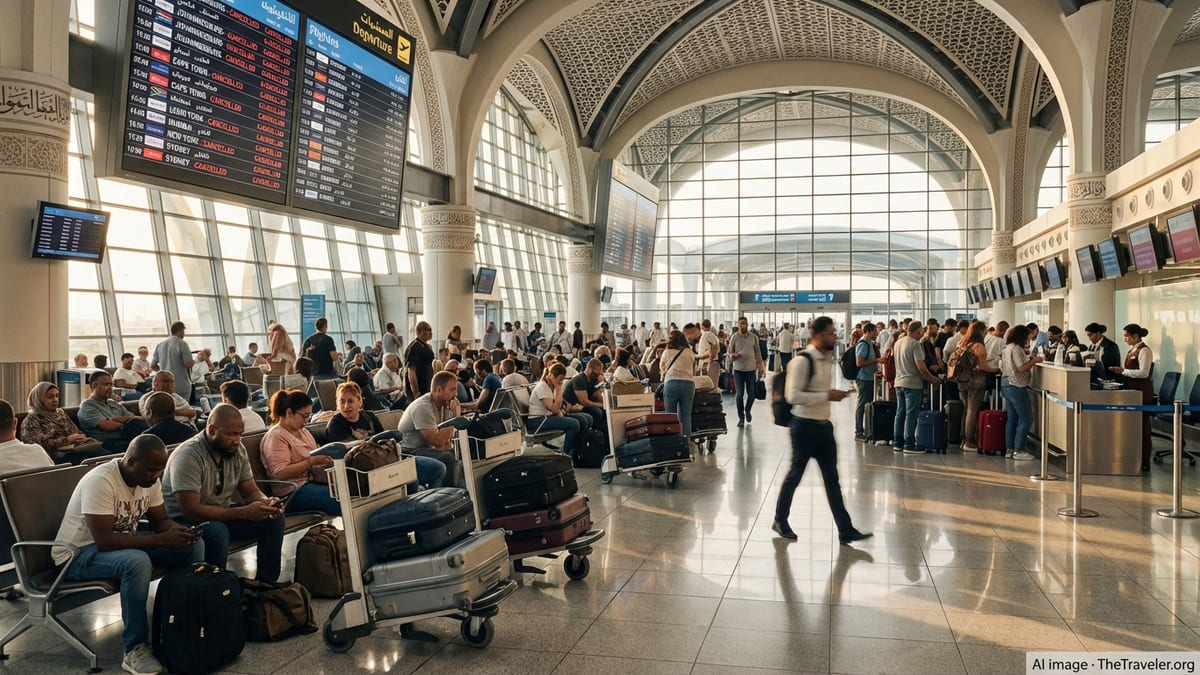
At Dubai, Abu Dhabi and Doha airports, terminals that usually bustle with transfer passengers have become holding zones for stranded travellers awaiting news of when flights might resume. Among them are large numbers of South Africans en route to or from South Africa, many of whom departed before the scale of the conflict and its impact on aviation became apparent.
Regional aviation experts warn that even once limited corridors reopen, backlogs, crew duty-time constraints and aircraft positioning challenges will likely delay a full return to normal operations, prolonging uncertainty for travellers worldwide.
South African Airports See Wave of Cancellations
The shockwaves of the Middle East shutdown have been felt immediately at South Africa’s three main international gateways. Airports Company South Africa has confirmed a growing tally of cancellations on Gulf-operated routes, particularly those served by Emirates and Qatar Airways, which normally funnel thousands of South Africans through their hubs each week.
At O. R. Tambo International Airport in Johannesburg, at least eight flights linked to Middle Eastern hubs were cancelled over the weekend, the majority being outbound services. Cape Town International has seen multiple outbound cancellations as well, while King Shaka International in Durban has also recorded disruptions on its limited but strategically important Gulf connections.
Airport authorities have urged passengers not to travel to the airport without first confirming their flight status directly with airlines or travel agents. Terminals reported scenes of confusion and frustration as families, business travellers and tour groups discovered only on arrival that their flights had been removed from departure boards with little clarity about alternative arrangements.
Ground staff and airline call centres have been scrambling to rebook affected passengers, but with airspace still closed and no firm reopening timeline, many travellers face the prospect of extended delays, unscheduled hotel stays and missed onward connections around the globe.
SA Tourism Issues Critical Advisory to Travellers
In a formal update issued on 1 March, South African Tourism acknowledged what it described as confirmed global flight disruptions and cancellations linked to the evolving Middle East situation and associated airspace closures. The organisation said it is working closely with aviation authorities, airport operators, airlines and tourism partners to stay abreast of developments that affect trips to and from South Africa.
The tourism body is urging all travellers to verify their flight details directly with airlines, travel agents or airports before proceeding with any journey. Travellers whose flights have already been cancelled are being advised to engage immediately with their booking channels to explore rebooking options, refund policies or alternative routings that bypass the affected airspace.
South African Tourism has also appealed to the wider local industry, including hotels, tour operators and ground transport providers, to support stranded visitors where possible. In a statement, acting leadership praised the sector’s tradition of hospitality and called on partners to embody a spirit of collective care toward those who unexpectedly find themselves stuck far from home.
The agency has committed to issuing further public updates as the crisis unfolds, stressing that the safety and wellbeing of visitors remains its top priority and that official communications channels should be treated as the primary source of authoritative information for travellers and trade partners.
South Africans Stranded Across Gulf Transit Hubs
As airspace closures took hold, South Africans transiting through Gulf hubs on long-haul journeys quickly found themselves in limbo. Reports from Dubai and Doha describe terminals filled with travellers sleeping on benches or terminal floors, queueing at airline counters and refreshing mobile apps for updates that change by the hour.
Some South African passengers were en route to major international events, business conferences or family reunions when the conflict escalated. Others were returning home after holidays in Asia, Europe or the Middle East. Many are now facing unexpected accommodation and subsistence costs as they wait for airlines to confirm when, and how, they can be rerouted.
The Department of International Relations and Cooperation has confirmed that it is in contact with South Africans in the region and that diplomatic missions are monitoring conditions on the ground. Officials say evacuation plans exist for worst-case scenarios but emphasize that, for now, airspace closures remain the primary barrier to movement, rather than damage to airport infrastructure.
Social media posts from stranded South Africans describe patchy communications, difficulty reaching airline hotlines and limited clarity on compensation for out-of-pocket expenses. Travel agents in South Africa have in turn reported a surge in calls from family members seeking updates on loved ones stuck at Gulf airports.
What Travellers Need to Know and How to Respond
Travel authorities and aviation experts are advising South Africans to adopt a cautious and flexible approach to any itineraries involving the Middle East in the coming days. Passengers with upcoming departures routed through Dubai, Abu Dhabi, Doha or other Gulf hubs are encouraged to review their tickets, check airline advisories and consider rebooking onto services that avoid affected airspace where options exist.
For those already abroad, consumer groups recommend documenting all expenses incurred as a result of cancellations, including accommodation, meals and local transport, as these may be needed later when pursuing refunds or insurance claims. Travellers are also being urged to regularly monitor official government and airline communication channels rather than relying solely on informal social media updates.
Industry analysts note that the disruption underscores the degree to which global connectivity from South Africa relies on Middle Eastern hubs. Routes via the Gulf have long provided competitive fares and extensive networks, but the current crisis highlights the risks that geopolitical flashpoints pose to heavily concentrated air corridors.
In the short term, airlines and tourism bodies expect ongoing schedule volatility, possible fare increases on alternative routings and a spike in demand for seats that bypass the region completely. For many South Africans whose journeys have already been upended, the priority now is simply finding a safe and reliable way home, even if it means longer travel times and multiple connections as the conflict and its aviation fallout continue to unfold.