

More news on this day
Canada could take delivery of its first Swedish-built Gripen fighter jet within three to five years if it decides to proceed with a deal, according to recent comments from Saab’s chief executive that are sharpening debate over the country’s future combat aircraft fleet.
Get the latest news straight to your inbox!
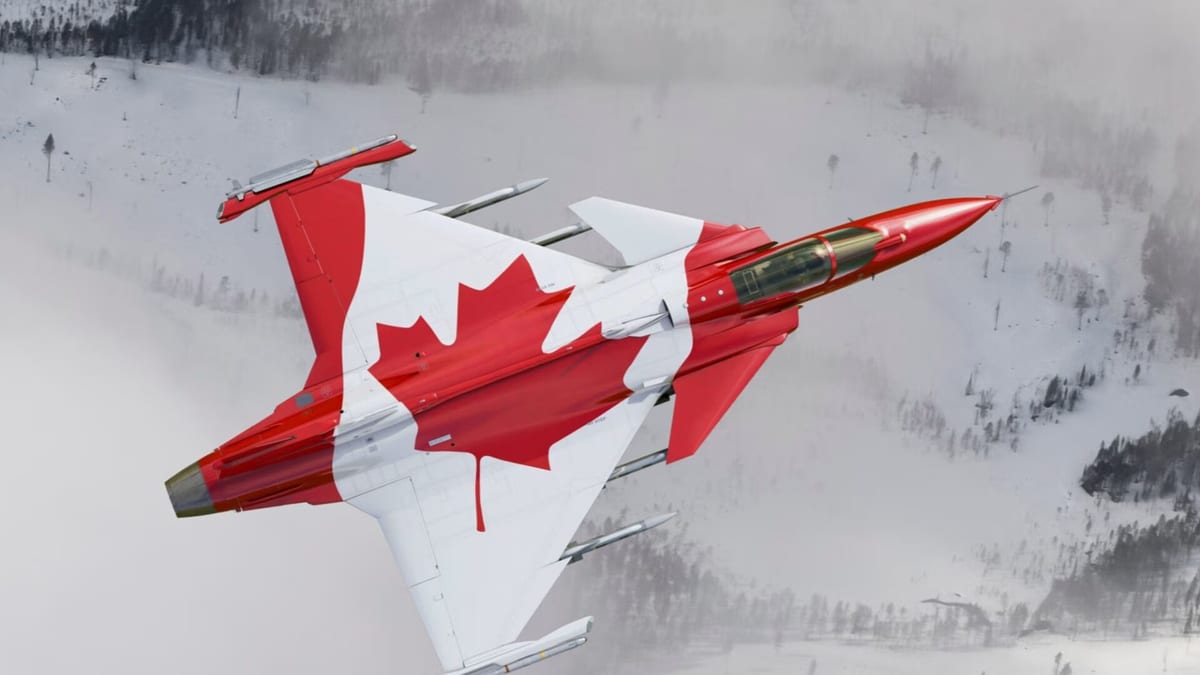
Image by AeroTime
A Fresh Timeline in Canada’s Fighter Debate
Recent coverage of Saab chief executive Micael Johansson’s remarks indicates that the company believes an initial Gripen for Canada could be delivered in as little as three years, with a broader window of up to five years once a final agreement is in place. The proposed schedule would depend on how quickly Ottawa moves from exploratory talks to a concrete contract for the aircraft.
These comments arrive as Canada reassesses its long-running plan to field the U.S.-built F-35 as its primary fighter, a program that has faced questions over cost, industrial participation and delivery pacing. Publicly available information suggests Ottawa is exploring options for a mixed fleet or complementary platform to ease pressure on its aging CF-18 Hornets while maintaining commitments to NATO and continental defence.
The suggested three to five year delivery horizon positions Gripen as a relatively rapid option among advanced fighters, especially if early aircraft are built on existing Saab production lines in Sweden or Brazil before any Canadian assembly facility is fully established.
Analysts following the file note that such a timeline would place the first Canadian Gripen arrivals broadly in line with, or slightly ahead of, some of the F-35 deliveries currently being discussed in open sources, a comparison that is likely to feature prominently in political and military assessments.
What the Gripen Offer Would Mean for Canadian Industry
Beyond delivery dates, Saab has presented Gripen as a gateway to a substantial onshore aerospace footprint. Previous public proposals linked to Canada’s earlier fighter competition highlighted full or partial assembly in Canada, extensive technology transfer, and long-term maintenance and upgrade work carried out by local firms.
Recent reporting on Johansson’s latest comments indicates that, if a Canadian facility is established, locally manufactured Gripen aircraft could start leaving the production line in roughly three to five years. That schedule would parallel or closely follow the arrival of the first jets built overseas, potentially turning Canada into a secondary production hub for future orders or upgrades.
Saab representatives in earlier public forums have suggested that such an arrangement could sustain thousands of skilled jobs in areas such as aerostructures, avionics integration, and systems support. For aerospace clusters in Quebec, Ontario and Western Canada, a Gripen line could represent a new anchor program at a time when civil aviation markets are still adapting to post-pandemic realities.
For federal decision-makers, the industrial package is likely to be weighed alongside operational needs. Any final agreement would have to mesh with export control rules, existing partnerships with U.S. and European suppliers, and Canada’s desire to deepen its role in defence supply chains serving both NATO and Ukraine.
How Gripen Fits Canada’s Strategic and Operational Needs
The Gripen E variant under discussion is a modernized evolution of Saab’s multi-role fighter, designed to operate from dispersed bases, handle harsh climates and integrate a wide range of sensors and weapons. Public technical data emphasizes its relatively low operating cost and shorter runway requirements, attributes that could appeal to a country with vast northern territories and a network of remote airfields.
According to open-source assessments, Gripen’s design philosophy prioritizes high sortie rates and ease of maintenance, with a focus on quick turnaround and smaller ground crews. This approach is seen by some commentators as a potential advantage for an air force that has faced persistent personnel and sustainment challenges.
At the same time, public debate inside Canada continues to focus on the importance of stealth, deep integration with U.S. forces and advanced sensors, areas where the F-35 is often described as having an edge. Some defence analysts argue that any second fighter type would have to justify its added training and logistics burden by offering clear benefits in cost, availability, or industrial returns.
The prospect of training pilots and technicians on two different advanced platforms has raised questions in commentary from current and former personnel. If Gripen were added as a complementary fleet, the Royal Canadian Air Force would need to manage parallel transition programs while sustaining readiness on existing aircraft.
Implications for Alliances, Ukraine and Future Cooperation
Johansson’s recent statements have also been framed within a wider discussion about allied support to Ukraine and the future of European airpower. Public reporting indicates that Saab and Swedish officials have explored the idea of expanding Gripen production capacity, potentially including Canada, to help meet growing demand from European partners.
Some analysts suggest that a Canadian Gripen line could eventually build aircraft or key components destined not only for the Royal Canadian Air Force but also for export customers, particularly in Europe and Latin America. That possibility would align with Ottawa’s stated interest in using defence procurement to reinforce both NATO’s eastern flank and broader transatlantic cooperation.
For Canada’s tourism and travel sectors, any decision to anchor a major fighter production site in the country could have indirect effects. Large defence programs typically bring an influx of international engineers, test crews and supplier representatives, supporting higher demand for business travel, long-stay accommodation and conference facilities in host cities.
In addition, if Gripen becomes a regular presence at Canadian air bases and air shows, it could further raise the country’s profile as a destination for aviation enthusiasts. Events built around new aircraft types often attract visitors from abroad, benefiting local hotels, restaurants and regional airports.
What Comes Next in Ottawa’s Decision Process
For now, the Gripen discussion remains one element in a broader reassessment of Canada’s defence investments. Public comments from Swedish and Canadian officials in recent months describe the talks as intensive but stop short of confirming a formal selection or contract.
Observers expect that any move toward a Gripen purchase would be shaped by several factors, including costed proposals from Saab, updated lifecycle estimates for the F-35 fleet, and evolving threat assessments linked to the Arctic, the North Atlantic and commitments in Europe and the Indo-Pacific.
Should Canada decide to proceed, the next visible milestones would likely include a government announcement outlining the chosen aircraft mix, the scale of industrial participation and a provisional delivery schedule. That would be followed by more detailed implementation plans covering training pipelines, base infrastructure upgrades and integration into binational defence arrangements with the United States.
Until then, Johansson’s assertion that a first Gripen could arrive within five years offers a clearer benchmark for how quickly Canada might add a new fighter type to its fleet, and sets the stage for a high-stakes debate on the future shape of its airpower and aerospace industry.