

More news on this day
Sabre has used ITB Berlin 2026 to unveil what it describes as a once-in-a-generation rebuild of its business, debuting a unified AI-first platform and refreshed brand identity that signal a decisive break from legacy travel technology architectures.
Get the latest news straight to your inbox!
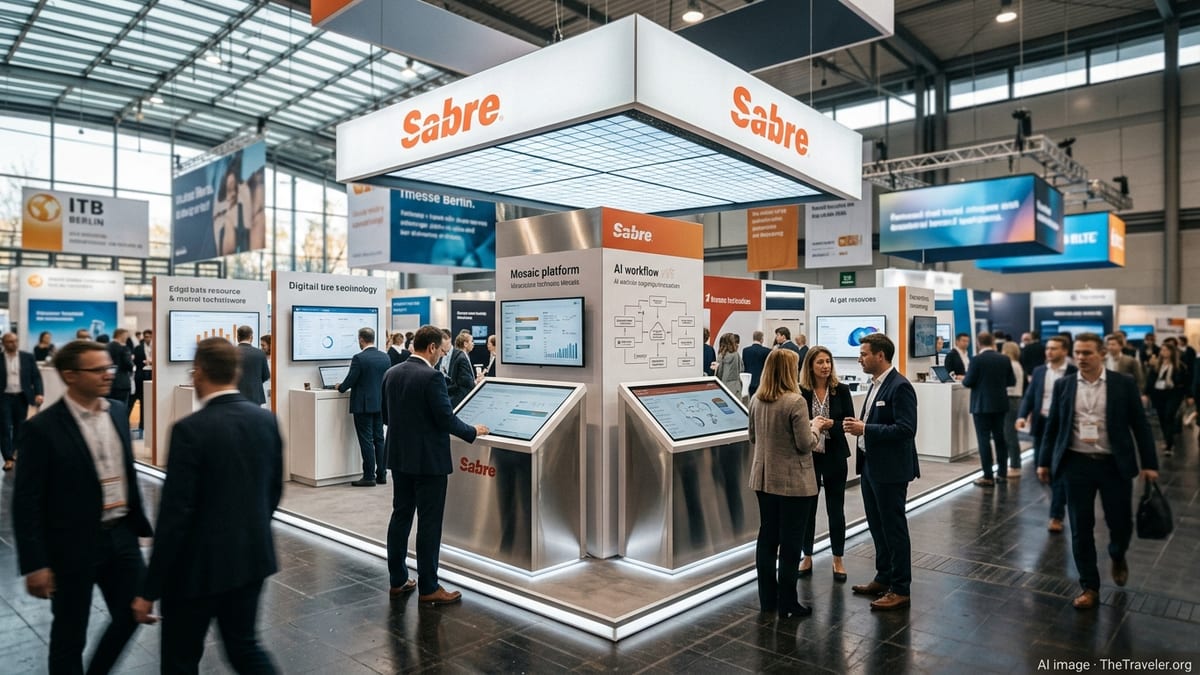
A Multiyear Rebuild Culminates on ITB’s Global Stage
The announcement in Berlin on March 3, 2026 marks the public culmination of a multiyear transformation of Sabre’s technology stack, operating model, and product portfolio. Publicly available information indicates that the company has spent recent years moving core systems to the cloud, re-architecting long-standing code bases, and consolidating fragmented tools into a single platform.
This initiative is framed by the company as a foundational reset rather than an incremental upgrade. The result is the new Sabre Mosaic platform, a high-performance, cloud-native environment designed for continuous deployment and large-scale resiliency. Mosaic sits at the center of Sabre’s claim to be entering what it calls the agentic era, in which travel systems are expected to plan, act, and optimize autonomously across complex workflows.
The timing coincides with ITB Berlin’s own focus on travel technology and artificial intelligence, with Sabre positioned among the major global distribution and tech players drawing attention in the show’s travel technology halls. Demonstrations in Berlin showcase live, production-grade use cases rather than lab experiments, underlining the company’s push to present its rebuild as fully in-market.
Inside Sabre Mosaic: AI-Native Architecture and Travel Data at Scale
At the heart of the ITB announcement is Sabre Mosaic, described in company materials and industry coverage as an AI-native, cloud-based platform that unifies retailing, distribution, and operations capabilities. Instead of discrete systems linked by interfaces, Mosaic is built on a microservices architecture designed to support intelligent retailing, real-time analytics, and autonomous workflows.
Artificial intelligence is positioned as an embedded design principle rather than an add-on. The platform is powered by advanced models from Google’s Gemini family, with AI woven into shopping, pricing, servicing, and disruption management processes. This approach is intended to shift travel technology beyond static request-and-response transactions toward systems that can interpret context, recommend actions, and execute multi-step tasks.
Supporting this is Sabre’s Travel Data Cloud, a governed data environment that reports indicate contains more than 50 petabytes of compliant, contextualized travel data. This data layer underpins personalization, decisioning, and forecasting, enabling the platform to learn from large-scale behavioral and operational patterns while maintaining enterprise-grade controls over access and use.
The company also highlights an orchestration layer that includes a Model Context Protocol server and an assurance framework designed to manage prompts, guardrails, and monitoring for AI-driven workflows. This governance emphasis is intended to reassure airlines, agencies, and corporate buyers that autonomous capabilities can be deployed in live environments with clear accountability.
From Legacy GDS to Agentic Travel: Strategic Shift in Positioning
Sabre’s unveiling at ITB Berlin 2026 is also a repositioning moment. Public coverage emphasizes that the company is seeking to redefine itself from a traditional global distribution system provider into a broader AI-first travel technology backbone. The concept of “agentic travel” sits at the center of this shift, referring to software agents capable of handling complex tasks such as itinerary building, trip servicing, and offer optimization.
In this model, human travel agents and corporate travel managers are increasingly supported by autonomous digital counterparts that can assemble content from multiple providers, run scenario analyses, and respond dynamically to changes such as disruptions or pricing shifts. Sabre’s APIs and orchestration tools are being marketed as the infrastructure that allows travel sellers, airlines, and new entrants to build their own agentic applications on top of Mosaic.
This repositioning is reflected in a new visual identity, including a refreshed logo and design system that appear prominently across Sabre’s ITB Berlin presence. The updated brand language emphasizes openness, modularity, and speed, aligning the company more closely with cloud-native software players than with legacy transaction-processing utilities.
Analyst commentary around the show notes that this transformation arrives amid intense competitive and investor pressure as AI agents begin to reshape how travel demand is generated and fulfilled. Sabre’s strategy is to present itself as an enabler of that shift rather than a disintermediated casualty of it.
Financial Restructuring and Operational Readiness
The once-in-a-generation technology rebuild has taken place alongside an extensive financial and operational restructuring. According to investor-facing materials and business press coverage, Sabre has used portfolio adjustments, debt management, and targeted cost reductions to fund the modernization while aiming to improve its balance sheet.
These efforts have reportedly included workforce realignment to prioritize cloud engineering, data science, and AI-focused roles. The company indicates that engineering capacity has increased, supporting faster product cycles and a greater cadence of feature releases on the Mosaic platform.
With the core rebuild now presented as complete, Sabre is describing its current phase as one of value creation. That includes a sharper focus on monetizing AI-enabled capabilities, expanding attach rates for analytics and decisioning tools, and deepening wallet share with key airline, hotel, and agency customers.
Industry observers at ITB Berlin 2026 are closely watching how this strategy translates into measurable performance, including platform adoption, reliability metrics, and revenue growth in AI-driven products. The extent to which large carriers and global travel management firms standardize on Mosaic will be an important indicator of how successful Sabre’s repositioning proves over the next several years.
Partnerships, Live Use Cases, and Competitive Implications
The ITB Berlin showcase also highlights how Sabre is using partnerships to reinforce its AI-first narrative. Coverage of the announcement points to collaborations with payment providers, AI-native travel startups, and airlines that are already piloting or scaling agentic workflows on Mosaic.
Travel sellers are being shown scenarios such as end-to-end automated trip building, conversational servicing powered by large language models, and predictive disruption handling that can reroute travelers before irregular operations cascade. These examples are designed to illustrate how Sabre’s platform can help customers reduce manual workloads, improve conversion, and raise traveler satisfaction.
For the wider travel ecosystem, Sabre’s move effectively raises the competitive bar for technology suppliers. Other global distribution and tech players are also racing to reposition around AI and microservices, but Sabre’s decision to frame its work as a wholesale rebuild rather than a gradual upgrade underscores the pace at which the distribution and retailing landscape is changing.
As ITB Berlin 2026 places technology in the spotlight, Sabre’s once-in-a-generation overhaul serves as both a signal and a test case for how deeply artificial intelligence will reshape the infrastructure behind global travel in the years ahead.