

More news on this day
South African carrier Safair has emerged as the Middle East and Africa region’s on-time performance champion for 2025, outpacing heavyweight rivals including Saudia, Qatar Airways, Etihad Airways, Kuwait Airways and Flyadeal to set a new operational reliability benchmark for the year.
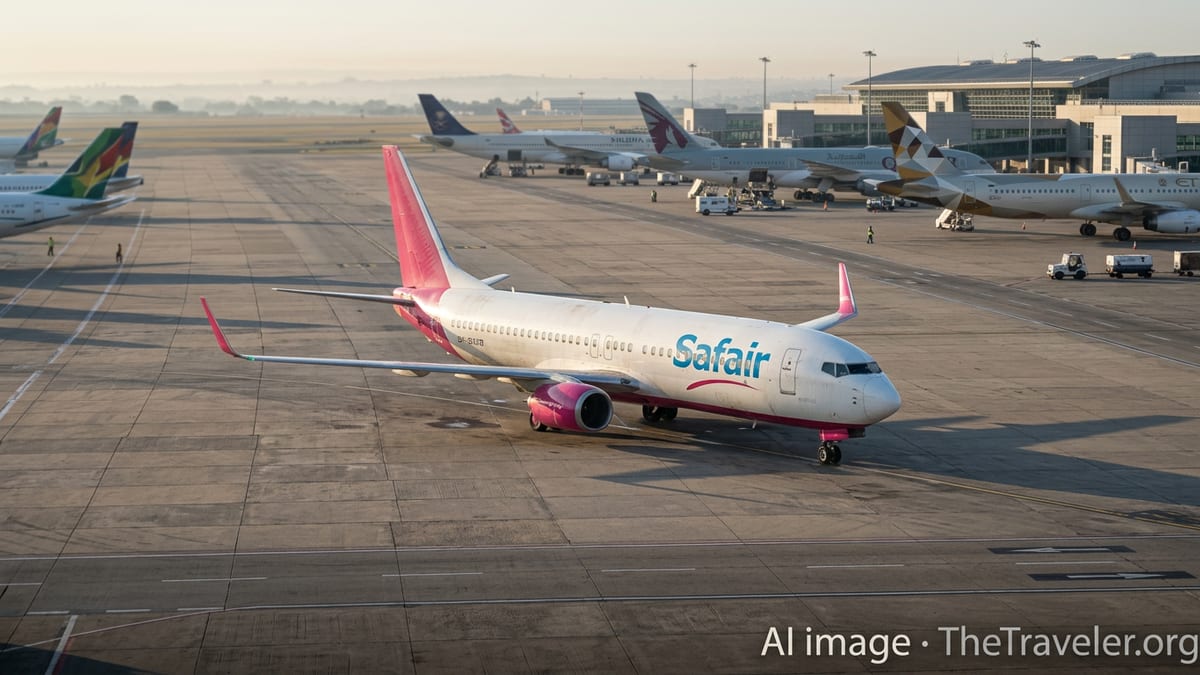
Regional Leader in a Punctuality Race
The latest Cirium On-Time Performance Review for 2025 places Safair at the top of the Middle East and Africa rankings, with an on-time arrival rate just above 91 percent across more than 60,000 flights. That score edges out regional competitors such as Royal Jordanian and Flyadeal and underscores the consistency of the South African operator’s performance on some of the continent’s busiest and most delay-prone routes.
Safair’s regional victory comes against a backdrop of improving punctuality among Gulf and African carriers. Airlines such as Qatar Airways, Etihad Airways and Saudia have all invested heavily in schedule discipline and operational control, helping lift the broader region’s reliability metrics. Yet the 2025 data shows Safair converting those ambitions into measurable outcomes more effectively than its peers, especially on dense short-haul networks.
Analysts note that Safair has built on momentum from the 2024 review, when its low-cost unit FlySafair was already singled out as the most on-time airline in the Middle East and Africa. Maintaining that leadership into 2025, and extending the gap over traditional full-service rivals, strengthens South Africa’s profile as a hub for dependable regional air travel.
How Safair Pulled Ahead of Gulf Heavyweights
Behind Safair’s headline figure is a series of operational decisions designed to keep aircraft, crews and passengers moving despite infrastructure and weather challenges. Industry data shows that in multiple 2025 monthly reports, Safair regularly posted on-time arrival rates in the mid-90 percent range, even as congestion and airspace disruptions affected carriers across the broader region.
By contrast, large network airlines such as Saudia, Qatar Airways and Etihad Airways faced more complex operational environments. Their vast long-haul networks expose them to ripple effects from storms, air traffic control restrictions and geopolitical diversions that can cascade across multiple regions. Even when these carriers report strong punctuality by global standards, the relative simplicity and tight focus of Safair’s route map have allowed the South African carrier to convert operational discipline into a higher overall on-time score.
Safair’s performance is particularly notable given that many of its flights operate from Johannesburg and Cape Town, airports that have seen rising traffic as post-pandemic demand recovers. While Gulf hubs have invested heavily in capacity and technology, South African operators have had to extract reliability gains from existing infrastructure, putting more emphasis on fast turnarounds, robust maintenance planning and disciplined ground handling.
Low-Cost Model, High-Reliability Expectations
Safair’s ascent has also reshaped expectations around low-cost carriers in the Middle East and Africa. Historically, passengers in the region associated low fares with limited schedule reliability. The 2025 rankings disrupt that perception, with Safair not only leading budget rivals such as Flyadeal but also eclipsing the on-time records of several full-service flag carriers from the Gulf and North Africa.
The airline’s strategy leans on a standardized narrow-body fleet, which simplifies maintenance and crew rotations, while high aircraft utilization is balanced by conservative scheduling and buffers for peak congestion periods. Industry observers say these choices have enabled Safair to absorb typical day-of-operation disruptions, from late inbound aircraft to weather-related delays, without significant knock-on effects to later departures.
For time-sensitive travelers on key business and leisure routes within South Africa and to nearby regional destinations, punctuality has become a core part of Safair’s value proposition. Travel agents report that corporate clients increasingly request performance data when selecting preferred carriers, and Safair’s 2025 showing gives it a compelling selling point against better-known Middle Eastern brands on overlapping markets.
Raising the Bar for Middle Eastern and African Carriers
Safair’s outperformance is resonating beyond South Africa’s borders, putting pressure on other Middle Eastern and African airlines to reexamine their own operational strategies. Regional rankings that place Safair ahead of Saudia, Qatar Airways, Etihad Airways and Kuwait Airways have sharpened focus on metrics such as block-to-block times, schedule padding and turnaround efficiency.
Executives at rival airlines are publicly emphasizing ongoing investments in integrated operations centers, data-driven disruption management and improved coordination with airport partners. The goal is not only to climb the punctuality tables but also to reassure passengers that reliability is central to the region’s aviation growth story, particularly as carriers add new routes linking Africa, the Gulf and Europe.
Industry analysts suggest that Safair’s success could spur closer collaboration between African and Middle Eastern hubs on air traffic flow management and ground operations. With airspace congestion and weather disruption unlikely to ease in the near term, airlines that match Safair’s focus on precise execution and rapid recovery from irregular operations are expected to be best placed to win high-yield business and connecting traffic.
Implications for Travelers and the 2025 Travel Season
For passengers, Safair’s 2025 performance offers a practical takeaway: in a region where schedule disruptions still feature regularly in traveler complaints, carrier choice can significantly affect the likelihood of arriving on time. Frequent fliers on South African domestic trunk routes and select regional services are increasingly factoring punctuality rankings into booking decisions, alongside fare and onboard product.
The broader Middle East and Africa market is also becoming more transparent. Regular publication of comparative on-time statistics has created a form of league table for reliability, turning punctuality into a competitive differentiator rather than a back-office metric. Safair’s lead in 2025 has elevated the profile of these reports among both consumers and corporate travel managers.
As airlines finalize schedules for the peak 2025–26 travel season, Safair’s example is likely to influence how capacity is deployed, how turnaround times are planned and how contingency resources are allocated. If rivals succeed in narrowing the gap, the region could see a virtuous cycle in which carriers compete not only on price and product, but also on the simple promise of getting passengers where they are going, when they were told they would arrive.