

More news on this day
Across the Himalayan arc, from Uttarakhand and Sikkim to Nepal, Bhutan and northern Pakistan, a mounting cascade of climate shocks and unrestrained development is forcing governments and regional bodies to reconsider how to safeguard one of the world’s most fragile mountain systems.
Get the latest news straight to your inbox!
High-Level Attention on a Warming “Third Pole”
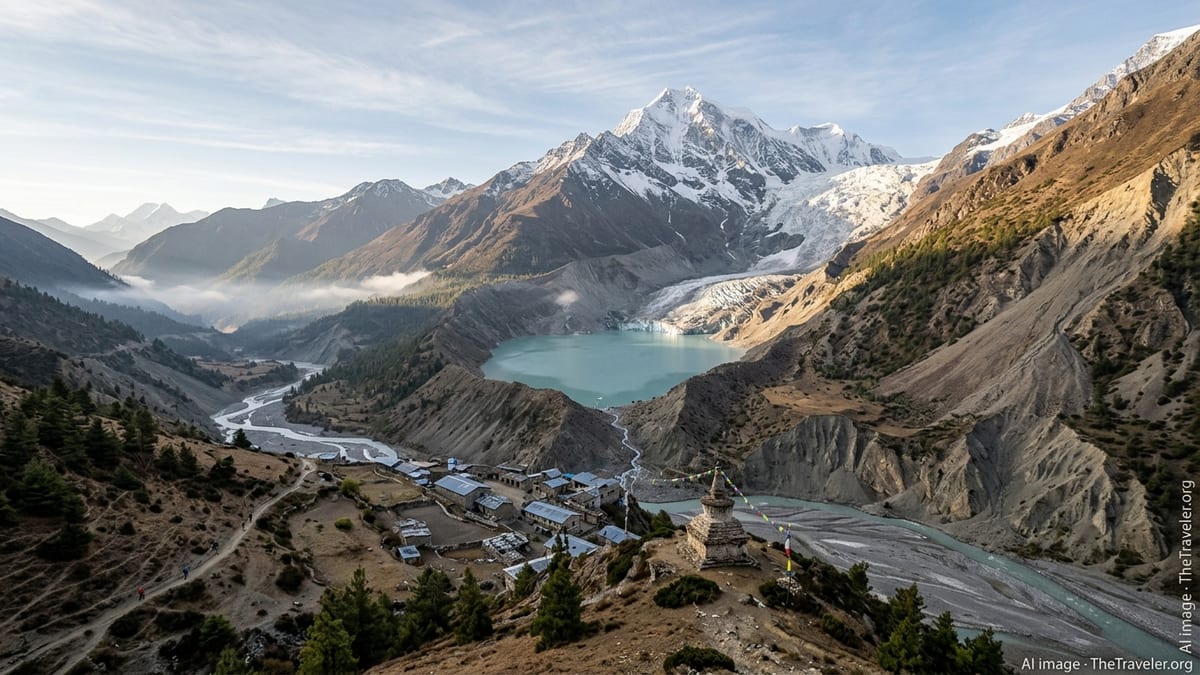
Recent regional gatherings on mountain sustainability, including a high-level roundtable held alongside conferences on resilient Himalayan settlements, have sharpened the focus on what is at stake in the world’s so-called Third Pole. Publicly available information from these forums highlights a shared concern: rapid glacier retreat, expanding glacial lakes and more volatile weather patterns are converging with dense human settlement and growing tourism in ways that are intensifying risk.
Scientific assessments presented in these discussions describe warming rates in the Himalaya and Karakoram that significantly outpace the global average. A study in a leading natural hazards journal reported accelerated glacier mass loss and widespread formation of new and enlarged glacial lakes, warning that glacial lake outburst floods, or GLOFs, could become several times more frequent across the Hindu Kush Himalaya by the end of the century.
Regional development agencies and research centers are using these findings to argue for a coordinated policy response that links climate adaptation, disaster risk reduction and sustainable tourism. They point out that the Himalayan watershed underpins the water, food and energy security of hundreds of millions of people downstream, meaning local failures of resilience can carry far-reaching consequences.
Statements from multilateral organizations and national planning bodies suggest that the emerging consensus from the high-level roundtable and related meetings is clear: the costs of inaction on Himalayan sustainability will be measured not only in lost lives and infrastructure but also in long-term regional instability.
Climate Disasters Redraw the Himalayan Risk Map
In recent years, the Himalayan region has seen a string of destructive events linked to glacier dynamics and extreme precipitation, underscoring the urgency of the issues raised at the roundtable. In India’s Sikkim state, a glacial lake breach in October 2023 sent a surge of water and debris down the Teesta River, damaging hydropower facilities and washing away critical road links. In Nepal, a 2024 event in Thame village in the Everest region destroyed homes, guesthouses and local infrastructure after the sudden failure of glacial lakes high above the settlement.
Reports from Nepal, India and Pakistan also document flash floods, landslides and cloudbursts that have cut off valleys and disrupted both local livelihoods and tourism flows. In Uttarakhand, repeated high-intensity rainfall and suspected glacial or landslide-related outbursts have damaged roads, bridges and riverside hotels, complicating pilgrim and trekking routes that are economic lifelines for mountain communities.
Technical reviews by climate and disaster specialists indicate that the risk profile is shifting rapidly. Satellite data compiled for government assessments in India show that Himalayan glacial lakes expanded in area by more than 10 percent between 2011 and 2024, enlarging the volume of water stored behind often unstable natural dams. Separate analyses by international research teams suggest that more than 400 glacial lakes across the Hindu Kush Himalaya are now considered potentially dangerous, many in cross-border basins where floods can propagate from one country into another.
These converging lines of evidence are feeding directly into the sustainability debate. Participants in the high-level dialogues have pointed to such events as tangible markers of what unchecked warming and unplanned development mean in practice for the mountains, arguing that disaster response alone can no longer keep pace with the scale of risk.
Tourism, Hydropower and the Development Dilemma
At the same time, the Himalaya is experiencing an intensifying push for economic growth through tourism, hydropower and new infrastructure, creating a complex policy dilemma. Mountain destinations such as Ladakh in India, the Everest and Annapurna regions in Nepal and the Hunza Valley in northern Pakistan have seen a rise in visitor numbers, new roads and a wave of hotels and homestays. Travel and environmental reporting from these areas describes rapid change in land use, increased pressure on scarce water resources and encroachment on flood-prone riverbanks.
Hydropower has become another focal point of the sustainability discussion. In several Himalayan countries, large dams and run-of-river projects are central to national energy and climate strategies. However, recent GLOF and flood events have damaged or destroyed hydropower infrastructure, highlighting the tension between low-carbon energy ambitions and the exposure of assets built in unstable valleys below retreating glaciers.
Planning documents and independent analyses suggest that unregulated construction along river corridors and on steep slopes remains a critical vulnerability. In some Himalayan towns, hotels, shops and new housing have been built directly on alluvial fans and old floodplains, reducing the capacity of rivers to absorb extreme flows. When disaster strikes, losses to the tourism sector can be immediate and severe, with washed-out bridges, blocked trekking routes and damaged cultural sites undermining local economies for years.
According to research cited in the roundtable discussions, the challenge is not development itself but the lack of coherent land-use planning and risk-informed design. The emerging message is that sustainable Himalayan tourism and infrastructure will depend on tighter building standards, enforced zoning in hazard-prone areas and investment in nature-based buffers such as restored forests and wetlands.
Community Resilience and Early Warning
Another strong theme from the high-level exchanges is the need to strengthen community-level resilience, early warning and cross-border data sharing. Assessments by international agencies emphasize that many Himalayan villages and towns still lack reliable multi-hazard early warning systems, particularly for GLOFs and landslide-dammed floods that can travel long distances from remote glacial basins.
Several recent reports highlight efforts to integrate satellite monitoring of glacial lakes, river-stage sensors and community alert protocols, but coverage remains patchy. Case studies from Nepal and Bhutan show that where local authorities and residents have been trained to interpret warnings and maintain evacuation routes, flood events have resulted in fewer casualties, even when infrastructure damage has been extensive.
Experts contributing to the roundtable argue that investment in such systems offers some of the most immediate benefits for Himalayan sustainability. Recommended steps include expanding transboundary hydrometeorological networks, standardizing hazard maps that can be understood by local planners and tourists alike, and ensuring that early warning messages are accessible in local languages and through multiple communication channels.
Resilience strategies discussed at the regional level also stress the importance of preserving and documenting Indigenous and local knowledge. Mountain communities across the Himalaya have long traditions of reading snow, ice and river behavior, as well as customary rules on grazing and construction. Recent flood and landslide events have prompted new initiatives to integrate this knowledge with modern science in school curricula, training programs and settlement planning.
From High-Level Declarations to Action on the Ground
The central test for the high-level roundtable on Himalayan sustainability will be whether its recommendations translate into concrete changes in policy, finance and on-the-ground practice. Observers of past mountain initiatives note that ambitious declarations have often been followed by slow implementation, constrained budgets and fragmented responsibilities among government agencies.
Current policy proposals emphasize the need to embed mountain priorities in national climate plans, disaster risk frameworks and tourism strategies, rather than treating the Himalaya as an isolated environmental concern. Suggested measures include directing climate finance toward mountain-specific adaptation projects, supporting cross-border GLOF risk assessments and incorporating strict environmental safeguards into major road and hydropower schemes.
There is also growing discussion of how travelers, tour operators and investors can play a more constructive role. Responsible tourism guidelines promoted by regional organizations encourage limiting waste, respecting local water constraints and avoiding services that rely on fragile or illegally developed riverbank sites. Financial institutions are being urged by researchers and advocacy groups to conduct more rigorous climate risk screening before backing large-scale infrastructure in hazard-prone valleys.
For now, the Himalaya’s future hinges on whether the new attention generated by scientific warnings and high-level dialogue is matched by sustained, practical action. The mountains are warming quickly, and the window to align development with the realities of a changing cryosphere is narrowing. The choices made in the coming decade will shape not only the resilience of remote high-altitude communities, but also the security of the vast lowland regions that depend on these peaks for water, food and energy.