

Safety is a primary concern for foreigners considering property purchases in Mexico. While national crime statistics remain elevated by global standards, risk levels vary significantly between regions, cities, and even neighborhoods. Understanding these security patterns and how they intersect with property markets is essential for investors and relocating households seeking comparatively safe locations.
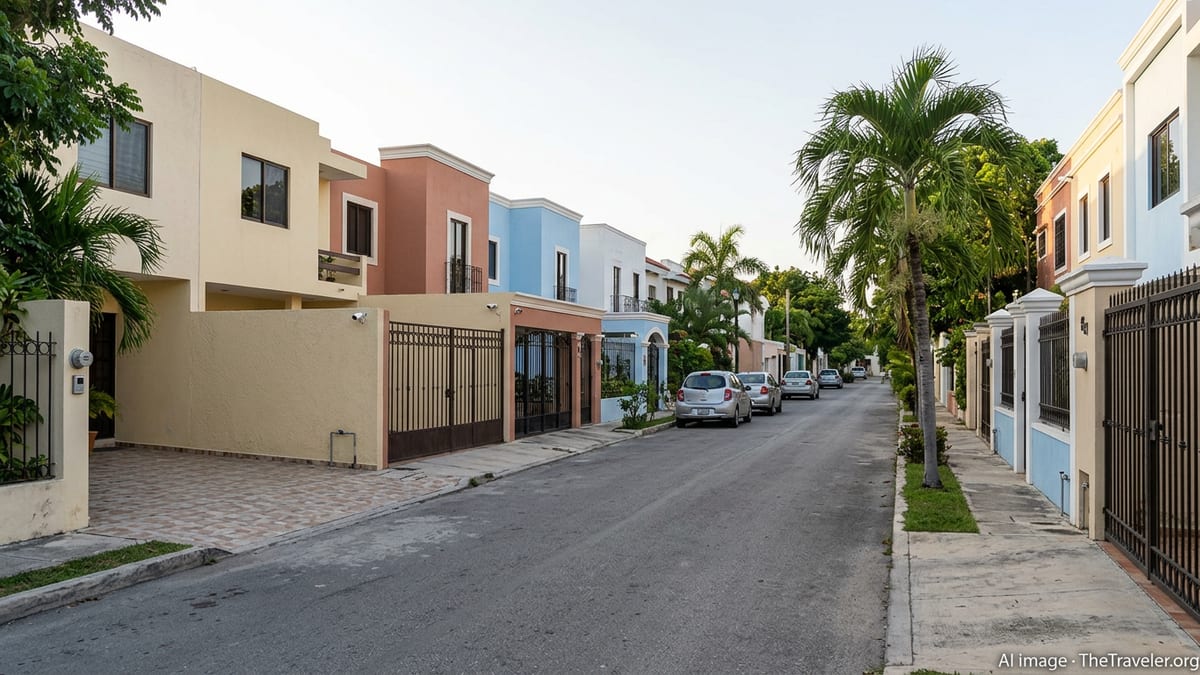
Security Landscape in Mexico for Property Buyers
Mexico’s overall security indicators show gradual improvement but remain a critical factor for relocation and property acquisition decisions. Government data indicates that intentional homicides fell below 30,000 cases in 2023, with a rate close to 25 per 100,000 inhabitants, down from peaks above 30 per 100,000 earlier in the decade. In 2025 authorities reported a further decline to around 17.5 murders per 100,000 inhabitants, the lowest level since 2016, although independent analysts caution that underreporting and impunity can mask local realities.
The key point for foreign buyers is the extreme spatial concentration of violence. A limited number of states and specific corridors linked to organized crime, ports, and trafficking routes account for a disproportionate share of serious violent incidents. By contrast, several interior and southeastern states register homicide rates closer to, or only moderately higher than, those in some higher-crime regions of North America and Europe.
Beyond homicides, victimization surveys suggest that non-lethal crimes such as robbery, extortion, and vehicle theft affect a broad segment of the population. Perception of insecurity remains high in many large urban areas even as homicide rates fall. For property buyers this means that city and neighborhood selection, due diligence, and security design of homes or condominiums matter as much as choosing a generally safer state.
Foreign nationals are rarely direct targets of organized crime, but can be exposed to collateral risks where criminal groups contest territory. The safest strategy is therefore to prioritize states and municipalities with consistently lower violent crime rates, robust local governance, and mature residential markets where foreign ownership is well established.
How Safety Risk Intersects with Foreign Property Ownership Rules
Mexico’s Constitution establishes a restricted zone for foreign ownership that extends approximately 50 kilometers from any coastline and 100 kilometers from international borders. Within this strip foreigners generally purchase residential property via a bank trust structure rather than holding title directly, while outside it they can own land in fee simple. This legal framework exists independently of security conditions, but it shapes where foreign demand tends to cluster.
Many of the most popular resort and coastal markets for foreigners, such as parts of Quintana Roo and Baja California Sur, lie inside the restricted zone. These areas mix relatively secure tourist and residential enclaves with higher-risk logistics corridors that can attract organized crime disputes. Buyers in these locations must assess local urban security, condominium security measures, and municipal crime levels rather than assuming that a popular beach area is automatically low risk.
In contrast, several of the safest medium and large cities based on homicide and victimization data are inland and fall outside the restricted zone. Here, foreigners can generally own property directly, and many central and southeastern cities combine improved security metrics with established middle-class and upper-middle-class neighborhoods that cater to both domestic professionals and expatriates.
Foreign property buyers should therefore think of “safest places” not only as entire states or cities but as the overlap between three elements: comparatively low violent-crime rates, clear and functional property ownership mechanisms for foreigners, and local housing submarkets with a track record of foreign or out-of-state buyers.
States and Cities with Strong Security Profiles
Although exact rankings fluctuate year by year, several states consistently appear among the safest in Mexico when measured by low homicide rates and stronger peace index scores. Recent analyses of crime rates show Yucatán at the bottom of the national homicide table with roughly 2 to 3 murders per 100,000 inhabitants, far below the national average. Other frequently cited lower-risk states include Querétaro, Aguascalientes, Campeche, and parts of Coahuila and Durango, which report homicide rates in the low to mid single digits or low double digits per 100,000 residents, depending on the year.
Within these states, specific cities stand out as comparatively secure environments for foreign property purchases. Mérida, the capital of Yucatán, is widely recognized as one of the safest large cities in Mexico and has been acknowledged in international evaluations for its public security and urban management. Querétaro City and Aguascalientes City similarly exhibit lower violent-crime rates than national averages, with functioning local institutions and expanding professional classes that support stable residential markets.
Property buyers often focus on medium-sized cities where security indicators, economic diversification, and infrastructure combine. Examples include Mérida in Yucatán, Querétaro in Querétaro state, Aguascalientes in Aguascalientes state, and selected municipalities in Campeche, Coahuila, and Durango. These locations typically feature planned residential developments, gated communities, and condominium complexes designed for middle- and upper-income households, which can incorporate controlled access and private security arrangements that further mitigate day-to-day risk.
Even in safer states, security can change street by street. Buyers should therefore cross-check state-level data with municipal crime statistics, local perception-of-safety surveys, and on-the-ground observations, and should obtain legal and security due diligence before committing to a purchase.
Comparative Overview of Safer vs Higher-Risk Regions
National averages conceal stark differences between Mexico’s safest and most violent states. In recent years the national homicide rate has hovered in the mid-20s per 100,000 inhabitants. Yet some states linked to intense organized-crime competition recorded rates five or more times higher than the national average, while the safest states reported rates ten times lower than the worst performers. This dispersion has direct implications for risk exposure of residential property owners.
A simplified comparison can be expressed as follows:
Safer-profile states typically include Yucatán (around 2 to 3 homicides per 100,000), Querétaro, Aguascalientes, Campeche, and some northern interior states that record single-digit or low double-digit rates. These areas see less frequent large-scale criminal confrontations, and serious incidents are often more isolated. By contrast, states such as Colima and Guanajuato have recently posted homicide rates or totals far above the national average, reflecting persistent conflicts over ports, fuel theft, and trafficking routes.
For foreign buyers this does not mean that all property in higher-risk states should be avoided. Some cities and neighborhoods in those states maintain relative stability and offer secure gated communities, while particular corridors even in safer states can face targeted criminal disputes. However, the margin of error is narrower in high-violence states, and due diligence must be significantly more intensive. Buyers who prioritize safety above other considerations usually find more predictable conditions by concentrating their search in the safest quartile of states.
It is also notable that some coastal resort corridors with strong foreign demand exist within states that have mixed or deteriorating security records. In such cases, buyers need to distinguish between protected tourist-residential zones with strong local policing and private security, and peripheral areas where organized crime operates more openly. Purchase decisions should be anchored in the specific security configuration of the municipality and the immediate neighborhood, not the marketing profile of the region.
City-Level Examples of Relatively Safe Property Markets
Mérida in Yucatán illustrates how a strong security profile can underpin a growing property market targeted at both domestic and foreign buyers. The city benefits from one of the lowest violent-crime rates among Mexican state capitals and has been recognized in international indices for its quality of life and public security. Residential development has expanded toward the north of the city and along ring-road corridors, with a concentration of gated communities and condominium complexes that integrate controlled access and private security services.
Querétaro City offers another example of a comparatively safe environment. The state’s peace indicators place it among the better performers nationally, and the capital has gained a reputation for orderly growth, industrial diversification, and relatively low violent-crime levels compared with many central Mexican cities. Residential projects in the metropolitan area range from vertical condominiums to planned subdivisions, often with enclosed perimeters and professional security arrangements, which appeal to both domestic professionals and foreign buyers seeking risk mitigation.
Aguascalientes City similarly ranks among Mexico’s more secure mid-sized capitals, supported by a diversified industrial base and smaller population. Its homicide rates are typically well below the national average, and victimization surveys often reflect lower levels of fear of crime than in larger metropolitan areas. The property market includes established residential neighborhoods and more modern gated developments, which can offer an additional layer of security for owners who spend part of the year abroad.
Other smaller or less publicized cities in states like Campeche, Coahuila, and Durango combine relatively low violent-crime rates with modest but stable property markets. These locations may not have the same international name recognition as beach destinations, but they can provide a favorable security-to-price balance for buyers primarily interested in safety and asset preservation rather than tourism-linked rental income.
Risk Considerations in Popular Coastal and Tourist Markets
Many foreigners look first at coastal cities and resort areas when considering property purchases in Mexico. Security conditions in these markets vary widely. Some coastal cities lie in states with moderate or high homicide rates but maintain relatively well-controlled tourist and residential zones. Others have seen spikes in violence linked to organized crime disputes, sometimes spilling into or near areas frequented by visitors and foreign residents.
In markets of this type, the relevant safety question is highly localized: not “Is the state safe?” but “How secure is this specific neighborhood and condominium project?” Within a single metropolitan area, one gated community might have professional security, strong building management, and low reported incidents, while another suburb or peri-urban zone faces frequent robberies or occasional targeted attacks related to criminal activity.
Potential buyers in coastal or tourist-oriented markets should place particular emphasis on the following factors: presence of 24/7 controlled access and perimeter security for the building or subdivision, quality of lighting and urban infrastructure around the property, ease of access to main roads and police or security services, and historical patterns of violence in the municipality. They should also be aware that some resort corridors rely heavily on private security arrangements to compensate for limited public policing resources.
Where a coastal city lies within a state with persistently high homicide rates or recurrent organized-crime confrontations, even well-secured developments can be affected indirectly, for example through sporadic road blockades, extortion pressures on local businesses, or reputational shocks that affect property liquidity. Investors whose primary objective is personal safety and long-term security may therefore prefer inland cities in safer states and view coastal properties mainly as higher-risk, higher-reward options.
Practical Safety Criteria When Selecting a Property
Irrespective of the region, foreign buyers can apply a structured set of safety criteria when evaluating potential properties. At the state level, approximate homicide rates and peace index rankings provide a first filter. Prioritizing states with single-digit or low double-digit homicide rates per 100,000 inhabitants generally translates into a lower baseline risk environment compared with states that exceed 40 or 50 per 100,000.
At the city and neighborhood level, buyers should review municipal crime statistics where available, focusing on trends in violent crimes, robberies, and vehicle theft. Perception-of-safety surveys conducted by national statistical agencies can provide additional insight into how residents experience everyday security, complementing official incident reports that may be affected by underreporting.
For the individual property, key indicators include whether the building or subdivision has controlled access, professional private security, working CCTV systems, and clear visitor protocols. The immediate surroundings should be assessed for lighting, street activity patterns, and signs of abandonment or informal occupation. Buildings with active homeowner associations or professional management firms tend to maintain security infrastructure more reliably over time.
Finally, foreign buyers should engage local legal and security professionals to conduct due diligence not only on land title and permits but also on neighborhood risk. Local experts can flag recent incidents, emerging crime patterns, and any history of extortion or encroachment affecting nearby businesses or developments. This type of granular intelligence often proves more relevant for personal safety than national-level crime headlines.
The Takeaway
Mexico presents a complex security environment for foreign property buyers, characterized by high national crime indicators coexisting with pockets of relative safety. The safest options for foreigners seeking to buy property tend to lie in states such as Yucatán, Querétaro, Aguascalientes, and selected parts of Campeche, Coahuila, and Durango, where homicide rates and organized-crime activity are substantially lower than the national average.
Within these safer states, medium and large cities like Mérida, Querétaro City, and Aguascalientes City offer structured residential markets, functioning institutions, and neighborhoods where private and public security measures align to reduce day-to-day risks. In coastal and tourist markets, safety is more fragmented, and buyers must evaluate individual developments and neighborhoods with particular care.
Decision-grade assessment should combine macro-level indicators with detailed local intelligence and on-site evaluation. By focusing on states and cities with consistently favorable security metrics, scrutinizing neighborhood-level crime patterns, and prioritizing properties with robust physical security features, foreign buyers can substantially mitigate safety risks while acquiring real estate assets in Mexico.
FAQ
Q1. Is buying property in Mexico generally safe for foreigners from a security perspective?
Buying property in Mexico can be reasonably safe for foreigners who focus on lower-crime states and secure developments, but national crime levels remain elevated and due diligence is essential.
Q2. Which Mexican states are considered safest for foreign property buyers?
States such as Yucatán, Querétaro, Aguascalientes, Campeche, and parts of Coahuila and Durango are often cited as having comparatively low homicide rates and more stable security conditions.
Q3. Are inland cities safer than coastal resort areas for buying property?
Many inland cities in safer states show better overall security indicators than some resort areas, but conditions vary by municipality and neighborhood, so specific local analysis is required.
Q4. How safe is Mérida for foreign property ownership?
Mérida is widely regarded as one of Mexico’s safest large cities, with low violent-crime rates and a growing residential market that includes numerous gated communities and condominiums.
Q5. What security features should foreigners prioritize when choosing a property?
Key features include controlled access, 24/7 security staff, CCTV coverage, good external lighting, clear visitor protocols, and active building or homeowners’ associations that maintain these measures.
Q6. Do gated communities significantly improve safety for property owners?
Gated communities often reduce opportunistic crime through access control and private security, but they do not eliminate wider regional risks such as road blockades or organized-crime incidents in surrounding areas.
Q7. How important are state homicide rates when deciding where to buy?
State homicide rates are a useful first filter, as states with single-digit or low double-digit rates per 100,000 residents typically offer a safer baseline environment than those with much higher rates.
Q8. Can popular tourist destinations still be high-risk areas for property buyers?
Yes, some tourist destinations lie in states with high levels of organized crime, and while specific hotel or residential zones may be well protected, nearby areas can experience serious violence.
Q9. How can foreign buyers obtain reliable local security information?
Foreign buyers should combine official crime statistics with advice from local legal and security professionals, reputable real estate advisors, and, when possible, direct observation during extended visits.
Q10. Are foreigners specifically targeted by organized crime in Mexico?
Foreigners are not typically primary targets of organized crime, but they can be exposed to collateral risks in high-conflict areas, so choosing safer states and secure neighborhoods is critical.