

More news on this day
A powerful combination of Saharan dust and storm Erminio is wreaking havoc across parts of Greece this week, turning skies an eerie red and triggering widespread flight disruption that is stranding visitors at key holiday gateways.
Get the latest news straight to your inbox!
Red Skies Over Crete as Erminio Intensifies Saharan Dust
The most dramatic scenes have been reported on the island of Crete, where a dense plume of African dust swept in on Wednesday, 1 April, casting cities such as Heraklion, Chania and Rethymno in an otherworldly orange and red haze. Publicly available images and videos show visibility dropping sharply as the storm front associated with Erminio pulled fine Saharan particles north over the eastern Mediterranean.
Local coverage describes the atmosphere as suffocating, with dust concentrations so high that nearby hills and even coastal landmarks disappeared from view. Residents and visitors alike reported the sky taking on deep, Martian tones by late afternoon, with street lighting and vehicle headlights glowing against a thick, rust-colored backdrop.
Meteorological summaries of the 2025–26 European windstorm season indicate that Erminio was named at the end of March and has been driving strong southerly winds across southern Europe, creating ideal conditions for large dust intrusions into Greece. Combined with unsettled weather and thunderstorms, the system has produced a volatile mix of low cloud, turbulence and poor visibility right at the start of the spring travel period.
Health advisories from previous dust episodes in the region are being echoed again, with vulnerable groups urged to limit outdoor activity when particle levels spike. For visitors arriving from cooler northern climates, the contrast between holiday expectations and the reality of gritty air and dim, red light has been especially stark.
Airports Grapple With Mass Cancellations and Diversions
The most acute travel disruption is centered on Heraklion’s Nikos Kazantzakis Airport, Crete’s main gateway for international tourism. Greek media reports on 1 April detailed a rapid escalation of problems as the dust thickened over the runway approaches, forcing air traffic controllers and airlines to cancel or divert flights.
According to publicly available airport updates, at least nine international and two domestic arrivals were cancelled in the space of several hours, with a comparable number of departures also scrubbed. Additional services were diverted to alternative Greek airports, including Chania on western Crete, Athens and Corfu, as pilots sought clearer conditions for landing.
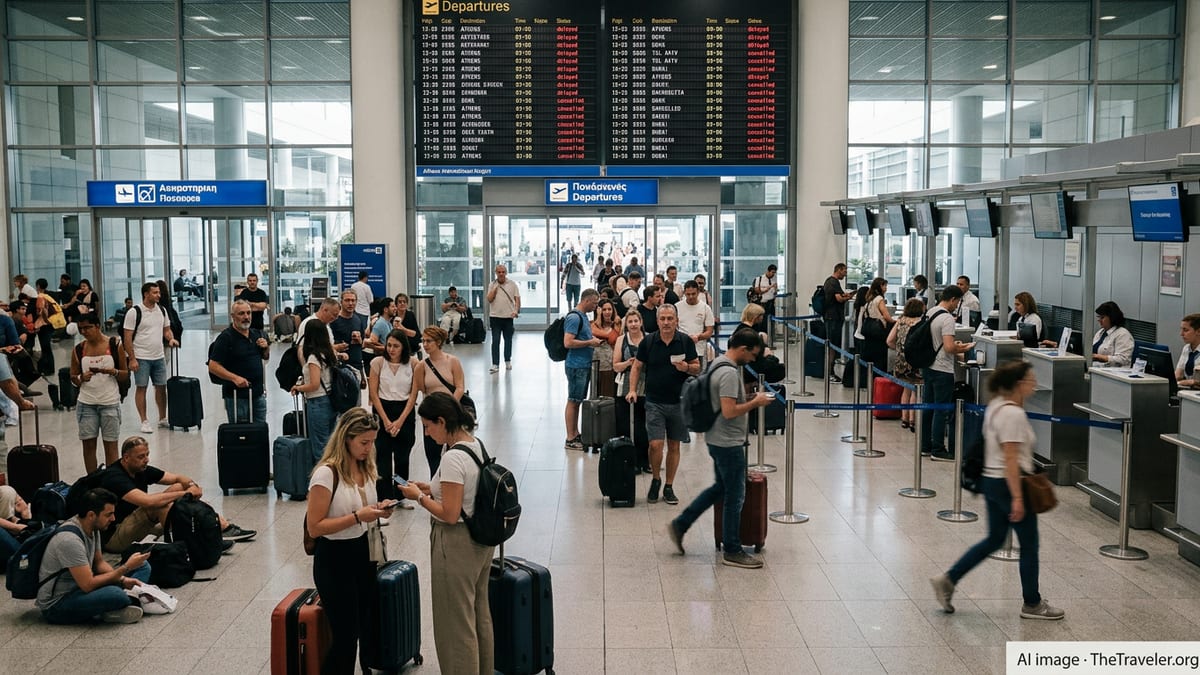
Other coverage of the same events describes long queues forming at service desks as passengers tried to rebook their journeys, while information screens filled with notices of “cancelled” and “delayed.” Some travelers reported being advised to expect overnight stays and to monitor airline announcements closely, as operators reviewed rolling forecast data before releasing updated schedules.
Even where flights managed to operate, airborne diversions extended travel times and complicated onward connections. Routes from major UK and European hubs that would normally land directly on Crete instead touched down at airports hundreds of kilometers away, leaving holidaymakers and Greek residents waiting on new arrangements to complete their journeys to the islands.
From Isolated Dust Events to a Wider Travel Nightmare
While Wednesday’s scenes on Crete have drawn global attention for their dramatic visuals, they follow a broader pattern of turbulence in Greek air travel since the start of 2026. Earlier in January, a technical failure affecting air traffic management systems in parts of Greek airspace prompted a temporary shutdown and a wave of cancellations and delays, especially on routes in and out of northern Greece.
Regional outlets at the time described hundreds of flights affected as radio communication issues forced airlines to pause operations or reroute aircraft around Greek territory. Passengers were urged to contact carriers before heading to airports, and the resulting backlog took many hours to unwind even after systems were restored.
These earlier incidents have amplified the sense of fragility among travelers now facing yet another round of disruption tied to Erminio and the Saharan dust outbreak. Travel forums and social media posts today show visitors comparing experiences of missed connections, lost hotel nights and sudden changes to island-hopping itineraries as weather-related events compound existing operational challenges.
Tourism analysts monitoring reservations into Greece and nearby Cyprus have recently highlighted a rise in booking cancellations and last-minute changes tied to broader regional uncertainty. The latest dust-driven turmoil adds another layer of unpredictability just as airlines and hoteliers attempt to stabilise schedules for the crucial spring and summer seasons.
Heavy Impact on Visitors’ Plans and On-the-Ground Experience
For visitors caught inside airports or already on the islands, the disruption is playing out in multiple ways. Travelers arriving in Heraklion report crowded terminals, with limited seating and long waits at customer service points as staff work through rebooking queues. Those forced into unexpected diversions face uncertainty over luggage transfers, additional transport costs and where to spend the night while they await new flights to Crete.
On the ground, the red-sky conditions themselves are heavily affecting the visitor experience. Tourists who had planned outdoor sightseeing, hiking or beach excursions are instead confronting limited visibility, airborne grit and warnings to avoid strenuous activity in the open air during the worst of the dust episodes. Photographs taken in popular resort areas show familiar landmarks barely discernible behind a thick veil of suspended sand.
Reports from travel communities indicate that some visitors are choosing to cut trips short or postpone inter-island transfers until conditions stabilise. Others are reshaping their time in Greece around indoor activities such as museum visits, culinary experiences and cultural events less exposed to the elements, accepting that typical postcard views of bright blue skies and clear seas are temporarily off the agenda.
The disruption is particularly acute for those traveling with children, elderly relatives or people with respiratory conditions, who may be more sensitive to fine particulate matter. Even where flights continue to operate, concerns about air quality and comfort are prompting some families to defer non-essential journeys until clearer weather returns.
What Travelers to Greece Should Expect in the Coming Days
Forecasts for early April suggest that dust concentrations over Crete and parts of southern Greece may ease intermittently, but further pulses of Saharan material remain possible while Erminio and associated systems continue to influence regional wind patterns. Weather services tracking the storm complex across the Mediterranean point to an unsettled picture, with rapid changes possible over relatively short timeframes.
Airlines are responding by adjusting schedules on a day-by-day basis, with some carriers pre-emptively thinning peak services into the most affected airports to create more flexibility for rerouting and recovery. Travelers holding tickets to Crete and other southern destinations are being encouraged, through public advisories and online updates, to monitor flight status frequently and to allow additional time for connections.
Tourism operators in Greece are also working to manage expectations, updating guests about local conditions and reminding them that Saharan dust events, while periodic, can be intense when combined with powerful storm systems like Erminio. Visitors already in the country are being advised to keep an eye on local weather bulletins, pay attention to health guidance during dusty periods and build more slack into their travel plans in case of sudden cancellations.
With the key Easter and early summer travel period underway, the extent of the lasting impact on bookings will become clearer in the weeks ahead. For now, Greece is facing a fresh test of the resilience of its transport networks, as the striking red skies generated by Saharan dust and storm Erminio translate into yet another complex travel headache for thousands of visitors.