

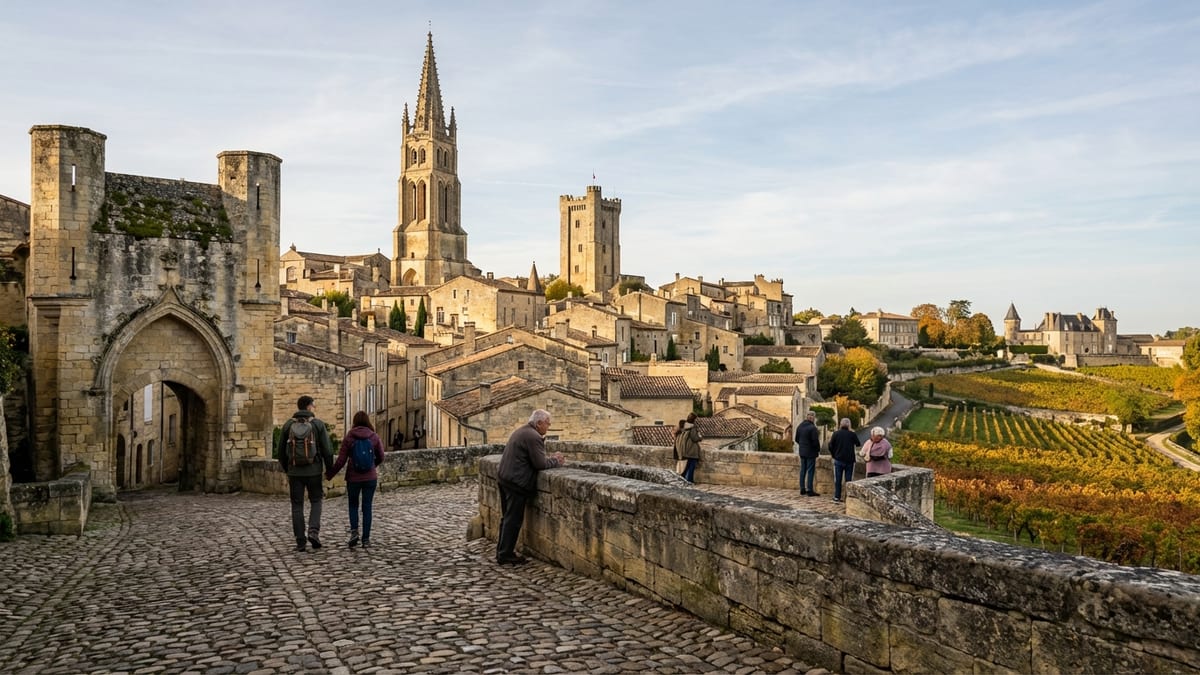
There are wine villages, and then there is Saint Émilion, where an entire medieval hilltop folds into a swirl of cobbled lanes, underground churches and honey colored stone. Compact enough to explore on foot yet layered with centuries of history, the village rewards anyone willing to slow down and walk. This guide is designed as a detailed walking companion through the old town, its surviving walls and gates, and the best viewpoints over the surrounding sea of vineyards.
How to Arrive and Start Your Walk
Saint Émilion lies about 35 to 40 kilometers east of Bordeaux, surrounded by the vineyards that bear its name. Most visitors arrive either by train to Saint Émilion station or by car from Bordeaux. From the station it is roughly 1.6 kilometers to the village, a 20 to 30 minute uphill walk that already introduces you to the landscape of vines and low stone walls. Those with luggage or mobility concerns often opt for a local shuttle, prebooked transfer or taxi, but if you can, walking that final stretch sets the right tempo for the rest of the day.
If you drive, you cannot park in the heart of the old town, which is intentionally protected and partly pedestrianized. Instead, plan to leave your car in one of the public lots on the outskirts, such as near the lower entrance at Place Bouqueyre or closer to the upper town near the collegiate church. There are a few free lots near the gendarmerie and other paid options that fill quickly on busy days, so arriving before late morning is wise, especially on weekends or in the summer season.
A practical place to begin any walking route is the Saint Émilion tourist office, located near the upper town. Staff can provide up to date opening times for monuments, details on temporary closures, and printed walking maps that outline suggested routes. Guided visits to the underground monolithic church and certain subterranean monuments must be booked here, often with fixed time slots, so it is sensible to coordinate your walk around those reservations before you set off through the lanes.
Saint Émilion’s slopes and cobbles should not be underestimated. Many streets are steep and paved with rounded stones polished smooth by centuries of footsteps. Comfortable shoes with good grip are essential, particularly after rain. The village is not large, but what it lacks in distance it makes up for in vertical gain, and a slower, measured pace will make the walk more pleasant.
First Impressions from the Old Walls
One of the most evocative ways to arrive on foot is via the Chemin des Fossés, a lane that follows the line of the medieval ditches outside the former ramparts. Here you encounter the ruins of the Cardinal Palace, once a grand 12th century residence whose broken walls and carved window bays now open directly onto grass and sky. This stretch allows you to imagine how Saint Émilion once sat fully enclosed within defensive walls measuring around one and a half kilometers in circumference.
Continue along this path and you begin to glimpse the village proper: the freestanding bell tower of the monolithic church rising above stone roofs, and beyond that the broader plateau lined with vines. At the far end of the Chemin des Fossés stands Porte Brunet, the last surviving town gate from the Middle Ages. Its pointed arch, flanked by solid towers, once controlled the flow of goods and people subject to local taxes. Today it is a scenic passageway and one of the finest vantage points over the Fongaban valley, where vines sweep down to a small stream.
Just before you step through Porte Brunet into the walled town, pause at the small esplanade. From here, the view opens to terraces of vineyards and distant châteaux, framed by the arch of the gate. The contrast between the rural calm beyond the walls and the dense tangle of alleys within is striking. This is an excellent place to orient yourself, as you can see clearly how the village clings to its limestone hill, with the highest point dominated by towers and church spires.
Passing under Porte Brunet, you cross an invisible threshold between countryside and town that would have been heavily regulated in earlier centuries. The route that follows climbs steadily toward the upper town, but detours to the ramparts remain rewarding. Portions of the former walls can still be traced along quiet streets, and occasional breaks in the buildings give unexpected glimpses down to the lower town or out across the vineyards.
Exploring the Upper Town and Monolithic Heart
The upper town holds the most famous monuments and broadest views. Aim first for the Place de l’Église Monolithe, the square that covers the huge underground monolithic church. At street level you see an elegant Gothic portal on one side and, rising above it, the bell tower that dominates almost every view of Saint Émilion. Only on a guided visit arranged through the tourist office can you descend into the rock hewn church itself and its accompanying catacombs, but even without going underground you can feel how the square is a lid over something vast.
From the square, narrow alleys radiate downhill in every direction, one leading to the town’s former market hall, another toward the only remaining half timbered house. Take a few minutes to study the façades around you. The warm limestone holds a patchwork of centuries: Romanesque fragments, Gothic windows, simple rural doorways and more ornate merchant houses. Look for carved symbols and stone lintels above doors that hint at trade guilds or religious affiliations long forgotten.
Nearby stands the Collegiate Church, or Église Collégiale, whose thick stone walls, cloistered courtyard and tall nave reflect the importance of the religious community that grew around the hermit Émilion. The cloister behind the church offers a rare pocket of quiet. Even when the main streets are crowded, this enclosed space, lined with simple arches and dotted with old tombstones, invites you to linger and imagine monastic life when Saint Émilion was a place of pilgrimage as well as commerce.
Before you leave the upper town, consider climbing the bell tower of the monolithic church if it is open during your visit. The climb, nearly 190 spiral steps depending on the count, is steep and narrow, but the reward is a full 360 degree panorama: terracotta roofs packed tightly around the central square, the Tour du Roy rising nearby, and beyond that the checkerboard of vine parcels stretching to the horizon. Late afternoon or early evening often brings the most flattering light, with the limestone glowing softly.
Secret Corners, Cloisters and Underground Heritage
One of the pleasures of walking Saint Émilion is discovering corners that many day trippers miss. A short stroll from the main square takes you to the Cloître des Cordeliers, a former Franciscan convent whose ruined cloister now frames a tranquil garden. Beneath your feet, an extensive network of underground galleries carved in the limestone doubles as cool cellars for sparkling wine, but at ground level the arches and monolithic columns tell their own architectural story. It is a scenic place to pause with a drink or simply rest beneath the plane trees.
The underground side of Saint Émilion extends far beyond the monolithic church. Centuries of quarrying have left tunnels and caverns under much of the village, some later adapted as cellars, others turned into chapels and burial places. Most of the significant subterranean sites, including the hermitage associated with Saint Émilion himself and nearby catacombs, are accessible only on guided tours booked through the tourist office. These visits usually involve modest staircases and dimly lit passages, so comfortable footwear and a readiness for enclosed spaces are important.
At street level, you can sense this underground world in small ways. Ventilation grates and stone openings appear unexpectedly in walls and pavements, sometimes accompanied by plaques that reference the quarries. On quiet side streets, remove yourself from the main flow of visitors and listen for a moment. The village can feel hollow underfoot, as if the rock itself has been shaped into a hidden second city.
Do not overlook the wash houses and fountains tucked into the slopes. The Petite Fontaine and Grande Fontaine provided fresh water and served as social gathering points for generations. Their basins, low roofs and surrounding stone benches remain evocative, especially in the early morning when few people are about and the sound of water echoes softly against the rock.
Descending to the Lower Town and Historic Gates
From the upper square, one of the most characteristic streets drops steeply down toward the lower part of Saint Émilion, passing through the Porte de la Cadène. This archway, linked to the village’s last remaining timber framed house, once symbolically divided the upper and lower town. Today the short, sharply sloped stretch of cobblestones just below it is a test of your balance. Walk carefully, using the smoother stone gutters on either side if the central strip feels too slick.
At the bottom of this descent lies Place Bouqueyre, a broad space that historically functioned as a market area and entrance to the fortified town. The line of the former ramparts is still visible along nearby streets, and some guides point out where another gate once stood to regulate movement between town and its growing suburbs. Thanks to the open layout and relative flatness, this area makes a good breather if you have spent time climbing and descending the steeper lanes above.
The lower town opens a slightly different side of Saint Émilion. Here you may find small workshops, less frequented cafés and a higher proportion of local life, particularly outside the busiest summer weeks. From certain corners, you can look back up at the village and appreciate its layered topography: terraces of houses rising toward church towers and the square keep of the Tour du Roy.
If you follow the streets outward from Place Bouqueyre you soon cross back through what used to be the line of defenses. Today a fragment of wall, a lone tower base or a sharp change in street level might be all that remains. Following these traces on foot encourages you to think of Saint Émilion not only as a picturesque cluster of wine shops, but as a once strategic stronghold whose boundaries were carefully controlled.
Walls, Towers and the Village’s Best Viewpoints
The most recognisable tower in Saint Émilion is the Tour du Roy, a square limestone keep that rises above the upper town a short walk from the central square. It is the only remaining Romanesque keep of its kind in the Gironde region and once formed part of the Château du Roi, a complex that doubled as town hall and symbol of authority. Today it hosts ceremonies for the Jurade, the local wine brotherhood that still proclaims the start of harvest each September from its rooftop.
Visitors willing to tackle about 118 steps can climb to the top of the tower for one of the finest views in the village. Unlike the bell tower of the monolithic church, which stands closer to the center, the Tour du Roy provides a slightly offset angle that places the church spire, collegiate complex and clustered roofs all within one sweeping panorama. From here, the geometry of the medieval street plan becomes clearer, with radiating lanes, wedge shaped blocks and irregular squares sculpted by the hill’s contours.
Beyond the high towers, there are several quieter vantage points worth seeking out. The terrace in front of the Cordeliers cloister, for example, offers a romantic perspective over tiled roofs to the Tour du Roy and bell tower without requiring any steps. The viewpoint near Porte Brunet, mentioned earlier, frames the vines and valley. Along the Chemin des Fossés, gaps in the tree line create natural balconies looking back at the village, particularly atmospheric at sunset.
For a broader landscape view, some visitors extend their walk just beyond the last houses, following lanes between vineyards that ring the village. Even a short loop provides fresh angles on the skyline, with rows of vines leading the eye toward the cluster of towers and walls. Be mindful of private property and follow marked paths or small public roads rather than cutting through rows without permission, especially during growing and harvest seasons.
Planning Your Time, Seasons and Practical Tips
Although Saint Émilion attracts heavy day trip traffic, especially between late spring and early autumn, the village reveals its best self when you slow down. A focused walking circuit of the old town, including some viewpoints and a tower climb, can be completed in a few hours, but allowing a full day makes a significant difference. This gives you time to adjust your route around monument opening hours, pause in cloisters and gardens, and perhaps venture into a nearby vineyard on the outskirts.
Timing is crucial. Mornings before 10:00 and late afternoons after day trip groups depart are generally calmer on peak season days. In July and August, midday heat accumulates on the stone, intensifying the sensation of walking uphill, so consider retreating to shaded interiors or underground visits at those hours. Shoulder seasons such as May, June, September and early October offer a more relaxed atmosphere, with vine foliage adding changing colors to the views, from bright green in late spring to deep gold at harvest time.
Apart from sturdy shoes, a few small items improve the walking experience. A refillable water bottle is vital, as climbing between squares quickly becomes thirsty work. Sun protection is necessary from late spring through early autumn, given the village’s exposed terraces and lack of shade on certain streets. In cooler months, the wind can be sharp on higher viewpoints, so an extra layer pays off, particularly if you plan to linger on tower tops.
Accessibility is mixed. Some of the steepest streets and monument staircases are challenging or impossible for visitors with limited mobility. However, sections of the upper square, parts of the collegiate church area and certain viewpoints near parking zones can be reached without major climbs. The tourist office can provide updated information on accessible routes and any temporary changes to access caused by restoration works.
The Takeaway
Walking Saint Émilion is less about ticking off individual sights and more about appreciating how they fit together in a compact yet intricate landscape. The same limestone that built the churches and ramparts was quarried from beneath your feet. The gates and walls that once controlled trade now frame views for visitors. Vines that have crept right to the edge of the village remind you that this is, above all, a working wine territory whose prosperity shaped the town you see today.
By approaching the village on foot, following remnants of the old walls, climbing to panoramic terraces and descending into shadowed underground spaces, you trace the layers of a place that has been both fortress and sanctuary, marketplace and pilgrimage site. The cobbled inclines may test your legs, but the reward is a deep and memorable understanding of how a medieval wine village grew, defended itself and endured into the present.
Give Saint Émilion the time and attention it deserves, and the village becomes more than a picturesque backdrop for a tasting. It turns into a living textbook of stone and vine, where every viewpoint, gate and alleyway has a story to share with those willing to walk slowly enough to listen.
FAQ
Q1. How much time should I plan for a walking visit to Saint Émilion village?
For a thorough walking visit that includes the old town, key viewpoints, a tower climb and time at the cloisters or underground sites, plan on a full day. If your schedule is tighter, you can see the core of the village in three to four hours, but you will need to prioritize a few highlights rather than exploring every lane.
Q2. Is Saint Émilion difficult to explore on foot because of the hills and cobbles?
Parts of the village can be physically demanding. Many streets are steep and paved with smooth cobblestones, which can be slippery in wet weather. Most reasonably fit visitors manage without trouble by taking their time and wearing supportive shoes with good traction. Those with mobility issues may prefer to focus on the upper square and viewpoints accessible from nearby parking areas.
Q3. Where is the best place to start a self guided walking tour?
A practical starting point is the tourist office in the upper town, where you can pick up a map, check monument opening hours and reserve guided visits to the underground church and other sites. From there, you can loop through the upper square, visit the collegiate church and cloister, climb a tower if you wish, then descend through the lower town and return along the old walls.
Q4. What are the must see viewpoints over the village and vineyards?
Top viewpoints include the bell tower of the monolithic church, the rooftop of the Tour du Roy, the esplanade at Porte Brunet, the terrace near the Cordeliers cloister and sections of the Chemin des Fossés that look back toward the hilltop. Short walks into the surrounding vineyards also yield rewarding perspectives of the village skyline.
Q5. Do I need to book in advance to visit the monolithic church and underground monuments?
Yes, visits to the monolithic church, catacombs and certain underground sites are only possible on guided tours arranged through the tourist office. In high season and on weekends, tours often sell out, so advance booking or early arrival on the day is strongly recommended if these sites are a priority.
Q6. Is Saint Émilion suitable for children and families on a walking visit?
Families generally enjoy Saint Émilion, but the steep cobbled streets require supervision, especially for younger children. Tower climbs involve narrow spiral staircases that may not suit everyone. On the positive side, open squares, viewpoints and short vineyard walks provide variety, and older children often find the underground church and stories of hermits, knights and towers engaging.
Q7. When is the best time of year for a walking visit to Saint Émilion?
Late spring, early summer and early autumn offer the best balance of pleasant temperatures and scenic vineyards. May, June, September and early October are particularly appealing, with fewer crowds than mid summer. Winter can be quiet and atmospheric, but some services and tours may operate on reduced schedules, so checking in advance is important.
Q8. Can I combine a village walking tour with visits to nearby wineries on foot?
Yes, several estates lie within walking distance of the village along small roads and paths through the vineyards. However, distances vary, and some routes involve hilly terrain. It is wise to research opening hours and reservation requirements for tastings, then plan your walking itinerary to include one or two conveniently located properties rather than trying to visit many in a single day.
Q9. Are guided walking tours necessary, or can I explore independently?
You can easily explore the streets, viewpoints and cloisters independently with a map and basic orientation. However, guided walking tours, whether organized through the tourist office or private guides, add context about the village’s history, architecture and wine culture that is difficult to glean from signage alone. Many visitors choose a mix: a guided tour for orientation and underground sites, then free time to wander on their own.
Q10. What should I wear and bring for a comfortable day walking in Saint Émilion?
Wear sturdy, closed toed shoes with non slip soles to handle cobblestones and staircases. In warmer months, light clothing, a hat and sunscreen are important, along with a refillable water bottle. In cooler seasons, a windproof layer makes high viewpoints more comfortable. A small backpack to hold tickets, water and a camera leaves your hands free to steady yourself on steep or uneven sections of the walk.