

More news on this day
Saipan’s tourism industry is breathing a sigh of relief after South Korea’s t’way Air and Jeju Air confirmed they will maintain key summer services to the Northern Mariana Islands, ensuring continued air links from Seoul at a time when the destination is fighting to rebuild visitor numbers.
Get the latest news straight to your inbox!
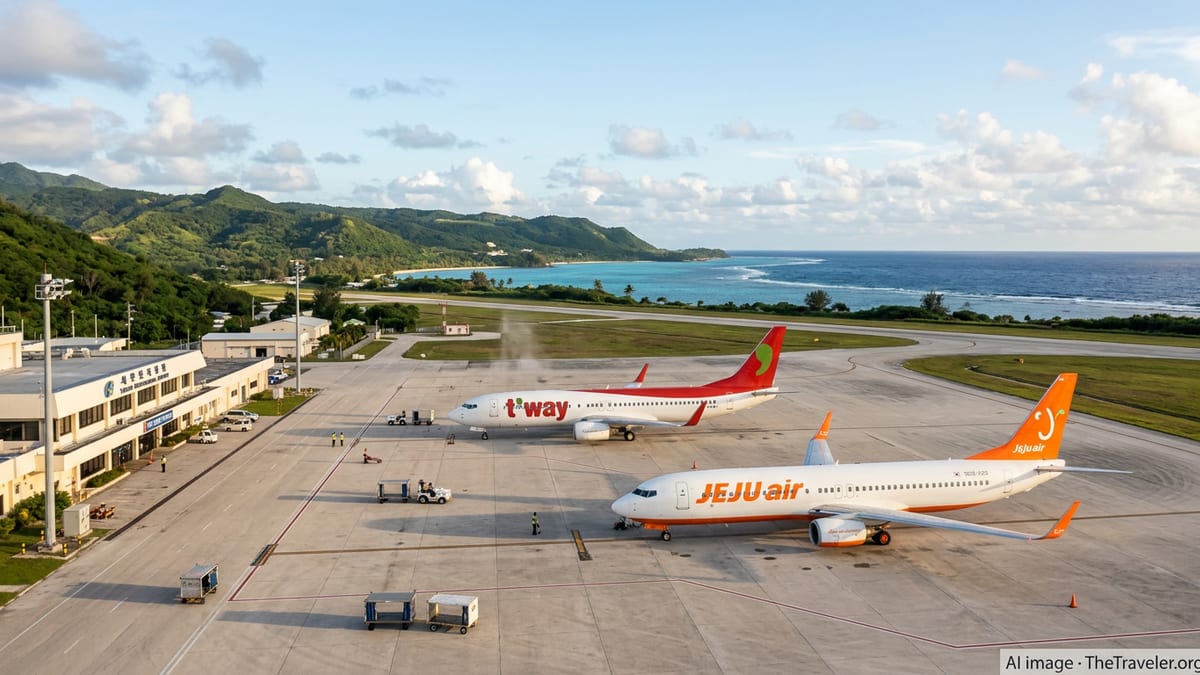
Daily Incheon–Saipan Flights Confirmed for Summer 2026
Following weeks of concern over a possible suspension of South Korean routes, t’way Air and Jeju Air have agreed to continue operating flights to Saipan throughout the upcoming summer schedule. The decision emerged from negotiations with the Marianas Visitors Authority, which has been working to stabilize air access to the U.S. Pacific territory after a series of capacity cuts and schedule adjustments.
According to the latest schedule filings, t’way Air will maintain a daily Incheon–Saipan service from March 29 through October 24, 2026, providing a consistent link between the South Korean capital and Saipan during the peak holiday period. Jeju Air, which had faced scheduling constraints, will pause its Saipan operations between March 29 and April 29 but plans to resume daily flights from April 30 for the remainder of the summer season.
The confirmation means Saipan will retain at least one daily flight from Seoul throughout the entire summer timetable, with a second daily service restored once Jeju Air returns at the end of April. For hoteliers and local businesses that rely on Korean package tourism, the announcement marks a critical reprieve after earlier signals that both carriers might withdraw.
South Korean travelers have been the single most important source market for the Northern Mariana Islands since before the pandemic, and they became even more central as direct flights from mainland China failed to return at scale. Any interruption in Korean air service would have had an immediate impact on arrivals, room occupancy and tourism-related employment.
Reversal Follows Alarming Signals Over Potential Pullout
The latest decision represents a sharp turnaround from February, when industry groups on Saipan sounded the alarm after t’way Air and Jeju Air closed reservations beyond March 28 while they finalized their summer 2026 schedules. At the time, hospitality leaders warned of a looming “air access crisis” and urged the local government to intervene, citing the risk of losing the islands’ primary tourism lifeline.
The uncertainty triggered concern across the Marianas’ visitor economy, which is still operating far below pre-pandemic levels. With annual seat capacity to the islands having fallen dramatically from late 2010s highs, stakeholders feared that another round of reductions from Korea could push some hotels and tour operators beyond the brink, particularly smaller, family-run businesses.
Behind the scenes, the Marianas Visitors Authority and Commonwealth officials entered talks with both airlines to preserve scheduled service. Industry sources say the discussions focused on marketing support, cooperative promotions and schedule coordination rather than direct subsidies, reflecting a broader shift toward partnership-based air service development in the islands.
For now, that strategy appears to have worked. By confirming continued operations, t’way Air and Jeju Air have given tour wholesalers and travel agencies in both markets the confidence to keep selling Saipan packages through the crucial summer travel window, a period that often sets the tone for the entire fiscal year.
Tourism Recovery Hinges on Korean Market Stability
The Marianas’ reliance on South Korea has only deepened over the past two years as other key source markets struggled to rebound. Data from the Marianas Visitors Authority show that overall visitor arrivals remain significantly below pre‑2020 peaks, with capacity reductions from Korea and the loss of several China routes weighing heavily on recovery.
Seasonal pauses and frequency cuts on the Incheon–Saipan sector have repeatedly underscored this fragility. In recent seasons, both t’way Air and Jeju Air have temporarily reduced or suspended flights in response to weak demand, fare pressures and rising operating costs, leaving Saipan at times with only a single daily flight from Seoul. Those gaps translated directly into fewer package tours and lower average occupancy levels across the island’s resorts.
The confirmation of daily services through October 2026 should help stabilize forward bookings for the second half of the year, particularly for family and group travel segments that tend to plan several months ahead. Operators on Saipan say having firm schedules allows them to lock in charter agreements with wholesalers, coordinate with resorts, and promote bundled air-and-hotel deals in the Korean market with greater certainty.
Still, the trajectory remains delicate. Local tourism officials stress that the islands must work harder to differentiate themselves from rival beach destinations now aggressively courting Korean vacationers with competitive pricing and new route launches. Maintaining airline interest will require sustained marketing campaigns and product development on the ground in Saipan, not just schedule guarantees in the air.
Competitive Pressures and Regulatory Headwinds
The negotiations with t’way Air and Jeju Air unfolded against a backdrop of growing competitive and regulatory pressures affecting Korean carriers. A strong U.S. dollar has made travel to U.S. jurisdictions, including the Northern Mariana Islands and Guam, more expensive for South Korean travelers compared with packages to Japan, Vietnam or domestic beach destinations.
At the same time, new seat-capacity requirements on the Korea–Guam corridor, introduced in connection with the planned merger of Korean Air and Asiana Airlines, have forced airlines to reassess their network strategies in the region. Industry analysts say these obligations can indirectly influence how Korean carriers deploy aircraft and capacity on nearby routes such as Saipan, especially during peak travel periods.
Low-cost carriers like t’way Air and Jeju Air are also juggling fleet utilization across a rapidly evolving route map that includes newly expanded services to popular Japanese and Chinese cities. With finite aircraft and crews, maintaining marginal routes with thin yields can be challenging, particularly when fuel costs are elevated and fare competition is intense.
In that environment, Saipan’s ability to retain daily flights from both airlines suggests the route still holds strategic value, whether as part of a broader portfolio of leisure destinations or as a niche market supported by strong partnerships with local tourism authorities and resort operators.
Saipan Looks to Broader Network to Reduce Risk
While the latest agreement with t’way Air and Jeju Air is being welcomed as a short-term win, policymakers and tourism leaders in the Northern Mariana Islands are increasingly focused on reducing their exposure to any single market. Philippine Airlines is preparing to revive its Manila–Saipan route in late March 2026, adding a fresh Southeast Asian gateway and creating new two‑stop options from other parts of Asia.
Officials say diversifying source markets is essential to building a more resilient visitor economy that can better withstand shocks, whether from airline schedule changes, currency swings or geopolitical tensions. Additional regional connectivity from Manila, as well as potential future links from Japan and Oceania, could help spread risk and smooth seasonality.
For now, though, South Korea remains the cornerstone. Travel agents in Seoul note that Saipan still appeals strongly to families seeking an overseas beach break with familiar language support, established resort infrastructure and the added reassurance of U.S. jurisdiction. With daily flights locked in for the summer, they expect renewed marketing pushes featuring bundled stays at marquee Saipan properties.
How long that momentum can be sustained will depend on broader economic conditions in Korea and on Saipan’s ability to keep fares and on‑island costs competitive. But after a tense scheduling season, the decision by t’way Air and Jeju Air to reinforce their services has given the islands what local hoteliers describe as a vital, if fragile, lifeline into the busiest travel months of the year.