

Framed by the baroque bulk of Salzburg Cathedral and watched over by the fortress on the hill, Domplatz is the square where Salzburg’s history, culture, and daily life all collide. Whether you arrive on a quiet weekday morning or during the roar of the Salzburg Festival or the glow of the Christmas market, this is the space that defines the Old Town. This guide walks you through what to see in and around Domplatz, how to experience it in different seasons, and the practical details to make the most of your time in Salzburg’s most atmospheric square.
Orientation: Getting Your Bearings in Domplatz
Domplatz sits in the heart of Salzburg’s UNESCO-listed Old Town, wedged between Salzburg Cathedral on one side and the arcaded arches leading through to Residenzplatz on the other. It is a mostly car-free, open cobbled square, so once you reach the historic center on foot, you will almost inevitably find yourself here. Many walking tours of Salzburg start or pause on Domplatz, using the cathedral façade and the surrounding palaces as a quick visual history lesson of the prince-archbishops who once ruled this small but wealthy city-state.
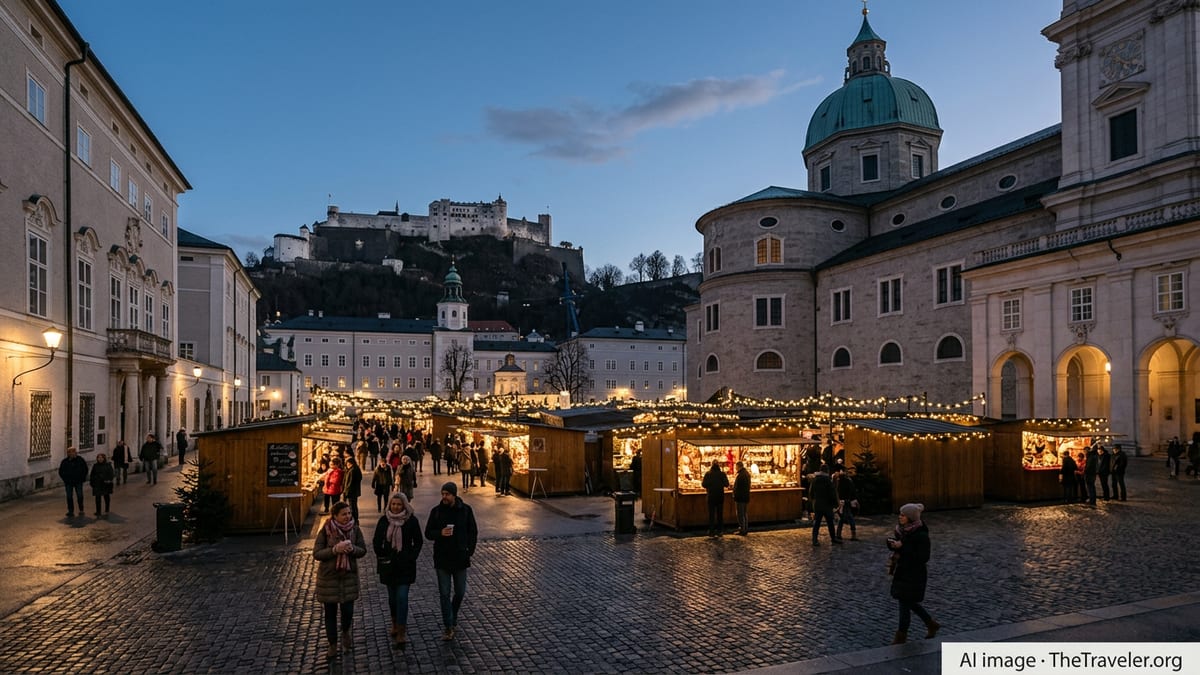
From the middle of the square, you can look up to see the green copper dome and twin towers of Salzburg Cathedral, then lift your eyes higher to the Hohensalzburg Fortress perched on the Festungsberg. To the north, low arcades lead through to Residenzplatz and its baroque fountain; to the south, narrow lanes peel away into the older medieval streets near St. Peter’s Abbey and the Kapitelplatz. Most first-time visitors spend at least 20 to 30 minutes just walking the perimeter of Domplatz to take in the architecture and get photographs from different angles.
Domplatz is compact enough to cross in under a minute, but the layers of activity change dramatically by time of day and season. In early morning you might share the space with only a handful of locals cutting across on the way to work. By midday in summer, tour groups cluster near the cathedral steps and street musicians sometimes play beneath the arches. In Advent it transforms again, filled with wooden market stalls, the smell of roasted chestnuts, and a steady flow of visitors drifting between stalls and concert stages.
Because Domplatz is paved with cobblestones and can get crowded during events, it is worth wearing supportive footwear and allowing extra time if you are traveling with a stroller or anyone with reduced mobility. The square itself is flat, but the approach from many Old Town hotels or bus stops involves short slopes or slightly uneven surfaces typical of a medieval city center.
Salzburg Cathedral: The Showpiece of the Square
Salzburg Cathedral dominates Domplatz both physically and historically. The current early baroque church was largely built between 1614 and 1628 to designs influenced by Italian architects, making it one of the first major baroque churches north of the Alps. From Domplatz, the façade appears almost theatrical: twin towers, a central pediment, and three large arched portals that once symbolized the three stages of entry into Christian life.
Inside, the cathedral rewards an unhurried visit. The bright white interior feels unexpectedly light compared with many darker European cathedrals, with stucco work and frescoes rather than heavy stone. If you pause in the nave and look up, you can pick out scenes from the life of Christ painted in the dome and vaults, while the choir area holds the ornate high altar flanked by marble columns. One of the most meaningful spots for many visitors is the baptismal font near the entrance, where Wolfgang Amadeus Mozart was baptized in 1756; today, tour guides often stop here to connect the cathedral with the city’s most famous son.
For everyday sightseeing, the cathedral is generally open to visitors from about 8:00 in the morning for most of the year, with closing times varying between roughly 17:00 and 19:00 depending on the month. There is a modest maintenance or preservation fee of around 5 euros for adults, while children and teenagers up to 18 are typically admitted free. Prices can change slightly, so it is sensible to carry some small cash or check the current fee at the information board in front of the cathedral. Holders of city passes such as the Salzburg Card often benefit from discounted entry.
If you are interested in a deeper dive, consider one of the short daily guided tours that last about 40 minutes and usually cost under 10 euros per adult. These tours, which often start from the cathedral forecourt on Domplatz, explain details you might otherwise overlook, such as the different organs dotted around the interior or the symbolism of statues on the façade. Audio guides are also widely available for a small additional fee and are a good alternative if you prefer to explore at your own pace and in your own language.
Art, Architecture, and the Domplatz Monuments
Beyond the cathedral itself, Domplatz functions as an open-air gallery of Salzburg’s baroque ambitions. In the center of the square stands the Mariensäule, or Marian Column, a tall column topped by a statue of the Virgin Mary that dates from the late 17th century. At ground level around the base, a set of allegorical bronze figures represent church and secular authorities, human wisdom, and the devil; when you stand in the right spot, the sculptures line up visually with figures and reliefs on the cathedral façade, creating a kind of baroque visual puzzle that guides love to point out.
The three great arches on the north side of Domplatz lead directly through to Residenzplatz and are part of the former archiepiscopal residence complex. Walking under these arches, you move from the more austere, ceremonial cathedral square into a space dominated by the Residenz fountain and surrounding palaces. The contrast gives a concrete sense of how the prince-archbishop’s power encompassed both spiritual and secular authority. Many visitors take photos framing the cathedral towers through the arches, especially in late afternoon when the light softens and shadows stretch across the cobbles.
Architecturally, the façades around Domplatz are a mix of early baroque and later additions. The cathedral’s marble exterior with its four-storey towers and large central window was designed to impress both locals and visiting dignitaries. In practice, this still works on 21st-century travelers. Even if you have seen famous churches elsewhere in Europe, the way the cathedral fills one side of a relatively modest square gives it an intimate drama. Simple details like the heavy bronze doors, decorated with scenes of faith, hope, and love, or the discreet bishop’s coats of arms above side entrances, reward close inspection.
Art lovers should also note that Domplatz is one of the entry points to the DomQuartier museum complex. With a combined ticket, you can visit the cathedral museum, the galleries in the former archbishop’s residence, and walk a high-level passage that looks down into the cathedral from above. For many travelers, this combination of interior art and aerial glimpses of Domplatz and the cathedral dome provides one of the most memorable perspectives on the square.
Domplatz Through the Seasons: From Jedermann to Christmas Lights
Domplatz is not just a static historic site; it is also one of Salzburg’s most important event spaces, and your experience will differ dramatically depending on when you visit. In summer, the square becomes an open-air stage for the Salzburg Festival, the city’s world-famous music and drama festival. One of the signature productions is “Jedermann,” a morality play by Hugo von Hofmannsthal, which has been performed in front of the cathedral for decades. On performance evenings, tiered seating rises across Domplatz, and the façade of the cathedral becomes the backdrop for actors lit against the twilight sky.
If you are visiting during Festival season, which typically runs from late July into August, do not be surprised to find parts of the square fenced off or filled with temporary structures in the late afternoon and evening. Even if you do not have tickets to a performance, it can be fascinating to linger nearby as elegantly dressed theater-goers arrive, festival staff adjust lighting rigs, and the square hums with anticipation. For practical sightseeing, plan your cathedral visit earlier in the day, as opening hours can be shortened on rehearsal and performance days and access routes may change.
In late November and December, Domplatz transforms again for the Salzburger Christkindlmarkt, the city’s main Christmas market that spills across both Domplatz and neighboring Residenzplatz. Wooden stalls with green roofs and strings of lights fill the square, selling everything from hand-carved wooden toys and glass candleholders to gingerbread and hot punch. Prices for food and drink are typical of major European Christmas markets: a mug of mulled wine or hot punch might cost around 4 to 5 euros, plus a refundable deposit for the ceramic mug, while simple snacks such as bratwurst, pretzels, or roasted chestnuts often fall in the 4 to 8 euro range.
Even if you are not shopping, the atmosphere alone is worth a visit. Choirs perform in front of the cathedral on certain evenings, and you may hear brass ensembles playing Advent music from the surrounding towers. For families, it is a comfortable, contained space where children can move fairly freely, though it does get crowded in the early evening and on weekends. If you prefer a quieter experience, aim for late afternoon on a weekday, when the lights are already glowing but the crowds are thinner. The market usually opens in the second half of November and runs through to just after New Year, but specific dates vary slightly each year, so it is worth checking locally closer to your travel dates.
Practical Visiting Tips: Tickets, Times, and Crowd Strategies
For most visitors, Domplatz itself is free to access at all hours, but Salzburg Cathedral and associated museums charge modest entry or maintenance fees. As of the most recent season, adults should budget around 5 euros for cathedral admission, with children and teens admitted free and discounts available for certain city cards or group tickets. If you plan to visit the DomQuartier complex, including palace rooms and galleries, expect a higher combined ticket cost, typically in the mid to high teens for adults, with family packages and concessions for students and seniors.
Opening times for the cathedral are broadly stable throughout the year but do fluctuate slightly by month. In the quieter months of January and February, sightseeing hours often run from 8:00 to 17:00 on weekdays and 13:00 to 17:00 on Sundays and holidays. In peak summer months they are generally extended to around 18:00 or 19:00. Remember that access is restricted during Mass, special services, and noon concert times, when the interior is reserved for worship or ticketed musical events. If your schedule is tight, it is a good idea to check the notice boards at the entrance in the morning to see whether any closures are posted for later in the day.
In terms of timing, early morning is usually the calmest moment to experience both Domplatz and the cathedral. Between 8:00 and 9:30, you may share the nave with a handful of independent travelers and quiet tour groups, which makes it easier to appreciate the acoustics and details without constant movement around you. Late afternoon, roughly from 16:00 onwards, can also be pleasant once the largest day-tour groups have departed, though this window is shorter in winter when darkness falls early.
During major events such as the Salzburg Festival or the Christkindlmarkt, crowd levels rise sharply. If you want photos of the square without market stalls or seating structures, you will need to plan your visit outside these periods, typically in spring or early autumn. If your trip coincides with them and you prefer less crowding, consider dropping by around opening or closing times for the market, or in the late morning on weekdays when many people are still at work. For cathedral visits during the Festival, aim for mid-morning and allow extra time to navigate temporary barriers or changed entry points.
Nearby Highlights: What to See Around Domplatz
One of the perks of focusing your visit around Domplatz is how close you are to many of Salzburg’s other major sights. Step through the arches into Residenzplatz and you will find the Residenzbrunnen, an elaborate baroque fountain whose sculpted horses and tritons have made appearances in everything from travel brochures to wedding photos. The surrounding Residenz buildings house parts of the DomQuartier museum route, where historic state rooms, galleries, and terraces give further context to the power and taste of Salzburg’s former rulers.
To the west of Domplatz, a few minutes’ walk brings you to St. Peter’s Abbey and its famous cemetery, one of the most atmospheric corners of the Old Town. Film fans may recognize the arcaded graves and wrought-iron markers from “The Sound of Music,” while others appreciate the contrast between the bustling square near the cathedral and the quiet, enclosed world of the abbey. Combining Domplatz, Salzburg Cathedral, and St. Peter’s in one loop makes a natural half-day walking itinerary without long distances.
For elevated views, the Hohensalzburg Fortress looms directly above Domplatz. You can reach it via a funicular from the nearby Festungsgasse or on foot via steep but manageable paths. At the top, panoramic terraces offer classic postcard views down over the cathedral dome, Domplatz, and the tightly packed roofs of the Old Town. Many visitors time their fortress visit to late afternoon to watch the light fade over the city, then descend to Domplatz as the cathedral and nearby buildings are lit for the evening.
If you are interested in shopping or a coffee break, several of the side streets running off Domplatz lead quickly to compact cafes, pastry shops, and small boutiques. Rather than searching for big international chains, look for intimate spots serving local specialties such as apple strudel, Salzburger Nockerl, or hearty open sandwiches. Prices are what you would expect in a popular historic center: a cappuccino might run around 3 to 4 euros, with cakes often in the 4 to 6 euro band. Choosing a side-street café rather than a front-row terrace directly on the square can keep costs a little lower while still leaving you close enough to return to Domplatz in just a couple of minutes.
Experiencing Domplatz Like a Local
For many Salzburg residents, Domplatz is woven into everyday routines rather than just being a tourist attraction. Office workers cut across the square on their way between meetings, families pass through on walks with children and grandparents, and students use the steps of nearby buildings as informal meeting points. Visitors can tap into this local rhythm by treating the square not only as a checklist sight but also as a place to pause, sit, and watch the flow of life around them.
One simple way to do this is to visit more than once during your stay. For example, you might inspect the cathedral interior on your first morning, then return after dinner another evening to see the façade lit up and the square quieter. In summer, when the sky stays light late, this might mean listening from a distance to a rehearsal or concert soundcheck. In winter, it may involve walking slowly through the market hut-lined square after the main crowds have thinned, warming your hands around a paper cone of roasted almonds.
Another local-style experience is to attend a service or musical event inside the cathedral rather than only sightseeing. Many visitors opt for a short midday organ concert, which typically costs under 10 euros and offers a focused half-hour immersed in the cathedral’s acoustics. Others attend a regular Mass, which is usually open without an entrance fee, though respectful behavior is essential and photography should be avoided during liturgy. Even if you are not religious, taking part in one of these moments can provide a more authentic sense of what the building means to the city’s residents.
Finally, remember that Domplatz is also a working religious and civic space. Weddings, funerals, special blessings, and civic commemorations occasionally start or end on the square. If you happen upon such an event, it is best to keep a discreet distance, avoid obstructing participants, and keep photography low-key. These unplanned encounters, handled respectfully, can offer some of the most memorable, human-scale impressions of Salzburg life.
The Takeaway
Domplatz is more than a pretty backdrop for Salzburg Cathedral. It is the stage on which the city’s stories play out, from the ambitions of baroque prince-archbishops to the cultural prestige of the Salzburg Festival and the cozy bustle of Advent markets. Spending time here helps tie together many of the threads that make Salzburg distinctive: the blend of Italian-inspired baroque and Alpine setting, the balance between religious heritage and secular festival culture, and the way locals and visitors share the same historic spaces.
For travelers, the best approach is to plan at least one structured visit, including time inside the cathedral and perhaps the DomQuartier, and then allow space in your itinerary simply to be in the square at different times of day. Stop for photos in the morning when light falls cleanly on the façade, return in the evening when the dome glows against the dark sky, and, if you come in late November or December, weave between the Christkindlmarkt stalls with a hot drink in hand. However you experience it, Domplatz has a way of anchoring your memories of Salzburg long after you have left the cobblestones behind.
FAQ
Q1. Is there an entrance fee to visit Salzburg Cathedral from Domplatz?
The square itself is free to access, but entering Salzburg Cathedral usually involves a small maintenance fee for adults, around the cost of a modest café drink, while children and teenagers are typically admitted free. Discounts are often available with local city cards or combined tickets, so it is worth checking current details at the cathedral entrance.
Q2. How much time should I plan for Domplatz and the cathedral?
Most travelers spend about one to one and a half hours combining a walk around Domplatz with a visit inside Salzburg Cathedral. If you also explore the DomQuartier museum or attend an organ concert, you may want to allocate up to half a day so you are not rushed.
Q3. When is the best time of day to visit Domplatz to avoid crowds?
Early morning, roughly between 8:00 and 9:30, is usually the quietest period, especially outside peak summer and Christmas market season. Late afternoon can also be calmer once the largest tour groups have left, although you should keep an eye on cathedral closing times if you still plan to go inside.
Q4. Are there special events on Domplatz I should know about?
In summer, Domplatz hosts open-air performances of the play “Jedermann” as part of the Salzburg Festival, which brings seating and stage structures into the square. In late November and December, the Salzburger Christkindlmarkt Christmas market fills Domplatz and nearby Residenzplatz with stalls, lights, and concerts, completely changing the atmosphere.
Q5. Can I take photos inside Salzburg Cathedral and on Domplatz?
Photography is generally allowed on Domplatz and in the cathedral outside of services, though flash and tripods are usually discouraged inside. During Mass or special liturgies, visitors are expected to refrain from taking photos and to behave as they would in any active place of worship.
Q6. How do I get to Domplatz from the main train station?
From Salzburg Hauptbahnhof, you can take a city bus toward the Old Town and get off near stops close to the historic center, then walk about ten to fifteen minutes through the pedestrian streets to reach Domplatz. Taxis are also available and typically cover the journey in around ten minutes, depending on traffic.
Q7. Is Domplatz accessible for visitors with limited mobility?
Domplatz itself is flat but paved with cobblestones, which can be slightly uneven for wheelchairs, mobility aids, or strollers. The cathedral has designated entrances for step-free access, though some interior areas and nearby museums include stairs or older passages, so it is sensible to check current access information on arrival.
Q8. What should I wear when visiting Salzburg Cathedral?
The dress code is respectful but not overly strict. Shoulders and knees covered are appreciated, especially in summer, and hats should be removed inside. Comfortable walking shoes are advisable, as you will likely be on your feet exploring both the cathedral and the cobbled streets around Domplatz.
Q9. Are there places to eat or drink right on Domplatz?
There are occasional seasonal stalls and, during the Christmas market, numerous food and drink stands directly on Domplatz. For sit-down meals or coffee, you will find a range of cafés and restaurants within a few minutes’ walk on the surrounding streets, offering everything from quick snacks to traditional Austrian dishes at typical Old Town prices.
Q10. Can I visit Domplatz and Salzburg Cathedral with children?
Yes, Domplatz and the cathedral are child-friendly, and the open square gives children space to move while you keep them in sight. Inside the cathedral, visits are usually short enough to hold the attention of older children, and audio guides or brief tours can help make the experience more engaging; just remind younger visitors to keep voices low while indoors.