

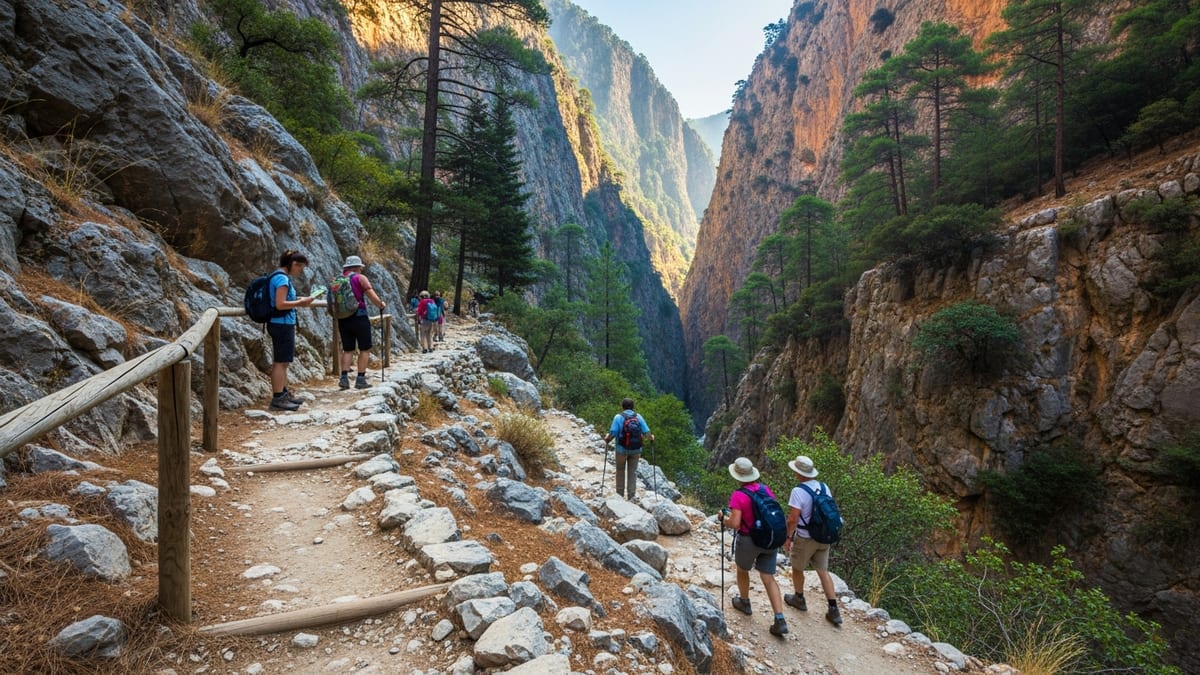
Samaria Gorge is one of Europe’s classic one-way hikes, a dramatic 16 kilometer descent through the White Mountains of Crete that ends at the Libyan Sea. For many visitors to Crete it is the single biggest day out of their trip, but also the one that raises most questions.
How long is the trail really, how difficult is it, and how much time should you allow to do it safely and comfortably? This detailed, up to date guide breaks down the distance, difficulty and timing so you know exactly what to expect before committing to the walk.
Samaria Gorge in a Nutshell: The Key Facts
The standard Samaria Gorge hike runs from the northern entrance at Xyloskalo, on the Omalos Plateau, down to the coastal village of Agia Roumeli. The official national park information describes a central trail of 13 kilometers inside the gorge, plus an additional two to three kilometers from the park exit to the seafront at Agia Roumeli. In practice, most hikers cover between 15 and 16 kilometers from ticket booth to village, then a little more if they walk to the beach at the far end of town.
This is a point to point hike, not an out and back walk. You begin at around 1,200 to 1,250 meters above sea level at Xyloskalo and finish at sea level on the Libyan Sea coast. Almost the entire route runs downhill, with a total descent of roughly 1,200 meters. That makes it easier on the lungs than on the knees, and the steep first section can feel punishing even if you are reasonably fit.
In terms of timing, the Samaria National Park authority and recent hiking guides suggest an average of 5 to 7 hours of walking time for a person of normal fitness, depending on the number and length of your breaks, the temperature and how busy the trail is. Faster hikers sometimes complete the descent in about 4.5 hours of steady walking, while those who stop frequently for photos, swim in Agia Roumeli and take a long lunch can easily turn it into a full 8 hour day between leaving the trailhead and boarding the ferry.
The difficulty is usually rated as moderate, but that label can be misleading. The trail is not technical and does not require special mountaineering skills, and thousands of casual walkers complete it safely every day in high season. At the same time, it is a long, sustained walk on rough, rocky footing with a serious descent, particularly in the first third of the route. For anyone who is unaccustomed to full day hikes, has knee issues or struggles in the heat, it will feel challenging rather than moderate.
Distance Explained: How Far You Really Walk
There is often confusion around the exact length of the Samaria Gorge hike because different sources quote slightly different figures. The national park information and local hiking organizations agree on a central figure of about 13 kilometers for the marked trail from the ticket booth at Xyloskalo down through the gorge to the old Agia Roumeli outpost near the southern entrance gate. From there, you continue another two to three kilometers on a gravel road and path to reach the current village of Agia Roumeli on the coast, bringing the typical total to approximately 15 to 16 kilometers.
Some travel and hiking sites mention 14.5 kilometers, others 16 kilometers, and a few list 18 kilometers including strolling around Agia Roumeli and walking the length of the beach. The difference usually comes down to whether they are measuring strictly from gate to gate inside the national park, or from the upper entrance to the water’s edge. For planning purposes, you should consider Samaria a 16 kilometer day: that will give you a realistic sense of the effort involved and avoid any surprises once you leave the gorge and realize there is still some walking left before a swim and a meal.
Within that total distance, the trail is structured around a series of rest points and small landmarks, such as Neroutsiko, Sykia, the chapel of Agios Nikolaos, the abandoned village of Samaria, and the riverside stop of Christos. These are spaced every 20 to 40 minutes of walking for most people. The signage between them helps you mentally break the distance into manageable sections rather than thinking of the route as one long push from top to bottom.
It is worth noting that while the gorge itself narrows to spectacularly tight sections only a few meters wide near the so called Iron Gates, this does not mean the path is extremely short there. The famous narrow passage comes roughly three kilometers before Agia Roumeli, so by the time you walk through it you still have at least one final hour of hiking left, even though the walls of the gorge are closing in visually.
Difficulty: Is Samaria Gorge Right for You?
The Samaria Gorge hike is widely rated at a medium difficulty level, but those words cover a broad range. To decide if it is suitable for you, it is helpful to understand exactly what that medium label means in this particular context. You do not encounter sheer drops next to the trail, fixed ropes, scrambling or exposure. The path is broad for most of its length and clearly defined. Hiking experience is an advantage, but you do not need to be a mountaineer or an expert trekker.
What you do need is solid general fitness, healthy joints and a realistic understanding of your own limits. The first three to four kilometers from Xyloskalo to the Agios Nikolaos rest area involve a steep descent of several hundred meters on stone steps and rocky switchbacks. This section is the most demanding on the knees and ankles, particularly for anyone with pre existing knee issues or a history of ankle injuries. Trekking poles and well cushioned, supportive footwear make a noticeable difference here.
Once you reach the valley floor near the Samaria village, the character of the trail changes. The rest of the route is never steep for long, but it is consistently uneven underfoot. Much of the path consists of dirt and rock, with loose stones, small boulders and occasional wooden footbridges over the riverbed. You must pay attention to where you place your feet, especially when you are tired around the five or six hour mark. People who underestimate the cumulative effect of this terrain sometimes stumble or twist an ankle late in the day.
Heat adds another layer of difficulty, particularly between June and early September. Midday temperatures in the gorge can rise well above 30 degrees Celsius and into the 35 to 40 degree range during heatwaves. Shade is more plentiful in the upper, forested section and around the middle of the gorge, but the final approach to Agia Roumeli is often exposed and feels significantly hotter. If you struggle in high temperatures or are not used to hiking long distances in the heat, you should treat the difficulty level as moderate to challenging and plan accordingly with an early start, plenty of water and sun protection.
Time Needed: How Long the Hike Really Takes
The official information from the Samaria National Park and a wide range of recent hiking reports place the average time for the full Xyloskalo to Agia Roumeli route at roughly 5 to 7 hours of walking. This estimate assumes an unhurried but steady pace, a handful of short breaks and a reasonably fit hiker who is not racing but also not stopping for extended photo sessions at every bend of the river.
Stronger hikers who are accustomed to long days in the mountains sometimes cover the trail in approximately 4.5 to 5 hours of moving time. That said, many visitors treat Samaria as a once in a lifetime experience and choose to enjoy the scenery rather than focus on speed. They might stop for an extended break in the abandoned Samaria village, pause repeatedly to photograph the cliffs and flora, rest at the Iron Gates and then cool down with a swim and a leisurely lunch in Agia Roumeli. For this more relaxed style of day, you should consider Samaria a full excursion from early morning until the mid or late afternoon ferry departure.
There are a few important timing constraints you must factor into your planning. The gorge normally operates seasonally from around 1 May to 31 October, although the exact dates vary slightly with weather conditions and trail safety. The trail is officially open to enter in the morning, usually from 7:00 until early afternoon, with last entry around 13:00. To comfortably complete the full route, catch the afternoon ferry and avoid hiking in the most intense heat, it is strongly advisable to be inside the park as close to opening time as possible.
Alone, the hike is a long morning and early afternoon, but combined with bus or transfer rides from Chania or other coastal towns, plus the ferry across the Libyan Sea from Agia Roumeli to Sougia or Chora Sfakion, Samaria becomes a long but rewarding full day. If you join an organized excursion, the timetable is usually arranged around the return boat, giving you a fixed window for the hike. Independent walkers should pay close attention to current ferry schedules and give themselves an ample margin of error rather than cutting things fine.
Route Breakdown: What to Expect Section by Section
Understanding how the Samaria Gorge route unfolds helps you set your own pace and manage energy and expectations. The first section from Xyloskalo down to Agios Nikolaos covers roughly four kilometers with a significant descent. You begin right at the rim of the gorge, stepping down stone and wooden steps with metal railings, quickly leaving the plateau behind. Views open out over forested slopes and deep ravines, and you feel the altitude drop in your legs as you zigzag downhill. This is where you need to be careful with footing because the combination of smooth rock, dust and early morning moisture can make the surface surprisingly slippery.
The second section runs from Agios Nikolaos to the abandoned Samaria village. Here the gradient eases and you walk through a mixed forest of pines and cypresses, occasionally crossing the river on small bridges or boulders. The path is still rocky but less punishing than the upper steps. You will pass water points and rest areas where you can refill bottles and take a short break in the shade. By this stage, many hikers have found their rhythm and the crowds begin to spread out along the trail, creating a more peaceful experience.
From the Samaria village to the Iron Gates, the gorge gradually tightens. Cliff walls loom higher, the riverbed becomes more prominent and the trail picks its way between massive boulders and along narrow passages. The famous Iron Gates themselves are the narrowest part of the gorge, where towering vertical cliffs squeeze the path into a short corridor only a few meters wide. This is the most photographed location on the hike, and also a place where congestion can build up in peak season as people pause for photos.
The final section from the Iron Gates to Agia Roumeli surprises some hikers. After the dramatic gorge narrows, the trail slowly widens and the canyon unfolds into a broader valley. You pass the southern park exit checkpoint, where rangers collect your ticket to verify that all visitors have safely left the gorge. From here, roughly two to three kilometers of gravel road and path lead to the modern village of Agia Roumeli. There is some sun exposure and gentle undulation along this stretch, and by now many walkers are tired, making it feel longer than the numbers suggest. Once you see the cluster of tavernas and the strip of beach, however, the sense of arrival and relief is real.
Seasonality, Park Rules and Safety Considerations
Samaria Gorge lies inside a protected national park and a designated UNESCO Biosphere Reserve. That status means it is subject to specific rules and seasonal closures designed to protect both the natural environment and visitor safety. In a typical year, the gorge opens in early May once snowmelt and rain runoff have subsided and the trail is deemed safe. It usually closes at the end of October or earlier if autumn storms render the path unstable or raise the risk of rockfall and flash flooding.
On days with especially high fire risk, extreme heat or severe weather, authorities may either close the gorge entirely or restrict access to shorter sections from each end. If your travel dates fall near the shoulder seasons in April or November, you should not count on the gorge being open and must verify the current status shortly before you go. Even in high summer, early morning checks can result in a same day closure if conditions inside the gorge are judged unsafe.
Once inside the park, you must follow a number of rules. Hikers are required to remain on the main marked trail and avoid entering side ravines or climbing on steep scree slopes. Removing plants, disturbing wildlife, lighting fires, swimming in the streams and discarding litter are all prohibited. Smoking is only allowed at specific rest points. The goal is to limit erosion and disturbance in what is still an important refuge for endemic species, including the wild Cretan goat known as the kri kri.
From a safety perspective, the main risks on the Samaria hike are slips, twisted ankles and dehydration or heat exhaustion on hot days. Rockfall is also a possibility in a deep gorge, particularly after heavy rain or seismic activity, which is part of the reason authorities sometimes close the path. To minimize your own risk, wear sturdy hiking shoes with good grip, pay attention to your footing, carry and drink sufficient water, and take advantage of shady rest areas. If you feel unwell, it is better to slow down, stop and inform a ranger than push on regardless, particularly given that access and evacuation in the gorge are more complex than on a road walk.
How to Plan Your Day: Transport, Timing and Logistics
Because Samaria is a one way hike that ends in a village only accessible on foot or by boat, logistics are a vital part of your planning. Most visitors either join an organized day tour from Chania or Rethymno, or they combine regular buses, ferries and taxis to complete the loop independently. The classic independent route from Chania involves an early morning bus to Omalos and the Xyloskalo entrance, the full hike to Agia Roumeli, an afternoon ferry to Sougia or Chora Sfakion, and then a bus ride back up the coast. This chain of connections works well, provided you coordinate your hiking pace with the latest ferry schedules and leave yourself ample time.
Travelers with a rental car often choose to park in Sougia or Chora Sfakion, catch an early taxi or bus up to Xyloskalo, hike down the gorge and then take the afternoon or early evening boat back to their car. This avoids the complication of retrieving a vehicle left at the trailhead and also allows more flexibility than a fixed coach excursion. If you are staying in Omalos the night before, you can sleep a little later and still start the hike early, which is valuable in peak summer when morning shade and slightly cooler temperatures make a significant difference.
Inside the gorge, facilities are fairly simple but adequate. There are basic toilets and drinking water points at intervals along the route, but no shops or cafes. You must bring all your own snacks and any extra supplies you may need, such as blister plasters or lightweight layers in case weather changes. The ticket price to enter the national park has remained modest and children under a certain age generally enter free, although adults should plan for additional costs in the form of bus tickets and ferry fares.
Once you arrive in Agia Roumeli, you will find several tavernas, small guesthouses and a pebbly beach suitable for swimming. Some hikers choose to spend the night in the village rather than rushing to catch the same day ferry, turning the Samaria hike into a slower paced two day experience. This option is especially appealing to those who want to enjoy the gorge without time pressure, or who wish to walk only the lower part of the gorge from Agia Roumeli up to the Iron Gates and back rather than tackling the full descent from Xyloskalo.
The Takeaway
Samaria Gorge is long enough, rugged enough and hot enough in summer that it deserves real respect, but it is also accessible and straightforward to complete for anyone with decent fitness and preparation. Plan for approximately 16 kilometers of walking, budget at least 5 to 7 hours for the hike itself, and allow a full day once you factor in transfers and the ferry. Expect steep, demanding downhill in the early stages, rough, stony paths along the riverbed in the middle, and a somewhat exposed walk out to the coast at the end.
If you bring proper footwear, carry sufficient water, start early and accept that your pace will be dictated by the terrain rather than ambition, the Samaria hike is more than achievable and immensely rewarding. The drama of the high cliffs, the changing light, the narrow Iron Gates and the sudden emergence at the Libyan Sea make it one of the most memorable single day walks in the Mediterranean. Approached with realism about its distance, difficulty and the time required, it can be the highlight of a trip to Crete rather than an ordeal.
FAQ
Q1: How long is the Samaria Gorge hike from start to finish?
From the upper entrance at Xyloskalo through the gorge to the lower exit and then on to the village and beach at Agia Roumeli, most hikers cover about 15 to 16 kilometers in total.
Q2: How many hours should I allow for the hike?
An average walker should plan on 5 to 7 hours of hiking time, not including bus transfers to the trailhead or the ferry ride from Agia Roumeli back to the road network.
Q3: Is the Samaria Gorge hike suitable for beginners?
It can be suitable for beginners who are reasonably fit, used to walking several hours at a time and do not have serious knee or ankle problems, but it is not ideal as a very first long hike because of the distance and the steep, rocky descent.
Q4: How difficult is the trail, technically speaking?
The trail is not technically difficult, as there is no climbing or exposure, but it is physically demanding due to the 1,200 meter descent, rough rocky footing and the potential for high temperatures, especially later in the season.
Q5: What is the best time of day to start the hike?
Starting as close to the park opening time as possible, typically around 7:00 in the morning, is ideal because it lets you walk the harder sections in cooler temperatures and gives a comfortable margin for catching the afternoon ferry.
Q6: Do I need a guide to hike Samaria Gorge?
A guide is not required because the path is well marked and heavily walked, but some travelers choose an organized tour for the convenience of bundled transport and the reassurance of having a leader who knows the logistics.
Q7: Can children hike Samaria Gorge?
Older children and teenagers who are used to walking long distances and can handle heat and uneven terrain often cope well, but the hike is generally too long and tiring for very young children and should be considered carefully by parents.
Q8: What footwear and gear are recommended?
Sturdy hiking shoes or boots with good grip, breathable clothing, a hat, sunscreen, a small daypack, at least one to two liters of water to start and some high energy snacks are strongly recommended for a comfortable and safe day on the trail.
Q9: Is it possible to hike Samaria Gorge in reverse, from Agia Roumeli up to Xyloskalo?
While it is physically possible, climbing the full distance uphill in the heat is significantly more strenuous and generally not recommended for most visitors; a more realistic reverse option is to walk only from Agia Roumeli up to the Iron Gates and back.
Q10: What happens if the gorge is closed on the day of my hike?
If authorities close the gorge because of weather, fire risk or other safety concerns, entry is not permitted and both independent travelers and tour groups must adjust their plans; in that case you can usually visit other nearby sights or coastal villages, but you will need to rearrange transport and tickets.