

More news on this day
In the eastern Aegean, the Greek island of Samos is emerging as a versatile destination that combines sheltered beaches, UNESCO-listed antiquities and short-sea links to Turkey, positioning itself as a natural crossroads for regional travel in 2025 and beyond.
Get the latest news straight to your inbox!
Beaches Framing an Eastern Aegean Landscape
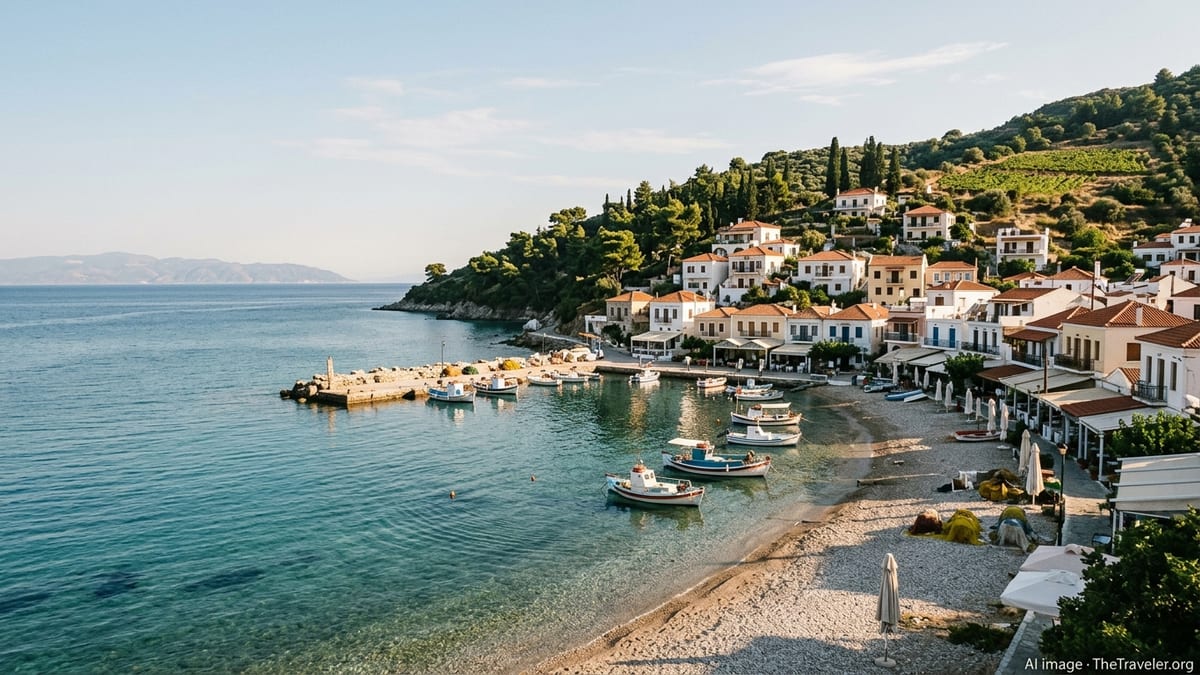
Recent travel guides describe Samos as one of the most scenic islands of the eastern Aegean, highlighting a coastline of pebble and sand beaches backed by pine forests and vineyards. Kokkari, on the north coast, is repeatedly cited for its waterfront setting and proximity to coves popular with swimmers and windsurfers. Tourism platforms also point to Psili Ammos, on the island’s southeast, for its shallow, family-friendly waters and views across the narrow Mycale Strait to Turkey.
Publicly available information from regional ferry and destination sites notes that Samos remains less saturated than some Cycladic islands, with beach areas that still feel integrated into local villages rather than dominated by large-scale resorts. This lower-key profile, combined with comparatively long seasons of mild weather, is helping the island attract travelers looking for quieter coastal stays and multi-day hiking and swimming holidays.
Travel commentary in 2025 continues to promote Samos as part of broader Aegean itineraries, with visitors pairing several beach days on the island with onward ferry trips to neighboring islands such as Ikaria and Patmos. The combination of protected bays, fishing harbors and inland mountain scenery is frequently cited as a key reason Samos is gaining visibility among repeat Greece travelers looking beyond the country’s headline beach destinations.
UNESCO Heritage and the Legacy of Pythagoras
Beyond the beaches, Samos leans heavily on its cultural profile. The island is home to the UNESCO World Heritage site of Pythagoreion and the Heraion of Samos, inscribed in 1992 for their testimony to the island’s significance in Archaic and early Classical Greece. Heritage descriptions emphasize the harbor town of Pythagoreio, built on the remains of the ancient city, along with the sanctuary of Hera and the Eupalinian aqueduct, an underground tunnel considered a landmark of ancient engineering.
Destination material and academic references underline that Samos is traditionally identified as the birthplace of the mathematician and philosopher Pythagoras, as well as astronomer Aristarchus, who is credited with an early heliocentric model of the solar system. This intellectual legacy shapes much of the island’s cultural branding, from festivals to small-scale visitor experiences, with walking routes linking archaeological remains, Byzantine churches and traditional villages.
Local and regional tourism guides also highlight the island’s longstanding wine culture, particularly Muscat-based sweet wines that have been promoted in recent years through museum exhibits and tastings near the main town of Vathy. This pairing of antiquities and viticulture allows Samos to present itself as more than a single-focus beach destination, offering layered experiences that connect ancient trade routes, agricultural traditions and contemporary island life.
Ferries and a Short Sea Bridge to Turkey
Samos’s strategic position off the coast of western Turkey remains central to its current tourism narrative. The island is separated from the Turkish mainland by a strait of roughly 1.6 kilometers, and recent ferry guides list Samos among the primary Greek islands linked to Turkish ports. Services between Samos and Kuşadası, a resort and cruise port near the ancient site of Ephesus, are operated by several companies, with typical crossing times ranging from about 30 minutes to an hour and a half depending on vessel and route.
Ferry platforms and travel agencies describe the Samos–Kuşadası corridor as one of the most popular connections between Greece and Turkey, often promoted as a day-trip option in both directions. Schedules vary with the season, but publicly available information for 2024 and 2025 shows multiple operators marketing Samos not just as an island break, but as a convenient stepping stone for travelers weaving together itineraries across the eastern Aegean.
Long-distance ferry networks also link Samos with mainland ports such as Piraeus and Thessaloniki and with other eastern Aegean islands, reinforcing its role as a node within a wider maritime grid. Travel planners note that this connectivity allows visitors to integrate Samos into overland journeys through Turkey or multi-island circuits in Greece, making it a natural stopping point for those interested in sea travel rather than point-to-point flights.
Cross-Cultural Travel and Easing Access
Recent policy developments have further positioned Samos as a place of cross-cultural encounter. Regional media and public commentary report that Greece has extended a visa facilitation scheme for Turkish nationals, allowing short visits to selected Aegean islands including Samos. Under this framework, Turkish visitors can obtain limited-area visas to spend up to a week on participating islands, a measure that analysts describe as part of a broader attempt to encourage people-to-people contact and tourism cooperation across the Aegean.
Travel operators on both sides of the sea are responding by packaging combined experiences, pairing stays on Samos with excursions to sites such as Ephesus and the coastal towns of western Turkey. Marketing materials emphasize shared maritime history, overlapping culinary traditions and the ease of combining Greek island beaches with Turkish urban and archaeological visits in a single itinerary.
Observers of regional tourism trends suggest that these developments are gradually shifting perceptions of Samos from a relatively isolated Greek island to a more prominent gateway between two neighboring countries. With short ferry crossings, simplified visa options for certain visitors and expanding study-abroad and cruising programs that stop at the island, Samos is increasingly presented as a space where travelers can engage with both Greek and Turkish cultural spheres during the same trip.
Outlook for a Diversified Island Destination
Looking ahead to the 2025 and 2026 seasons, publicly available tourism forecasts indicate steady interest in eastern Aegean destinations that combine coastal landscapes with heritage and cross-border mobility. Samos appears well placed within this trend, offering a mix of sheltered beaches, recognized archaeological sites and regular sea links to multiple ports.
Local promotional material continues to stress that the island’s appeal lies in balance. Visitors can spend mornings at Pythagoreion’s harbor and its hillside ruins, afternoons at nearby beaches, and then board ferries that reposition them within hours to another island or to the Turkish mainland. For travel planners building multi-country routes, that versatility is becoming a significant draw.
As ferry schedules are refined and visa facilitation schemes are evaluated year by year, Samos’s profile as both a holiday island and a maritime crossroads is likely to remain central to how the destination is marketed. For travelers, the island offers a compact introduction to the eastern Aegean, where sea, history and cross-cultural exchanges are closely intertwined.