

More news on this day
Hundreds of travelers departing San Antonio International Airport are reporting abrupt flight cancellations and missed connections to major U.S. destinations this week, as a volatile mix of severe weather, thin airline staffing and already constrained schedules leaves passengers sleeping in terminals and scrambling for scarce rebooking options.
Get the latest news straight to your inbox!
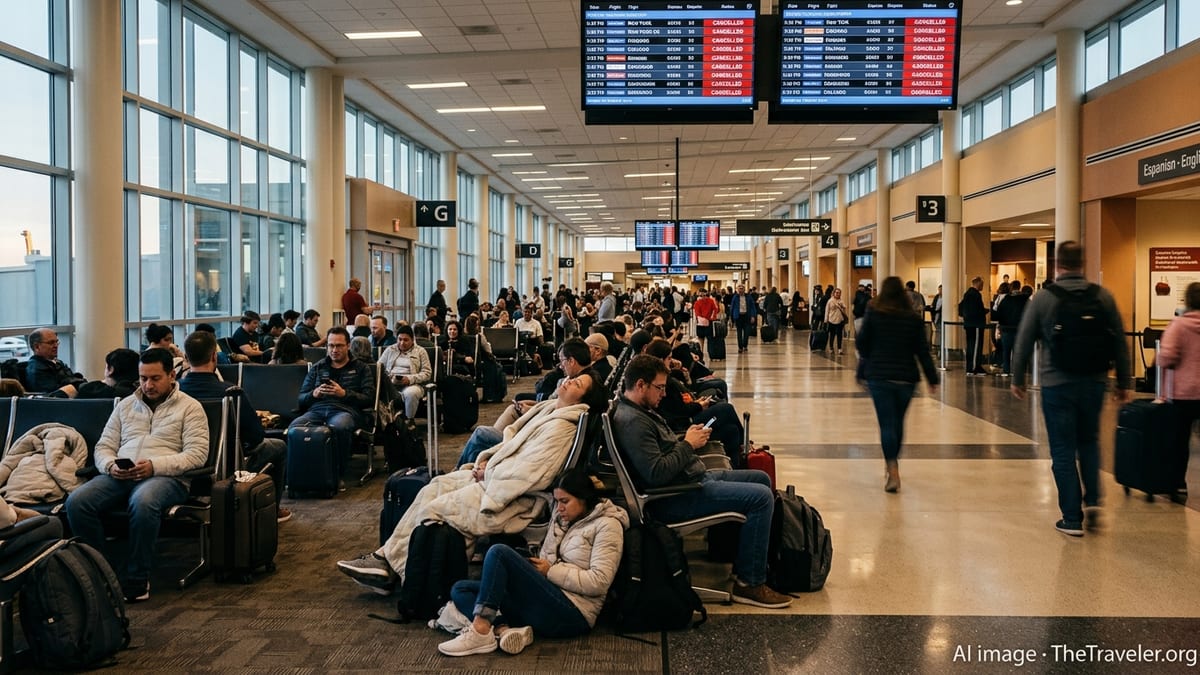
Disruptions Hit San Antonio as National Flight Cancellations Mount
Published coverage and real-time flight tracking data show that airlines across the United States are grappling with widespread disruptions in mid-March, with thousands of flights canceled or delayed as powerful storms move through key hubs and a partial federal government shutdown strains airport staffing. Against that backdrop, passengers departing San Antonio report a sharp spike in last-minute cancellations and hours-long delays on routes to top leisure and business destinations.
Reports indicate that cancellations affecting San Antonio are often tied to problems far from Texas. Major hubs such as Dallas Fort Worth, Chicago, Atlanta and Orlando have seen large numbers of grounded or heavily delayed flights, which in turn ripple into San Antonio’s relatively small schedule. When an aircraft or crew never arrives from a storm-battered or short-staffed hub, entire rows of departures from San Antonio to cities like New York, Washington, Denver, Phoenix and Orlando can vanish with little warning.
Passenger accounts shared on social platforms describe travelers bound for spring break destinations and business trips being stranded for a full day or more, sometimes after boarding and then deplaning, as flights are first delayed repeatedly and then canceled outright. With San Antonio’s limited nonstop options compared with nearby Austin or Houston, many travelers find that same-day alternatives simply do not exist once their original flight is scrubbed.
Why So Many Flights Vanish at Once
Publicly available information about current disruptions suggests that the problem in San Antonio is not a single local failure, but the result of several national pressures converging at the same time. A powerful storm system marching across the eastern half of the country has forced carriers to cancel or delay thousands of flights, especially at large connecting hubs that handle traffic from San Antonio-bound and San Antonio-originating aircraft. When a hub slows down, every spoke city feeding into it inevitably feels the impact.
In addition, the ongoing partial government shutdown has reduced staffing flexibility at some airport security checkpoints nationally, putting more strain on already crowded terminals during the busy spring break and March college basketball travel period. While San Antonio International has not reported a formal halt in operations, any slowdown or ground stop at a major hub quickly removes aircraft and crews from the rotation that San Antonio relies on for connections to top U.S. destinations.
Industry analyses published in recent months also highlight long-running vulnerabilities in airline operations that are now being exposed. Airlines trimmed schedules and staffing during slower travel periods, and have been cautious about fully rebuilding capacity. Flight attendants and pilots remain tightly scheduled, meaning that any weather delay can quickly push crews beyond legal duty limits. Once that happens, flights departing smaller markets like San Antonio are among the first to be cut in favor of protecting higher-revenue long-haul routes.
Budget Carriers, Tight Schedules and Limited Alternatives
San Antonio travelers appear to be feeling the effects of both full-service and low-cost carriers as disruptions cascade through the system. Recent discussions about the future of ultra-low-cost service at San Antonio International, including questions about routes from airlines such as Spirit and Frontier, underscore how delicate the city’s network can be. When a budget carrier pares back nonstop flights to western or coastal cities, travelers have fewer options even before bad weather or staffing gaps enter the picture.
Current disruptions at some low-cost carriers in other parts of the country, with reports of large blocks of cancellations and long rebooking lines, are another warning sign for San Antonio passengers attempting to reach top destinations on tight itineraries. When those airlines operate only one or two daily flights on a given route, a cancellation can leave travelers with no realistic way to depart until the next day or even later.
San Antonio’s own traffic statistics show that the airport is still rebuilding from past downturns, with overall capacity recently reported as below prior peaks. That leaves little slack in the system when national events disrupt aircraft and crew positioning. Travelers who miss one connection out of a hub may quickly discover that there are no onward seats left, causing them to back up into San Antonio’s terminals while they wait for space to open on later flights.
What Airlines Are Not Emphasizing to Stranded Passengers
As travelers crowd gates and customer service desks, much of the focus falls on immediate causes such as “weather,” “air traffic control” or “crew availability,” which are often the only explanations visible in airline apps. Less discussed are the structural choices that make a single storm system or staffing shortfall so disruptive, particularly for mid-size markets like San Antonio that depend on a handful of key connections.
Publicly available analyses of recent airline disruptions note that many carriers continue to operate very tight aircraft rotations, with limited spare planes and crews available to absorb delays. When a flight from a hub to San Antonio is canceled, the aircraft scheduled to operate the next departure out of San Antonio may never arrive, triggering a chain reaction of cancellations. Airlines often describe these as weather or operational issues without highlighting how lean scheduling magnifies the impact.
Another factor rarely highlighted in day-of-travel messaging is the difference between controllable and uncontrollable disruptions from a passenger compensation standpoint. Weather-related cancellations typically limit eligibility for hotel vouchers or meal support, while crew scheduling or equipment issues can fall into more ambiguous territory. Passengers stranded in San Antonio report that it can be difficult to understand what level of assistance they are entitled to, especially when a flight is initially attributed to one cause and later updated in internal systems.
Consumer advocates also point out that carriers do not generally volunteer information about alternative airports unless asked. For San Antonio passengers trying to reach major U.S. destinations during a systemwide crunch, routing through Austin or Houston by rental car or bus can sometimes be faster than waiting days for an open seat from San Antonio, but that option may not be clearly presented during stressful rebooking conversations.
What Travelers from San Antonio Can Do Right Now
With disruptions continuing, travel experts recommend that San Antonio passengers treat any trip over the coming days as potentially subject to major change. Monitoring flight status continually, even the night before departure, can provide early warning if an inbound aircraft is delayed or canceled. Passengers who see their connecting hub hit by storms or heavy cancellations may want to proactively explore alternate routings rather than waiting at the gate for rolling delays.
Publicly available guidance also stresses the value of using multiple channels at once when a flight from San Antonio is canceled. Airline apps and websites sometimes offer rebooking options faster than airport agents can, particularly when long lines form at customer service desks. At the same time, contacting the airline by phone or through direct messaging can surface possibilities that are not visible in automated tools, including reroutes through different hubs or nearby airports.
Travelers departing San Antonio are further advised to document all disruptions, including screenshots of delay codes and cancellation notices, in case they later seek refunds or compensation. Keeping receipts for unexpected expenses such as hotels, meals and ground transportation can be important if policies allow reimbursement under certain circumstances. For those with critical travel, such as international connections or time-sensitive events in other cities, building in extra buffer days may be the only true safeguard in a period of heightened volatility.
For now, the experience of San Antonio passengers bound for top U.S. destinations illustrates how quickly the national air travel system can seize up when weather, staffing and tightly wound schedules collide. As the broader crisis plays out across multiple hubs, travelers in South Texas are being reminded that even a relatively calm local forecast offers no guarantee that their flight will actually depart.