

More news on this day
San Diego International Airport is grappling with long security lines and pockets of flight delays as the ongoing Department of Homeland Security shutdown fuels staffing shortages among federal screeners and aviation workers nationwide.
Get the latest news straight to your inbox!
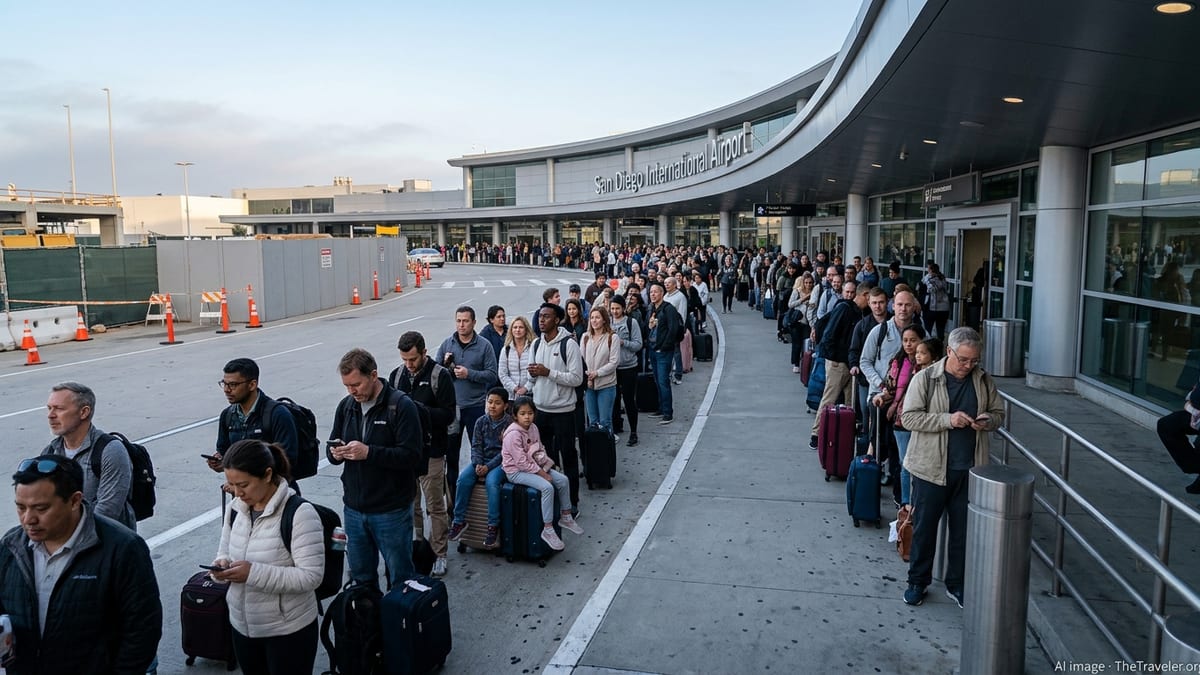
Morning bottlenecks stretch outside terminals
Recent days have brought striking early-morning backlogs at San Diego International, with travelers reporting security queues extending from checkpoints through Terminal 1 and out toward curbside drop-off areas. Social media posts and local discussion boards describe lines forming before dawn and snaking outside the building as passengers wait for security lanes to open.
Publicly available information indicates that Transportation Security Administration staff at San Diego, as in many other cities, are working through an extended period of financial uncertainty as the DHS funding lapse drags on. National data show elevated callout rates and resignations among screeners, leaving some checkpoints more thinly staffed at precisely the hours when departures are most concentrated.
The uneven staffing picture appears to be creating a split experience for travelers. Passengers arriving before 5:30 a.m. for 6 a.m. departures report waits of an hour or more in general screening, while those flying later in the morning or afternoon often describe moving through TSA in a fraction of that time. Frequent flyers note that the early opening time for checkpoints has become a critical factor, with lines building rapidly once bag-drop counters and security lanes begin accepting passengers.
Airport contingency planning documents highlight that San Diego International is heavily dependent on efficient passenger flow during peak morning “banks” of flights, particularly from low-cost carriers in Terminal 1. Even small reductions in available staff at checkpoints can therefore trigger visible lines that spill into public areas, feeding anxiety among travelers and prompting many to arrive far earlier than usual.
Nationwide TSA strain ripples through San Diego
The pressures at San Diego are unfolding against a national backdrop of prolonged stress on airport security operations. According to recent coverage from major news outlets, TSA has seen thousands of officers call out sick or resign across the country since the DHS shutdown began on February 14, as workers navigate missed or delayed paychecks and uncertainty over when full funding will resume.
Reports indicate that absentee rates at some major hubs have climbed to several times normal levels, prompting temporary closure of PreCheck or priority lanes and consolidation of checkpoints. Analysts note that when staffing falls short in one region, federal managers may reassign officers from smaller or mid-sized airports to the busiest hubs, potentially tightening resources in markets like San Diego even when local callout rates are moderate.
National aviation briefings describe a patchwork of conditions for travelers, with some airports moving smoothly at off-peak times and others experiencing wait times of two to three hours during rush periods. San Diego appears to mirror that pattern: relatively manageable processing for many midday and evening flights, contrasted with unpredictable congestion in the early morning wave.
Separate reports also describe federal plans or proposals to draw on personnel from other agencies, including Immigration and Customs Enforcement officers, to assist TSA at select airports. Aviation security experts caution that such stopgap measures have limits, given that specialized training is required for screening duties, and that untrained staff can only support ancillary tasks such as crowd management.
Flight delays and missed connections add to disruption
While San Diego has not seen the worst of the ground stops and large-scale cancellations affecting some East Coast and Southern hubs during the shutdown, delays linked to staffing strains are increasingly visible on departure boards. Public flight-tracking data show clusters of late departures in the early morning and evening banks, particularly on days following spikes in national absentee rates among screeners and air traffic personnel.
Travel industry advisories point out that congestion at security checkpoints can translate into missed departure times even when aircraft and crews are ready. When large numbers of passengers reach gates late due to long lines, boarding takes longer and flights may miss their scheduled departure windows, causing knock-on delays throughout the day. Connections through other hubs can become more precarious, especially for travelers with tight layovers.
According to guidance from travel associations, airlines are generally operating full schedules out of San Diego, but with more frequent minor delays than in typical periods. Passengers who miss flights because they were stuck in security lines may be rebooked, subject to availability, yet they are not always entitled to additional compensation. Consumer advocates are urging travelers to document wait times and monitor airline notifications closely as conditions evolve.
The fragile state of the broader air traffic system also looms over San Diego’s operations. National coverage notes that any further reductions in staffing among controllers could force the Federal Aviation Administration to slow traffic flows into busy airspace, potentially impacting arrivals and departures along the West Coast and creating additional delays for San Diego-bound flights.
Airport and airlines emphasize preparation and flexibility
San Diego’s airport authority has long maintained irregular-operations and emergency contingency plans that outline how the facility would respond to prolonged disruptions, including federal funding lapses. Those documents, made public as part of regulatory requirements, emphasize coordination with federal partners, airlines and concessionaires to keep essential services functioning even when some staffing is constrained.
While the current shutdown is centered on DHS rather than the entire federal government, the impact on TSA and related security operations is enough to test those plans in real time. Public advisories from airlines serving San Diego are urging passengers to arrive earlier than usual, enroll in trusted traveler programs where possible, and use mobile apps to track gate changes, rebookings and same-day standby options.
Airport observers say that local infrastructure projects, including the ongoing redevelopment of Terminal 1, add complexity to crowd management. Construction walls, temporary walkways and evolving curbside traffic patterns can make it harder to absorb unusually long lines, particularly at peak times. Wayfinding signage and staff directing crowds have become more important as first-time visitors navigate both the shutdown-related congestion and the changing layout.
For many travelers, flexibility has become the watchword. Travel agents and online booking platforms recommend building in extra time for connections through hubs known to be hard-hit by staffing shortages and considering flight options that avoid the earliest departures if schedules permit. In San Diego, passengers who can shift to mid-morning or afternoon flights often report a calmer experience at security, even as the early rush remains unpredictable.
Uncertain outlook as shutdown negotiations continue
The trajectory of conditions at San Diego International will largely depend on developments far from the airport itself. Negotiations in Washington over DHS funding have yet to produce a long-term deal, and national coverage describes a political standoff that shows few signs of quick resolution. Temporary measures to pay TSA employees partially ease financial pressure but have not fully stabilized staffing, according to recent reports.
Aviation analysts warn that, if the shutdown persists, more screeners may seek other jobs, deepening shortages even after funding is restored. Past shutdowns have shown that rebuilding staffing levels can take months, leaving airports to manage lingering operational challenges long after the political crisis has officially ended.
In the meantime, San Diego travelers face a reality of day-to-day uncertainty. One morning may bring modest lines and on-time departures, while the next sees queues stretching outdoors and a string of delayed flights. Local chatter suggests that the visibility of the lines is itself reinforcing the problem, as anxious passengers arrive earlier and swell the crush around opening time.
For now, the experiences of San Diego passengers reflect the broader story playing out at airports across the United States: an aviation system still functioning, but under strain from a funding impasse that has turned routine security checks into a source of national frustration.