

More news on this day
Thousands of air travelers across the United States and Canada faced fresh uncertainty on March 7 as cascading disruptions at San Diego International Airport and Raleigh-Durham International Airport triggered 144 flight delays and 106 cancellations, snarling connections through major hubs from Detroit and Chicago to New York, Boston and Atlanta.
Knock-on Turmoil From West Coast to Research Triangle
Operational problems concentrated at San Diego International and Raleigh-Durham International quickly spilled into the wider North American network, according to flight-tracking data and airport status boards on Saturday. While both airports handle smaller volumes than the country’s busiest hubs, their role as key spokes for major carriers meant schedule changes reverberated through dozens of domestic and transborder routes.
By early afternoon, at least 144 flights linked to San Diego and Raleigh-Durham were reported delayed, with 106 canceled outright. Travelers connecting through those airports to or from cities including Detroit, Atlanta, Boston, New York and Chicago reported sudden gate changes, rolling departure times and overnight rebookings as airlines raced to reposition aircraft and crews.
Industry analysts note that even a modest concentration of cancellations at mid-sized airports can quickly create outsized disruption. When crews time out or aircraft go out of rotation, the effects are often felt hundreds or even thousands of miles away, particularly on tightly wound evening and early-morning bank schedules.
Airports in Canada also began to feel the strain as cross-border flights were held for inbound crews or reassigned to cover domestic routes. Passengers at Toronto, Montreal and Vancouver reported growing queues at customer service desks as airlines attempted to juggle limited spare capacity at the tail end of a busy winter travel period.
Travelers Stranded From Detroit to Boston
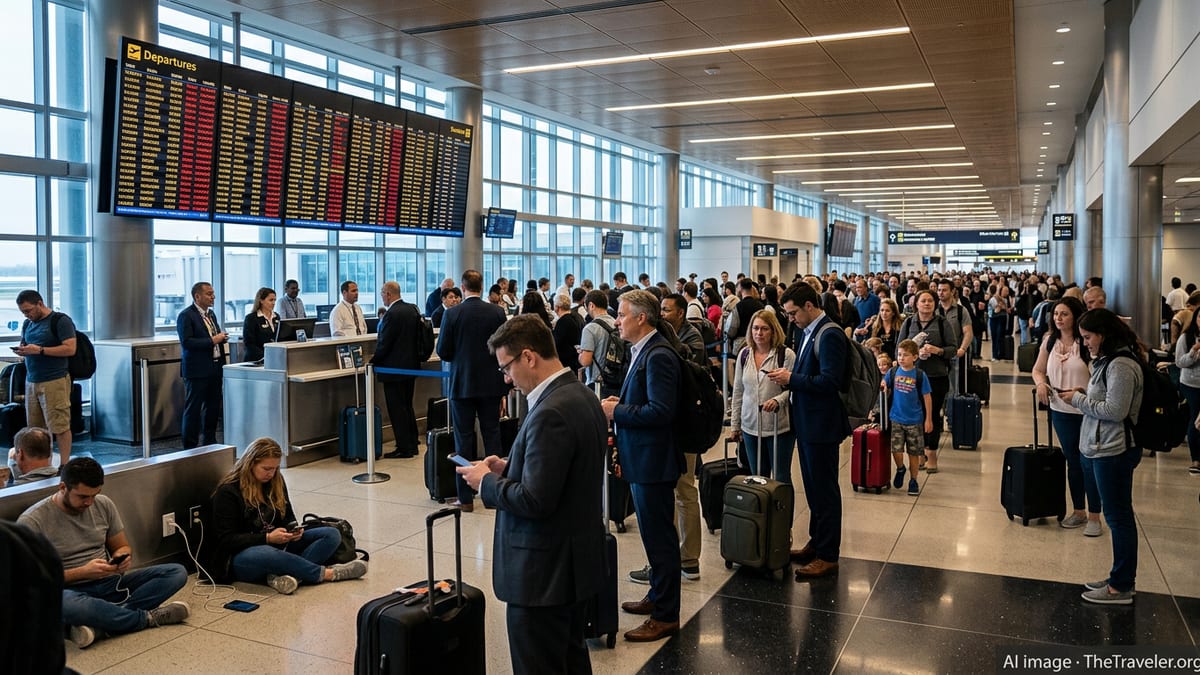
At Detroit Metropolitan Wayne County Airport, passengers bound for Southern California and the Carolinas described clogging departure concourses and flashing delay notices on departure boards. Many had already endured weather-related disruptions in recent weeks and arrived at the airport expecting a routine trip, only to find their connecting flights through San Diego or Raleigh-Durham grounded or significantly delayed.
In Chicago and Atlanta, two of the country’s busiest aviation hubs, airline agents fielded a wave of rebooking requests as misaligned connections piled up through the day. Some passengers were rerouted through alternative hubs such as Dallas-Fort Worth or Denver, while others were offered next-day departures or refunds in line with federal rules for canceled flights.
Boston Logan and New York area airports, still in recovery mode after repeated winter storms over the past month, were particularly vulnerable to fresh schedule shocks. Travelers reported that even flights not directly touching San Diego or Raleigh-Durham were pushed back as carriers shuffled aircraft between transcontinental and short-haul routes to protect long-haul operations and crew rest requirements.
For leisure travelers returning from school holidays and business passengers heading to early-week meetings, the compounding effects were felt in missed events, unplanned hotel stays and hours spent on support lines. Social media feeds filled with photos of departure boards peppered with red and yellow delay indicators, along with calls for clearer, earlier communication from carriers.
What Is Driving the Latest Wave of Disruptions
While airlines did not immediately identify a single underlying cause, early indications suggested a mix of lingering weather constraints in parts of the country, tight aircraft utilization and continued sensitivity to any local operational hiccups after an already difficult winter season for aviation. San Diego’s coastal location and runway configuration can magnify the impact of even minor weather or airspace constraints, while Raleigh-Durham serves as a critical connecting point in the busy Eastern corridor.
Recent weeks have seen a series of storms batter major hubs in the Northeast and Midwest, leaving airlines with reduced slack in their systems and aircraft often out of ideal position. When irregular operations hit secondary hubs like San Diego and Raleigh-Durham, carriers have less spare capacity to absorb new disruptions, leading to quick escalation from a handful of delayed departures to triple-digit totals.
Aviation consultants say the pattern is becoming more familiar as airlines optimize schedules around peak demand and leaner staffing. With tighter turn times and fuller planes, relatively routine issues such as minor maintenance checks, crew duty limits or brief air traffic control restrictions can snowball into widespread knock-on effects across regions.
Regulators have been pressing carriers to improve their resilience and passenger care policies after several high-profile meltdowns in recent years. However, consumer advocates argue that progress has been uneven and that travelers still bear the brunt of the cost and stress when cascading delays emerge on busy travel weekends.
Airlines Scramble to Recover and Rebook
Airlines serving San Diego and Raleigh-Durham moved quickly to trim schedules, consolidate lightly booked flights and prioritize routes with the most connecting passengers. In some cases, carriers deployed larger aircraft on select services in an effort to accommodate disrupted travelers, while canceling less critical segments where alternative options were more readily available.
Ground staff at affected airports reported long but generally orderly lines at customer service desks as passengers sought meal vouchers, hotel information and new itineraries. Many travelers turned to airline mobile apps and online chat tools to avoid waiting in physical queues, though some complained of app crashes and long virtual hold times during the busiest hours of the day.
At hubs including Atlanta, Chicago and New York, crew schedulers worked behind the scenes to source reserve pilots and flight attendants, sometimes shuttling them on short repositioning flights from nearby cities. Even with such measures, airline officials cautioned that full recovery could take into the next operating day, particularly for early-morning departures that depend on aircraft and crews ending up in the right place overnight.
Hotel operators near key airports reported a spike in same-day bookings, with some properties close to San Diego, Raleigh-Durham and major connecting hubs approaching full occupancy by Saturday evening. Ride-share drivers around the airports also saw a surge in demand as passengers opted to leave and try again the following day rather than wait for uncertain standby seats.
What Travelers Can Do Now
With schedules in flux, travel advisers urged passengers to assume that knock-on delays could persist into Sunday, especially for itineraries involving tight connections through San Diego, Raleigh-Durham or already congested hubs in the Northeast and Midwest. They recommended that travelers check flight status frequently, even after arriving at the airport, and be prepared with backup routing ideas in case a last-minute cancellation occurs.
Experts also advised that travelers review their rights under airline contracts and federal regulations. While carriers must offer refunds for canceled flights a passenger chooses not to take, compensation for hotels, meals and ground transportation often depends on whether the disruption is deemed within the airline’s control. Keeping receipts and documenting interactions with staff can help in later reimbursement requests or customer relations claims.
For future trips, frequent flyers suggest building in longer connection times when linking through weather-prone hubs during winter and early spring, and avoiding the last flight of the evening on critical legs whenever possible. Purchasing flexible or refundable fares, or paying with credit cards that include robust travel protection, can also provide a safety net when large-scale irregular operations emerge.
Airports and airlines signaled that they would continue to monitor the evolving situation through the weekend as they worked to stabilize schedules. For the thousands of travelers whose plans were upended on Saturday, the latest disruption served as another reminder of how interconnected and fragile the modern air travel system has become at the peak of the busy season.