

More news on this day
San José Mineta International Airport has introduced IntBot, an AI powered humanoid robot that greets passengers, answers questions, and guides travelers through the busy Bay Area hub using conversational artificial intelligence.
Get the latest news straight to your inbox!
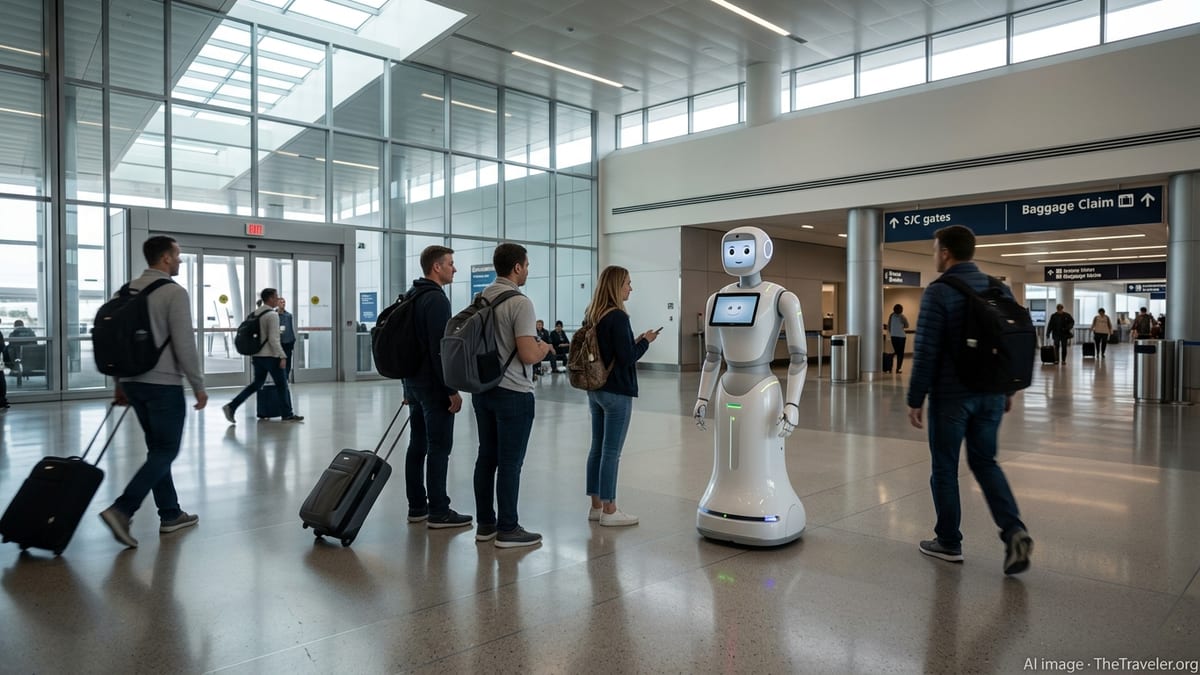
New AI Humanoid Marks a First for the Silicon Valley Gateway
The launch of IntBot at San José Mineta International Airport positions the Silicon Valley gateway as an early adopter of humanoid robotics for real time passenger assistance. Publicly available information describes the robot as a mobile, humanlike assistant that can move through terminal spaces, interact via voice and on-screen text, and draw on live airport data to support travelers.
The deployment aligns with the airport’s wider push to highlight San José’s technology ecosystem inside its terminals. Previous initiatives have included digital wayfinding tools and interactive art centered on robotics and space themes. The arrival of IntBot brings that emphasis into a more practical, service focused role that travelers can engage with directly.
Early coverage indicates that IntBot will operate in high traffic public areas such as check in halls and post security concourses, where passengers most often need help with directions, gate changes, and last minute itinerary questions. The humanoid form factor is intended to make the system easier to spot from a distance and more intuitive to approach than a static kiosk.
Airport observers note that the rollout comes at a time when hubs across the United States are experimenting with AI driven tools to manage crowds and streamline information. By adopting a humanoid robot, San José Mineta International Airport is testing whether a more expressive and mobile platform can deepen traveler engagement with these technologies.
How IntBot Assists Travelers Inside the Terminal
According to published descriptions, IntBot connects to airport information systems to provide details on flight status, gate locations, security wait times, and ground transportation. Travelers can ask spoken questions, and the robot’s onboard AI interprets the request, retrieves the relevant data, and responds conversationally while displaying key information on an integrated screen.
The humanoid robot is expected to complement rather than replace existing customer service touchpoints such as staffed information counters and digital signage. For example, a traveler who has just landed can ask IntBot for the fastest route to baggage claim and rideshare pickup, while another passenger might use the system to locate a specific restaurant, bottle filling station, or family restroom near their gate.
Reports indicate that IntBot’s mobility allows it to reposition as traffic patterns shift during the day, operating in departures during the morning rush and moving closer to arrivals areas as evening flights land. This flexibility is intended to keep the robot present in areas where questions are most frequent, while minimizing congestion in already crowded spaces.
The AI system also supports multiple languages, reflecting the airport’s mix of domestic and international routes. For visitors who are unfamiliar with American airport layouts, the combination of spoken guidance, on screen maps, and a clearly visible humanoid figure aims to lower stress during tight connections or first time visits.
Design, Safety, and Accessibility Considerations
IntBot’s humanoid design has been shaped around approachability and safety in shared public spaces. Public materials emphasize softer contours, moderate height, and smooth movements intended to feel welcoming rather than industrial. Integrated sensors help the robot navigate around luggage, strollers, and groups of travelers while maintaining a safe distance.
Lighting, sound, and display features have been adapted to the visual and acoustic environment of a large terminal. The front facing screen is designed for legibility under bright overhead lights and varying reflections from windows, while audio responses are tuned to cut through background noise without being intrusive. Clear visual cues signal when the robot is listening, thinking, or responding, which helps users understand what is happening during an interaction.
Accessibility considerations include large text options, simple icon based menus, and the ability to interact via touch instead of voice for passengers who are deaf or hard of hearing, or who prefer not to speak in public. Seating areas and wide corridors near the robot’s primary operating zones are expected to make it easier for passengers with reduced mobility to approach and use the system.
Observers in the aviation and robotics communities are watching how travelers respond to a humanoid presence in queues and circulation spaces. If passengers find the design intuitive and non obstructive, San José Mineta International Airport’s approach could become a reference point for other medium sized airports considering similar deployments.
Part of a Broader Move Toward AI Enhanced Airport Services
The introduction of IntBot fits into a broader wave of AI adoption in the travel sector, from automated baggage systems to predictive maintenance and biometric identity checks. Industry analyses describe humanoid robots as a natural next step in customer facing applications, where natural language interfaces can reduce confusion and shorten informal help interactions.
San José Mineta International Airport has already appeared in discussions about driverless ground transportation and digital wayfinding, reflecting the region’s concentration of technology companies and startups. The decision to pilot a humanoid robot for in terminal assistance builds on that identity and showcases how AI tools can be embedded directly into the passenger journey.
Travel technology observers note that airports are under pressure to manage growing passenger volumes without proportionally increasing staffing. AI powered systems like IntBot are being tested as one way to extend service coverage, especially during off peak hours or irregular operations when information needs spike but staff may be stretched thin.
The performance of IntBot during its first months will likely influence how quickly similar systems appear elsewhere. Metrics such as number of interactions, average question types, and changes in wayfinding related complaints are expected to shape future investment in humanoid assistance platforms across the aviation sector.
What Travelers Can Expect When Meeting IntBot
For travelers passing through San José Mineta International Airport, encountering IntBot will feel similar to approaching an information desk that can move and respond instantly to a wide range of questions. Passengers can walk up to the robot, wait for a visual cue that it is ready, and then ask for help in plain, conversational language.
Those who are hesitant to speak to an AI system can instead tap options on the display, filtering by topics such as flights, services, shopping, dining, or transportation. The robot then presents clear, step by step directions, often accompanied by simple maps that highlight the most direct route through the terminal.
Families and tech curious travelers may treat IntBot as both a functional tool and a novelty, using it for directions while also exploring its capabilities. Business travelers facing tight connections may focus on speed, asking targeted questions about gate changes, estimated walking times, or the quickest way to reach security.
As usage patterns become clearer, San José Mineta International Airport may refine where and how often IntBot appears, and whether additional units are justified. For now, the humanoid robot stands as a visible sign of how AI is moving from back office systems into the center of the passenger experience at one of Northern California’s key air gateways.