

More news on this day
San José Mineta International Airport has introduced IntBot, an AI-powered humanoid robot designed to help travelers with directions, information, and basic customer-service tasks as the hub expands its use of emerging technologies in the terminal.
Get the latest news straight to your inbox!
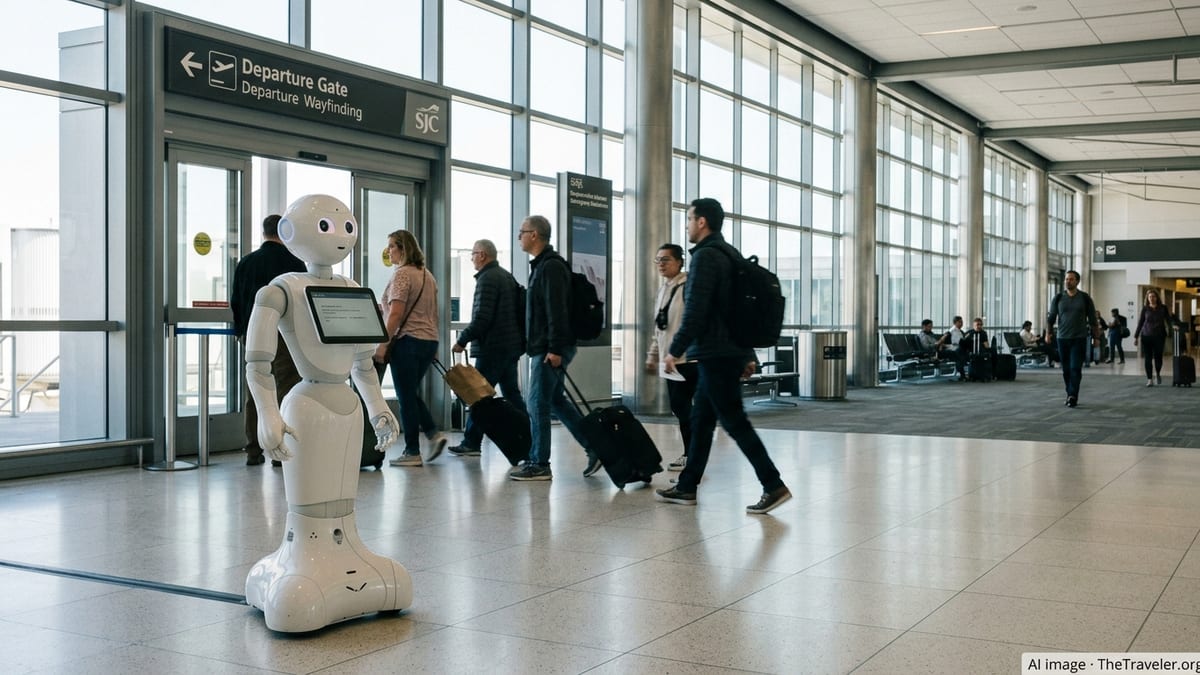
A New Humanoid Presence in the Terminal
Publicly available information indicates that IntBot has been deployed inside the terminal at San José Mineta International Airport as a mobile, humanoid-style service robot. The unit is designed to move around pre-mapped areas of the concourses, interact with travelers through a touchscreen and voice interface, and serve as a highly visible guide in some of the airport’s busiest spaces.
Reports describe IntBot as roughly child-sized, with a rounded head, expressive digital “face,” and a body that incorporates cameras, sensors, and a display panel. The form factor is intended to appear approachable while still housing the hardware required for navigation and interaction in a crowded, noisy environment.
The airport has experimented with interactive technology before, including earlier generations of stationary information robots. The rollout of IntBot represents a shift toward more autonomous, AI-driven systems that can move with passengers, respond to evolving conditions in real time, and gather operational data to support future planning.
AI Features Tailored to Busy Airport Operations
According to published coverage, IntBot relies on a mix of conversational artificial intelligence, natural language processing, and sensor-based navigation. The robot is designed to understand spoken questions in multiple languages, offer concise responses, and display supplemental details on its touchscreen, such as gate information or directions to security checkpoints, restrooms, or concessions.
Behind the scenes, IntBot uses mapped routes and obstacle-avoidance technology so it can travel short distances in public areas without disrupting passenger flow. Its cameras and proximity sensors support path planning in environments where rolling luggage, families, and queues create shifting obstacles throughout the day.
Reports indicate that the system can be updated remotely with changing airport information, including terminal layout adjustments, occasional construction impacts, and seasonal service changes. That approach allows the robot’s guidance to reflect current conditions, rather than relying on static signage alone.
Enhancing the Passenger Experience at a Tech-Focused Airport
San José Mineta International Airport sits in the heart of Silicon Valley and has developed a reputation for piloting emerging technologies in its terminals. Public information shows that previous initiatives have included interactive robot programs, upgraded digital wayfinding, and partnerships around autonomous vehicle access to the airport.
The introduction of IntBot fits into that broader pattern by offering travelers another self-service option. Instead of waiting in line for in-person assistance, passengers can approach the robot for help locating their gate, clarifying basic check-in steps, or finding nearby dining and retail options. The interaction is intended to be straightforward, with clear on-screen prompts and simple spoken responses.
For families and infrequent travelers, the humanoid design also functions as a point of engagement and reassurance. Observers note that the robot’s moving head, changing facial expressions, and ability to play short audio cues are meant to make the experience more memorable than a static kiosk, while still providing practical information.
Data, Testing, and the Future of Airport Robotics
Reports indicate that IntBot’s launch at San José Mineta International Airport is being treated as a live test of how AI-powered humanoid robots can operate in a complex public space. Each interaction helps the airport and its technology partners understand when travelers are most likely to seek robotic assistance, which questions are most common, and how the robot’s presence affects wayfinding behavior.
The data gathered can inform decisions about where to position future units, what languages and features are most valuable, and how robots might complement or relieve pressure on traditional customer-service desks. It may also guide refinements to the robot’s software, including improved speech recognition in noisy areas and more context-aware responses.
Industry observers point out that airports in North America, Europe, and Asia have been experimenting with service robots for several years, ranging from simple rolling information units to more advanced humanoid designs. IntBot’s deployment at San José Mineta International Airport signals that this trend is now entering a new phase, in which AI capabilities and real-time data integration are central to how these systems are conceived and evaluated.
Implications for Travelers and Regional Connectivity
The presence of IntBot at San José Mineta International Airport comes at a time when Bay Area air travel is evolving, with new mobility options and technology pilots appearing across the region. Within that context, the robot functions as a visible example of how digital tools are being layered onto existing infrastructure to improve the passenger journey.
For travelers, the immediate effect is an additional, highly noticeable way to get information without opening an app or searching for a staffed counter. For the airport, the robot offers a flexible platform that can be adjusted as flight schedules, passenger volumes, and terminal layouts change in the coming years.
As AI systems continue to advance, San José Mineta International Airport’s IntBot experiment provides an early look at how humanoid robots may become a more familiar presence in large transport hubs. The current deployment suggests that, for now, the emphasis is on practical assistance, modest automation gains, and an experience that reflects the innovation-focused identity of the region.