

More news on this day
San José Mineta International Airport is introducing a new artificial intelligence service robot named José, marking a fresh phase in the airport’s long-running push to use emerging technology to improve efficiency and the passenger experience.
Get the latest news straight to your inbox!
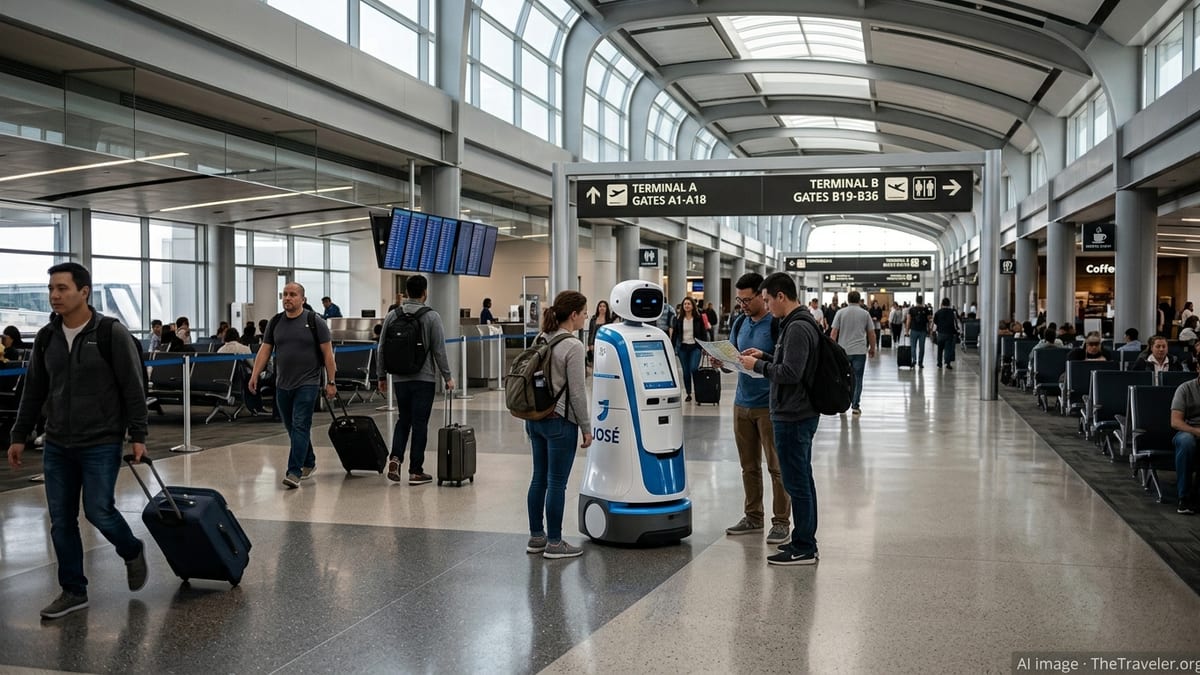
A New Digital Concierge for Silicon Valley’s Airport
Positioned in busy terminal corridors, José is designed as an always-on digital concierge for travelers navigating San José Mineta International Airport. The robot uses natural language processing and touch-screen prompts to answer questions about gates, security checkpoints, restrooms and dining, reducing the need for passengers to join customer service lines for basic information.
José’s introduction builds on a decade of experimentation at the airport with robotics and automation, from interactive customer service machines to robotic coffee bars. Publicly available information shows that San José Mineta has consistently framed these pilots as part of its identity as the airport serving the heart of the technology industry, and José is intended as the most integrated use of AI in the terminal to date.
The robot’s core tasks focus on wayfinding and real-time information. Passengers can ask for directions, check opening hours for concessions, and request step-by-step guidance to services such as ground transportation or baggage claim. In high-traffic periods, this support is expected to relieve pressure on fixed signage and staffed information counters.
Airport planning documents indicate that José’s deployment is also being used as a test bed for how AI tools can be safely embedded into day-to-day operations in a public space, with an emphasis on clear labeling, multilingual access and robust support if the technology is unavailable.
Improving Passenger Flow and Reducing Friction
By handling routine questions, José is intended to free human staff to concentrate on more complex customer needs, including irregular operations and special assistance. The robot can provide gate-to-gate routing, highlight the quickest path through the terminal and point travelers toward lesser-used security checkpoints when available, all of which is designed to shorten walking times and minimize congestion at chokepoints.
According to published coverage of past technology initiatives at the airport, earlier generations of customer service robots demonstrated that travelers were quick to engage with mobile kiosks in open areas. Those trials showed that interactive devices helped distribute foot traffic more evenly across concourses, which is a key objective as passenger volumes continue to recover and expand.
José’s software stack is designed to integrate with live airport data feeds, including flight status and concession schedules, so the information it provides reflects changing conditions. When a gate is reassigned or a restaurant closes early, the robot can adjust its guidance in near real time, reducing the risk that travelers follow outdated signage.
There is also an efficiency dimension behind the scenes. Each interaction with José can be logged in anonymized form, allowing airport teams to identify recurring questions or problem areas. Over time, this data is expected to inform decisions about where to place new signs, how to adjust staffing and which services may require additional communication.
Part of a Broader AI and Automation Ecosystem
José does not stand alone. The robot arrives at a time when San José Mineta International Airport is becoming a showcase for AI-enabled mobility, including fully autonomous ride-hailing services that connect the terminals with neighborhoods across the South Bay. Public announcements describe the airport as the first commercial facility in California to introduce a commercial robotaxi offering, positioning José as an in-terminal complement to AI-powered transportation at the curb.
Inside the terminals, earlier technology experiments have included interactive customer service robots, child-friendly educational robot demonstrations and an automated barista serving travelers at a robotic coffee bar. These initiatives have helped normalize the presence of robotics in the passenger journey, from check-in to boarding gates.
Regional planning material and city AI guidance documents indicate that San José is promoting responsible adoption of artificial intelligence in public services. José’s deployment is consistent with that approach, pairing a visible, traveler-facing tool with policies around data handling, safety processes and accessibility for travelers who may prefer traditional forms of assistance.
The airport’s technology roadmap highlights digital tools as a way to handle growth without proportionally increasing terminal footprints or staffing levels. Robots like José, together with autonomous ground transportation, self-service kiosks and mobile wayfinding apps, form a layered system aimed at keeping operations smooth as the region prepares for major events and sustained visitor demand.
Design, Accessibility and Traveler Trust
To encourage adoption, José’s design emphasizes approachability as much as technical sophistication. The robot features a clear display, simple language options and visual cues that invite interaction from passengers who may be unfamiliar with AI tools. The interface is intended to be intuitive for infrequent travelers, with large icons, step-by-step prompts and the option to repeat or refine requests.
Accessibility has been a central consideration, with support for multiple languages, audio guidance and visual contrast designed to assist passengers with different needs. Public materials about earlier deployments at the airport show that multilingual support has been well received, and José extends this by combining translated text with spoken instructions and visual maps.
Building traveler trust is another priority. The airport’s public AI guidelines stress clarity about what data is collected, how it is used and where human assistance remains available. Information signage around José explains that travelers are not required to use the robot and that traditional help desks and airport staff remain on hand. This approach is intended to make José an added option rather than a replacement for person-to-person interaction.
Feedback channels, including online surveys and comment forms, are being used to gauge traveler reactions and identify improvements. Early responses referenced in local coverage suggest that many passengers see the robot as a natural fit for an airport at the center of the technology industry, particularly when it shortens queues and helps them reach their gates more confidently.
What José Signals for the Future of Travel Tech
José’s arrival underlines how airports are increasingly treating AI and robotics as core infrastructure rather than experimental add-ons. By embedding the robot in everyday operations and tying its performance to measurable outcomes such as reduced wait times and improved wayfinding, San José Mineta is using the project to refine a template that could be replicated in other terminals.
Industry observers note that the combination of on-site AI assistance and autonomous ground transportation may become a benchmark for technology-focused hubs competing for airline routes and business travel. For San José, the pairing reinforces the city’s broader efforts to integrate artificial intelligence into civic services and position the airport as an entry point into that ecosystem.
Further enhancements are likely to focus on deeper integration with airline and security systems, allowing José to provide more personalized routing while maintaining privacy safeguards. There is also scope for collaboration with neighboring transit agencies so that the robot can guide passengers through multimodal journeys that extend beyond the airport perimeter.
For now, José’s presence in the terminal offers a visible sign of how AI is moving from abstract concept to tangible tool in the travel experience. Travelers passing through Silicon Valley’s primary airport are increasingly likely to encounter the robot on their way to security or baggage claim, providing a glimpse of how future journeys may blend human service with intelligent machines.