

More news on this day
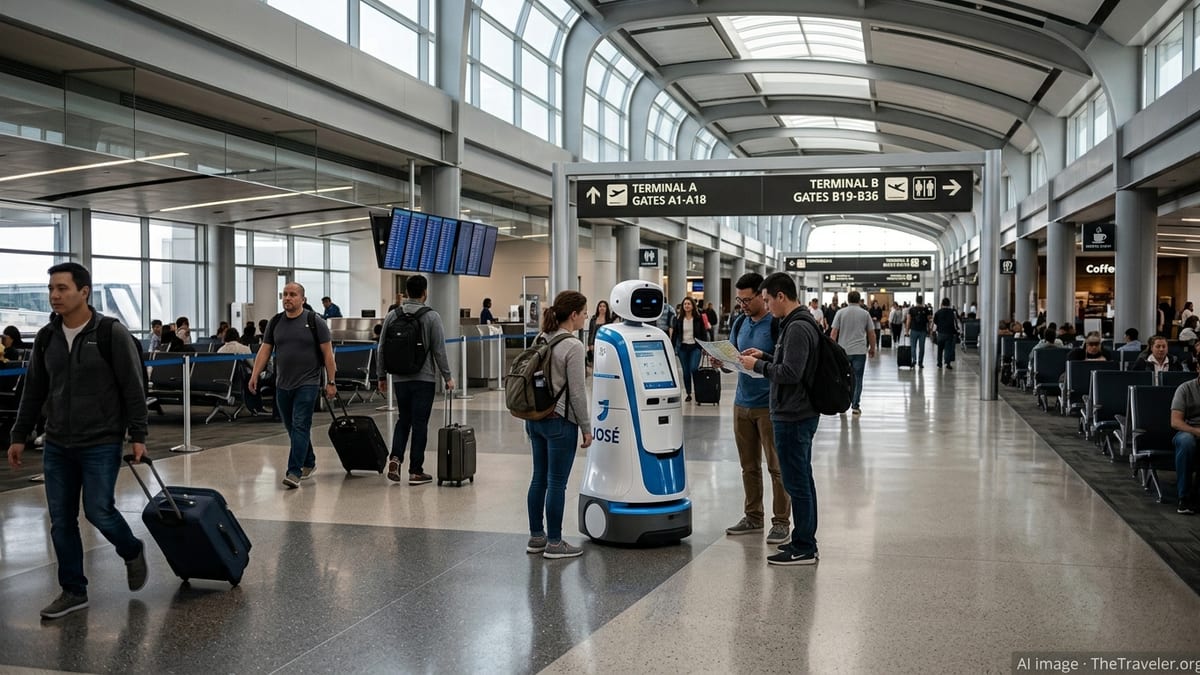
San José Mineta International Airport is introducing a new AI-powered assistant known as “José,” positioning the Silicon Valley gateway at the forefront of airport technology as it experiments with robotics to ease congestion, improve wayfinding, and enhance customer service ahead of a surge in major 2026 events.
Get the latest news straight to your inbox!
A Silicon Valley Airport Bets on Robotics
Publicly available information shows that San José Mineta International Airport has been steadily expanding its use of smart mobility and automation, positioning new technologies as a core part of its identity as the “Airport of Silicon Valley.” Recent airport briefings describing autonomous mobility vehicles for passengers with reduced mobility, combined with a broader strategy to digitize services, provide the backdrop for the introduction of “José,” an AI robot designed to interact directly with travelers inside the terminal.
According to published coverage of similar deployments at other hubs, customer-service robots are being tested to answer common questions, guide passengers to check-in and security, and provide basic flight and airport information via touchscreens and voice recognition. At San José, “José” is being framed as a next-step evolution of these systems, using more advanced AI to understand natural language, learn from repeated interactions, and integrate with existing airport information feeds.
Reports indicate that the airport’s goal is not simply to add a novelty feature, but to align its robotics program with a broader wave of autonomous transport options already emerging around the terminals, including driverless ride services and automated mobility devices. In this context, “José” functions as a visible, approachable embodiment of the airport’s larger innovation strategy.
How “José” Improves Wayfinding and Efficiency
Based on descriptions from airport technology briefings, “José” has been developed to tackle two persistent pain points for passengers: navigating unfamiliar terminals and finding reliable, real-time information without waiting in line. The robot is expected to help travelers locate airline counters, restrooms, security checkpoints, baggage claim areas, and ground transportation zones by combining map data with onboard sensors and interactive displays.
By handling routine questions such as gate locations, estimated walking times, or security preparation tips, the AI system is designed to free up human staff to focus on more complex or time-sensitive issues. Observations from previous robot trials at international airports suggest that even a modest reduction in repetitive inquiries at information desks can translate into faster service for passengers with special requests or tight connections.
Early demonstrations described in local media indicate that “José” can be repositioned to high-demand areas during peak periods, acting as a mobile information hub where lines are forming or traffic patterns are changing. That flexibility is expected to be particularly important as San José prepares for heavy flows of visitors during the Super Bowl and World Cup activity planned in the Bay Area in 2026.
AI-Driven Support for Accessibility and Special-Needs Travelers
Airport planning documents and recent announcements highlight a growing emphasis on accessibility at San José Mineta International Airport, including autonomous personal mobility vehicles intended for travelers who may not require a wheelchair but do need additional support navigating long concourses. “José” is being introduced as part of this shift toward layered, tech-enabled assistance options.
The robot’s interface is expected to offer multiple languages, visual prompts, and clear step-by-step directions, which can be particularly helpful for passengers with limited familiarity with English or with complex terminal layouts. For travelers with reduced mobility, “José” can serve as a first contact point to request additional services, learn the most direct routes with fewer elevation changes, or identify nearby rest areas.
According to industry analyses of airport robotics programs, AI-driven assistants can also reduce anxiety for infrequent flyers and older travelers by delivering consistent, easy-to-understand information in a calm, repeatable format. At San José, that role is likely to complement, rather than replace, human ambassadors and contracted mobility staff who remain essential for hands-on assistance and safety-sensitive tasks.
Integrating “José” Into a Wider Autonomous Ecosystem
The deployment of “José” coincides with San José Mineta International Airport’s broader move into autonomous mobility on the landside. Over the past year, reports from technology and transportation outlets have documented the rollout of fully autonomous ride services at the airport, operated by companies that already serve surrounding Bay Area communities. These services allow travelers to hail driverless vehicles for curbside pickup at designated ground transportation centers.
Paired with the AI robot in the terminal, this ecosystem is designed to create a more seamless journey from arrivals hall to curb. Travelers can obtain guidance from “José” on how to reach the correct pickup zone, understand signage, and review basic safety and boarding information before stepping outside. Publicly available airport communications describe this end-to-end approach as a way to reduce confusion, shorten curb congestion, and better distribute passengers among various transport options.
Technology observers note that San José’s efforts place it among a small but growing group of airports experimenting with both airside and landside autonomy at the same time. While many facilities are still piloting individual components in isolation, from smart mobility devices to off-site robotaxi trials, the Bay Area hub is gradually interconnecting them within its daily operations.
Balancing Innovation With Reliability and Traveler Trust
Despite the promise of “José” and related technologies, airport planners face a familiar challenge: ensuring that innovation does not come at the expense of reliability. Industry coverage of earlier airport robot deployments has pointed to issues such as limited battery life, difficulty handling crowded spaces, and the need for clear backup options if systems go offline.
San José Mineta International Airport’s recent communications around autonomous services emphasize phased rollouts, data collection, and iterative refinement. “José” is expected to operate initially in controlled zones and time windows, allowing the airport to monitor traffic patterns, user behavior, and maintenance requirements before considering expansion. Lessons learned from each phase can be applied to software updates, routing rules, and hardware adjustments.
Passenger education is another key element. Travel analysts suggest that clear signage, simple on-screen instructions, and staff trained to introduce and, when needed, override the robot help build trust among travelers who may be uncertain about interacting with AI. As San José prepares for an influx of visitors in 2026, “José” will function as both a practical assistant and a public-facing symbol of the airport’s commitment to innovation, one that will be judged as much by its day-to-day reliability as by its technological sophistication.