

More news on this day
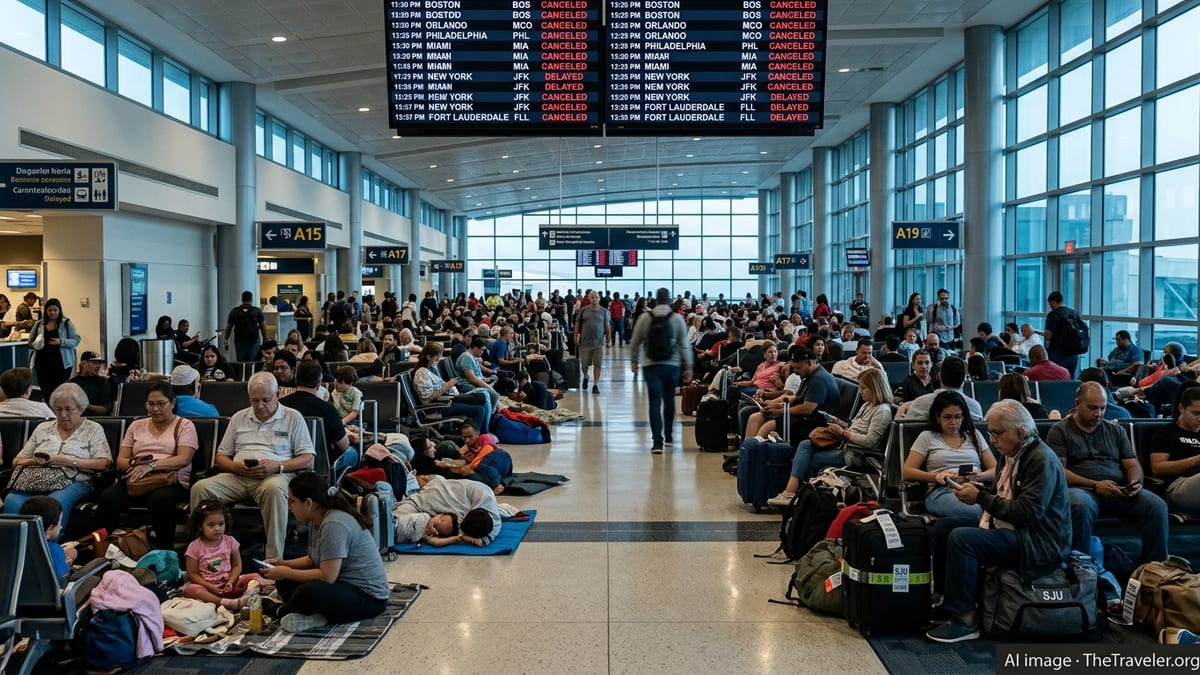
Hundreds of travelers have been stranded or severely delayed after widespread disruptions at Puerto Rico’s Luis Muñoz Marín International Airport triggered mass flight cancellations and schedule chaos across major U.S. gateways including Boston, Orlando and Philadelphia.
Get the latest news straight to your inbox!
Ground Restrictions Ripple Across Caribbean Airspace
Recent disruptions at Luis Muñoz Marín International Airport in San Juan have coincided with periods of heightened restrictions over Caribbean airspace that sharply curtailed commercial operations in and out of Puerto Rico. Publicly available information from aviation tracking platforms and passenger reports indicates that a temporary restriction on U.S. airline operations over Puerto Rico led to the cancellation of more than 200 flights in a single day, with departures and arrivals at San Juan reduced to a fraction of normal activity.
Reports describe an airport that, on some days earlier this season, shifted from its usual steady traffic pattern to only sporadic departures, with aircraft lifting off as infrequently as once every 60 to 90 minutes instead of the typical flow of jets taking off every few minutes. The sudden squeeze in available takeoff and landing opportunities quickly cascaded into airline schedules, forcing carriers to ground aircraft in San Juan and at mainland airports that feed the island.
These operational constraints meant that even flights not directly affected by weather or technical issues were pulled from schedules because aircraft and crews could not be positioned where they were needed. As a result, travelers found themselves facing same-day cancellations, rolling delays and rebookings stretching several days into the future, particularly on busy routes linking Puerto Rico to the U.S. East Coast.
Boston, Orlando and Philadelphia Among Hardest-Hit Gateways
The knock-on effects have been especially visible at major East Coast and Florida airports that handle significant traffic to and from San Juan. Boston, Orlando and Philadelphia, all key origin and destination points for Puerto Rico travelers, have seen a pattern of cancellations attributed to the San Juan disruptions, leaving passengers stranded far from home or their holiday plans.
Accounts shared on travel forums and social platforms describe travelers in Boston and other New England airports watching their nonstop flights to San Juan disappear from departure boards with little advance notice. In some cases, travelers reported being shifted onto multi-stop itineraries through hubs such as Washington or New York, only to have onward legs back to Puerto Rico later cancelled as the operational situation in San Juan remained constrained.
In Orlando and other Florida gateways that serve as major leisure corridors to the Caribbean, passengers have similarly reported canceled or heavily delayed departures as aircraft scheduled to operate from Puerto Rico failed to arrive. Philadelphia has seen disruptions on both leisure and visiting-friends-and-relatives routes, with travelers citing missed connections, overnight airport stays and rebookings several days out as airlines worked through backlogs created by the San Juan bottleneck.
Long Queues, Closed Checkpoints and Terminal Congestion at SJU
At San Juan itself, traveler accounts depict an airport under heavy strain even during periods when flights have resumed. Over the past week, passengers departing Luis Muñoz Marín have reported unusually long security lines stretching across multiple terminals, with general screening queues snaking from Terminal A toward other concourses during early-morning departure banks.
Public posts from travelers describe partial closures of security checkpoints, particularly in one terminal, which have concentrated crowds into fewer access points. While some premium screening options such as trusted traveler lanes have continued operating, they have not fully absorbed the surge of passengers arriving hours before departure out of concern about potential delays or renewed cancellations.
The resulting congestion has produced scenes of crowded departure halls, families with young children waiting on the floor near gate areas and travelers wandering terminals for hours as they await updated boarding times. Some accounts note that security processing times can vary widely throughout the day, with relatively quick passage for certain mid-morning departures but intense crowding in the early hours when many northbound flights are scheduled.
Hundreds of Travelers Face Rebookings and Extended Stays
The operational crunch at Luis Muñoz Marín has translated into significant disruption for individual travel plans, particularly for those on tightly timed vacations or work trips. Passengers have reported that when flights from San Juan were canceled, airlines in some cases could not offer alternative seats for several days, effectively extending trips and forcing last-minute changes to hotel, car rental and work arrangements.
Travelers attempting to reach Puerto Rico from mainland airports have experienced similar uncertainty. Some have described situations in which their first leg to a U.S. hub departed on time, only for the onward segment to San Juan to be removed from the schedule after they were already en route. In other instances, travelers returning from Puerto Rico have opted to stay put rather than risk becoming stranded mid-journey if connecting flights into San Juan’s constrained airspace were later canceled.
Publicly available flight data from recent weeks highlights how fast conditions can change, with days of relatively normal activity followed by sudden spikes in cancellations and delays tied to airspace limitations or operational adjustments. For passengers, this variability has meant building in contingency time and being prepared for last-minute itinerary changes on routes that are normally considered routine.
Airlines and Travelers Adjust as Operations Gradually Stabilize
As restrictions on Caribbean airspace have eased and daily operations at Luis Muñoz Marín have gradually increased, airlines serving Puerto Rico have worked to rebuild schedules and reposition aircraft. Recent flight-tracking snapshots show a more regular cadence of departures and arrivals at San Juan compared with the steep reductions seen during the height of the disruption, although certain early-morning and evening peaks remain under pressure.
Airlines have been relying on a mix of schedule changes, upgauging to larger aircraft on select routes and rerouting passengers through alternative hubs to absorb backlogs. Travelers posting updates from San Juan in the last several days note that while security lines for standard screening can still be lengthy, especially for those without expedited options, some departure periods now resemble more typical pre-peak crowds rather than the severe gridlock reported earlier in the month.
Even as operations normalize, recent events are prompting many travelers to adjust their planning for flights into and out of Puerto Rico. Common recommendations circulating on travel forums include arriving substantially earlier than usual for peak-period departures from San Juan, monitoring airline apps and flight-tracking tools closely, and remaining flexible about routings through alternate U.S. hubs if nonstop options to Boston, Orlando, Philadelphia or other key cities are disrupted again.