

More news on this day
High on the Acropolis plateau, east of the Erechtheion and away from the crowds circling the Parthenon, the elusive Sanctuary of Zeus Polieus is emerging as a key site for understanding how ancient Athenians linked divine protection, political identity and dramatic sacrificial ritual.
Get the latest news straight to your inbox!
A Walled Open-Air Sanctuary Above the City
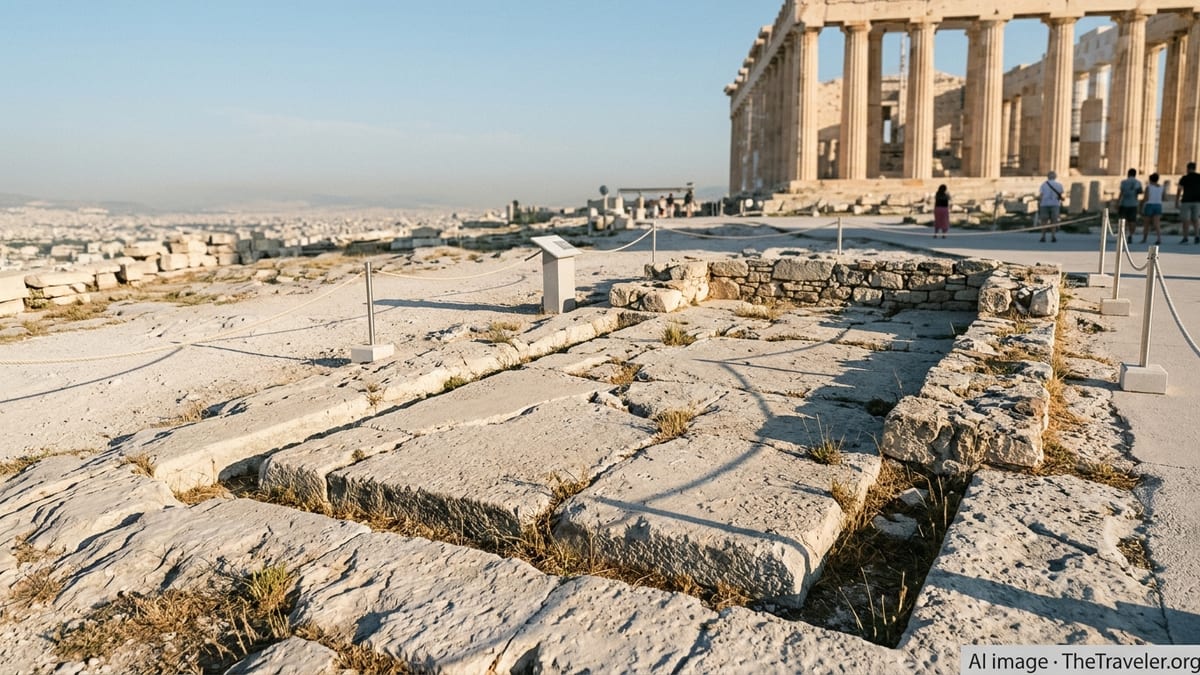
Archaeological research indicates that the Sanctuary of Zeus Polieus took shape around 500 BCE as a walled, open-air precinct on the eastern summit of the Acropolis, dedicated to Zeus in his role as protector of the city. Unlike the peripteral stone temples that dominate popular images of ancient Greece, this sanctuary appears to have been defined not by soaring columns but by a trapezoidal enclosure whose outline is reconstructed from cuttings in the bedrock.
These rock cuttings, mapped and reinterpreted in recent surveys and digital guides to the Acropolis, show multiple entrances and a carefully organized interior rather than a single monumental doorway. The main entrance, according to scholarly reconstructions, likely carried a pedimented façade that signaled the importance of the precinct even without a full temple building inside. Within the walls, worship and sacrifice unfolded under the open Attic sky, emphasizing Zeus’s authority over the city and the weather that sustained it.
Modern visitor information for the Acropolis now regularly includes the sanctuary in site plans and interpretive material, underscoring that it formed part of a dense religious landscape that also featured the Erechtheion, the Old Temple of Athena and later the Parthenon. Yet on the ground, the sanctuary’s remains are subtle, requiring informed observation to connect shallow rock cuttings and low foundations with the powerful civic cult that once animated the space.
For many visitors, the relative invisibility of Zeus Polieus compared with the marble temples nearby reflects broader shifts in archaeological interest, which for decades favored architectural showpieces. Current approaches give more weight to modest-looking precincts like this one, seeing them as crucial to reconstructing how Athenians experienced ritual life, negotiated sacred boundaries and expressed their sense of living under a divine protector.
Zeus as City Protector and Guarantor of Order
The epithet “Polieus” identifies Zeus as guardian of the polis, responsible not only for physical safety but for the cohesion of civic institutions and law. Scholars note that this role placed his Acropolis sanctuary at the symbolic heart of Athenian public life, complementing Athena Polias while stressing Zeus’s authority over oaths, assemblies and the agricultural cycles that underpinned the city’s economy.
Recent academic treatments of Greek religion emphasize that sanctuaries to Zeus Polieus and related epithets, such as Zeus Boulaios and Zeus Hellanios, formed a network of cults that connected local communities to wider Greek ideas about divine kingship, justice and shared identity. In Athens, the Acropolis sanctuary appears to have functioned as a ritual focal point where city protection, seasonal concerns and questions of communal guilt and responsibility could be staged in highly formalized ways.
This civic dimension is visible in literary testimonia, particularly the account preserved under the name of Pausanias, which describe a statue of Zeus Polieus and mention the distinctive sacrificial customs associated with the deity. Modern commentators draw attention to how these accounts situate Zeus Polieus within a long-standing narrative of Athenian origins, suggesting that the sanctuary’s rites were perceived as archaic survivals linking the contemporary city to a mythic past.
Because the sanctuary stood on the Acropolis, access and participation would have been tightly structured, reinforcing social hierarchies while also dramatizing the dependence of the entire community on the god’s favor. Publicly available archaeological and historical syntheses increasingly view sites like this not as isolated shrines but as stages where Athenians rehearsed what it meant to be a citizen under divine protection.
The Bouphonia: A Drama of Sacrifice and Blame
The sanctuary’s most famous ritual, the Bouphonia, took place during the Dipolieia festival in the midsummer month of Skirophorion. Literary descriptions and modern analyses agree that this ceremony centered on the paradox of killing a working ox for Zeus Polieus while also dramatizing collective discomfort with that act of violence. Grain or a seed cake was placed on the altar and left apparently unattended; when an ox stepped forward and ate, it was deemed to have implicated itself and was struck down.
In the aftermath, the ritual shifted into a stylized “trial” in which responsibility for the killing passed from person to person, and finally to the inanimate weapon itself. Contemporary scholarship interprets this sequence as a sophisticated ritual negotiation of guilt, reflecting anxieties about shedding the blood of a valuable animal that symbolized agricultural wealth. The sanctuary of Zeus Polieus, perched above the urban center, thus became a theatrical courtroom where Athenians explored the boundaries between necessity, consent and culpability.
Recent discussions of Greek ritual practice highlight how the Bouphonia complicates simple pictures of sacrifice as straightforward devotion. Instead, the ceremony staged a civic conversation about violence and obligation: the ox’s “choice” to eat from the altar allowed participants to frame the killing as a response to sacrilege, even as the elaborate blame-shifting acknowledged that the community remained entangled with the act. This tension gave the sanctuary a distinctive identity among the many sacred sites of the Acropolis.
Archaeologists working with site plans of the Acropolis identify an eastern sector of the sanctuary, sometimes referred to as the Bukoleion, as a likely holding area for the oxen used in the Bouphonia. While physical traces are limited, the reconstruction aligns with the ritual’s practical demands and with parallels from other sanctuaries where animals were housed and processed as part of formal sacrificial sequences.
Reading Subtle Ruins in the Acropolis Landscape Today
Unlike the heavily restored Parthenon or the prominent Erechtheion, the Sanctuary of Zeus Polieus survives mainly as a pattern of bedrock cuttings and fragmentary walls embedded in the Acropolis plateau. Updated digital guides and archaeological overviews encourage visitors to look beyond monumental façades, noting that the sanctuary’s outline can be traced just east of the Erechtheion where the hill flattens toward its eastern edge.
These resources also stress that the sanctuary forms part of the standard circuit included in Acropolis admission, even though there is no standing temple whose silhouette dominates the skyline. In practice, this means that travelers interested in the cult of Zeus Polieus must rely on interpretive panels, guidebooks or specialist maps to visualize the original enclosure and its internal divisions. Some recent publications employ 3D reconstructions and augmented reality to suggest how the sanctuary might have appeared around 500 BCE, though these remain carefully labeled as hypothetical models.
For heritage managers and scholars, the challenge is to present such understated remains in ways that connect with contemporary concerns without overstating what the archaeological record can securely support. Publicly available project descriptions underline a preference for reversible markings, discreet signage and digital interpretation over heavy reconstruction, especially in sensitive areas of the Acropolis rock where ancient cuttings themselves are valuable evidence.
As interest grows in the environmental and agrarian dimensions of ancient religion, the sanctuary is also being reinterpreted as a vantage point on how Athenians understood their dependence on seasonal cycles. The Bouphonia’s focus on a plough ox, the midsummer timing of the Dipolieia and the open-air character of the precinct together support readings of Zeus Polieus as a mediator between urban institutions and the countryside that sustained them.
New Scholarship and Renewed Visitor Attention
Recent years have seen a wider scholarly reappraisal of Zeus sanctuaries across Greece, from peak shrines on Aegina to rural complexes like Nemea and recently identified coastal sites. While these investigations do not target the Acropolis sanctuary directly, they provide comparative material that helps situate Zeus Polieus within broader patterns of worship and sanctuary design. Reports from ongoing projects stress the diversity of sacred spaces dedicated to Zeus, ranging from open-air altars to more conventional temples, underscoring that the Athenian arrangement fits a recognized type.
Public-facing archaeology outlets increasingly draw on this scholarship to craft narratives that link the Sanctuary of Zeus Polieus with themes of civic resilience, legal order and communal anxiety about violence against animals. By foregrounding how the Bouphonia ritual negotiated issues of guilt and necessity, these accounts suggest that the sanctuary can speak to modern ethical debates as well as to specialists in ancient religion.
At the same time, conservation-focused documentation on the Acropolis highlights the continuing need to protect the exposed bedrock cuttings and low masonry that define the sanctuary’s footprint. Visitor routes, protective barriers and maintenance plans are periodically adjusted to balance access with preservation, especially as tourism to Athens continues to recover and expand. For travelers informed about the site, a pause at the sanctuary offers a quieter counterpoint to the more photographed temples nearby.
Together, these research and presentation efforts are gradually bringing Zeus Polieus back into the story of the Acropolis as more than a footnote. In the subtle geometry of its rock-cut walls and the dramatic memory of its midsummer ritual, the sanctuary preserves a distinct vision of how Athenians once sought victory, protection and cosmic order from the god who watched over their city.