

More news on this day
Hilton’s luxury collection brand LXR Hotels & Resorts is marking its entry into Greece with the reopening of Sandblu Santorini as an upscale hideaway in Kamari, reflecting how international hospitality groups are pairing high-end design with stronger sustainability credentials to capture the country’s fast-growing luxury tourism demand.
Get the latest news straight to your inbox!
LXR Arrives in Greece Through a Revamped Santorini Icon
The relaunched Sandblu Santorini, LXR Hotels & Resorts positions Hilton’s independent-style luxury flag in one of the Aegean’s most competitive destinations. Recent investor and development materials list the property as part of Hilton’s global luxury pipeline, identifying it as the company’s first LXR address in Greece and one of a small number of new European openings under the brand.
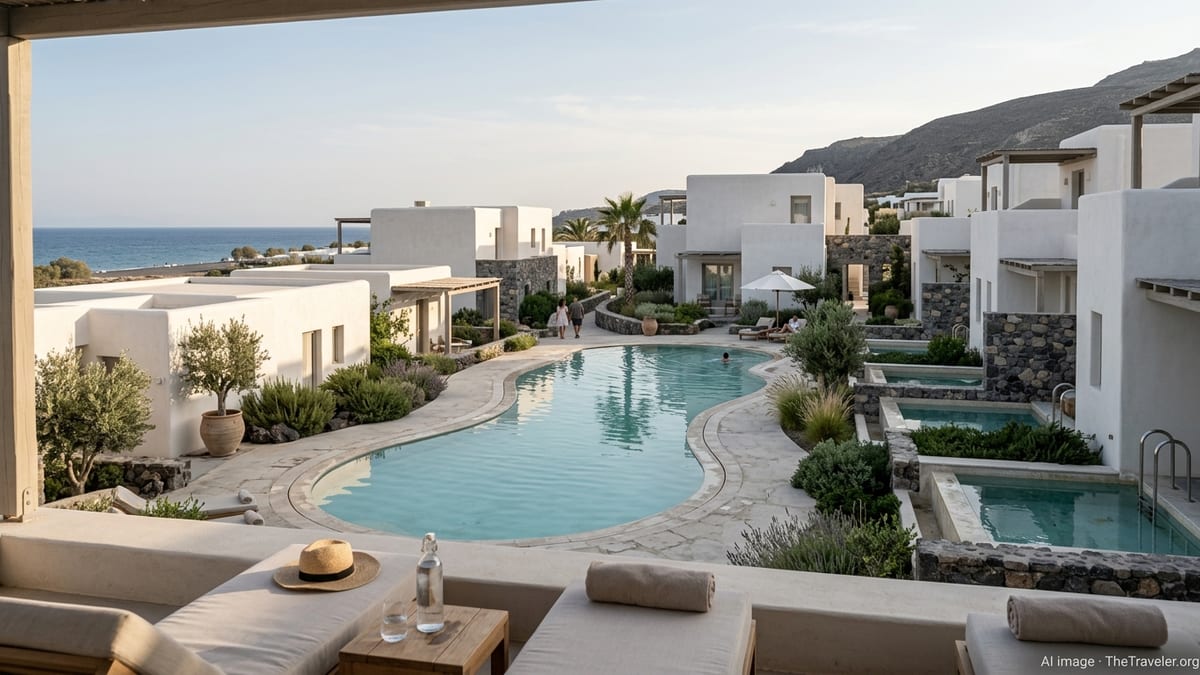
Located in Kamari on Santorini’s east coast, the resort has operated in recent years as Sandblu Resort before its transition into the LXR portfolio. Publicly available design and development documents describe a low-rise complex of suites and villas spread across a sizeable coastal site, integrating architecture and landscaping to maintain views toward the Aegean while preserving a village-style atmosphere.
The shift to LXR brings Sandblu into Hilton’s top-tier ecosystem while allowing it to retain an individual identity, in line with the brand’s focus on one-of-a-kind luxury properties. Industry reports indicate that the hotel will operate with a relatively intimate key count compared with mass-market resorts, reinforcing its positioning as a hideaway rather than a large-scale beach complex.
The move also strengthens Hilton’s presence in the Greek islands, where competition among global groups has intensified as visitor numbers and average daily rates at the upper end of the market continue to climb.
Designing a Secluded, Nature-Led Santorini Hideaway
Sandblu Santorini’s layout leans into the geography of Kamari rather than the caldera cliffs that have become synonymous with the island. Developer information and third-party booking descriptions highlight a resort set back from the black-sand shoreline, with low-slung white structures arranged around pools and gardens to create a more horizontal, resort-style environment than the stacked cave dwellings of Oia and Fira.
Suites and villas are described as contemporary Cycladic, combining whitewashed volumes with natural stone, timber details and neutral interiors intended to reflect the volcanic landscape. Many units are configured with private or semi-private pools and generous terraces, features that have become standard in Santorini’s upper-luxury segment and are central to the island’s appeal among high-spend travelers seeking privacy.
Outdoor space is a key part of the repositioning. The resort incorporates multiple pools, landscaped courtyards and pathways designed to give a sense of seclusion even at higher occupancy. The Kamari location also offers more direct beach access than most caldera hotels, with publicly available descriptions referencing proximity to a private or semi-private stretch of coastline.
Wellness infrastructure is another focus for the LXR-branded property. While full operational details are still being phased in, available materials point to spa and fitness facilities, as well as programming that draws on Santorini’s reputation for slow travel, yoga, and nature-based retreats, aligning the resort with broader wellness tourism trends.
Embedding Sustainability Into a Luxury Reopening
The Sandblu project is reopening at a moment when sustainability has become a central theme in Greek tourism strategy and in the development of new high-end hotels. Market reports on Greek hospitality investments between 2024 and 2027 emphasize energy-efficient construction, reduced water use and stronger integration with local communities as priorities for new-build and conversion projects across the islands.
Architecture and engineering notes on Sandblu point to systems and materials chosen with resource efficiency in mind, such as modern insulation, glazing designed to limit heat gain, and building orientation that takes advantage of natural light and ventilation. The resort’s relatively low-rise footprint and landscaped areas are positioned as part of a softer impact approach compared with denser cliffside developments.
In line with trends among international luxury brands in Greece, the property is expected to adopt measures such as optimized water management, careful pool technology, and selective use of native planting to reduce irrigation needs. Public information on the broader Sandblu concept also places emphasis on local sourcing and partnerships with island-based providers, fitting with the push toward more sustainable supply chains in upscale hospitality.
These efforts come as Santorini continues to debate how to balance volume with environmental pressure. By promoting resource-conscious design and operations alongside traditional markers of luxury, Sandblu Santorini’s LXR-branded relaunch is presented as a model of how new high-end openings can respond to local and national sustainability goals.
Riding Greece’s Expanding Luxury Tourism Wave
The rebranding of Sandblu Santorini under LXR Hotels & Resorts is part of a broader acceleration in luxury hotel investment across Greece. Recent industry analyses highlight a strong pipeline of five-star properties and luxury conversions from Athens and the Athenian Riviera to islands such as Paros, Mykonos and Santorini, driven by rising international arrivals and an extension of the tourism season.
Santorini, in particular, has seen a steady shift from mid-market accommodation towards boutique and luxury offerings, as visitors increasingly prioritize design-led stays, private outdoor space and curated experiences. New and repositioned resorts are competing on wellness, gastronomy and exclusive excursions, from vineyard visits and sailing trips to guided hikes along the caldera rim.
Within this landscape, Sandblu Santorini’s alignment with a global luxury brand gives it access to Hilton’s distribution and loyalty channels, expected to bolster occupancy outside of peak summer months. At the same time, its positioning as an independently styled LXR property allows it to market a distinct Santorini narrative rather than a standardized chain experience.
Observers of the Greek hotel sector note that such openings can have a multiplier effect, encouraging ancillary development in dining, transport and premium experiences. In Kamari, that could translate into further upgrades to the seafront and surrounding services as more high-spend travelers choose the beach village as a base.
Implications for Santorini’s Evolving Visitor Experience
For travelers, the reopening of Sandblu Santorini as an LXR hotel expands the choice of luxury environments beyond the traditional caldera view. Kamari offers a flatter, more accessible setting, with the resort providing a beach-and-garden alternative that may appeal to longer stays, families with older children and wellness-focused guests who value space and amenities over cliffside drama.
The property’s focus on seclusion within a relatively built-up part of the island underscores how Santorini’s hospitality scene is diversifying. Visitors can now choose between cliffside suites, vineyard retreats in the interior and full-service beach resorts, often at similar price points but with markedly different atmospheres.
Looking ahead to the next peak seasons, analysts expect the combination of a globally recognized luxury brand, a design-forward resort product and stated sustainability ambitions to make Sandblu Santorini a closely watched case study in how the island manages upmarket growth. Its performance will likely inform future decisions by international groups considering new projects in the Cyclades.
As Greece continues to focus on higher-value, lower-impact tourism, developments like Sandblu Santorini, LXR Hotels & Resorts illustrate the direction of travel: fewer purely volume-driven projects and more emphasis on experiential, environmentally aware luxury that can support both local economies and long-term destination resilience.