

More news on this day
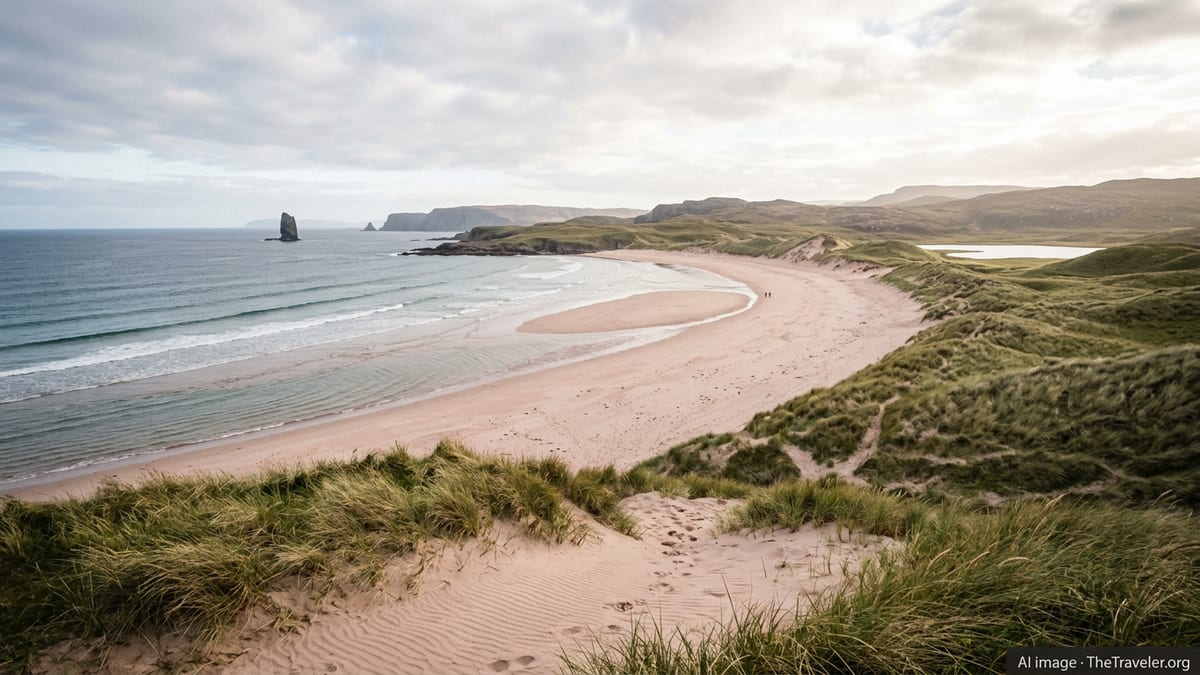
On Scotland’s far northwest fringe, a four-mile moorland track leads to Sandwood Bay, a mile-long sweep of pale-pink sand and towering dunes that is emerging as one of the country’s most talked-about wild beaches.
Get the latest news straight to your inbox!
A Remote Highland Beach in the Spotlight
Sandwood Bay sits near the crofting village of Kinlochbervie in Sutherland, overlooking the North Atlantic on one of the least populated stretches of Scotland’s coastline. Publicly available information describes it as one of the most remote beaches in the United Kingdom, accessible only on foot along a path from the small hamlet of Blairmore. The isolation has helped preserve an atmosphere that many visitors describe as otherworldly, with no road, buildings or visitor centre in sight once the shore comes into view.
Recent travel coverage highlights Sandwood Bay as a rising alternative for those seeking quieter coastal experiences away from crowded resort towns. Reports indicate that the bay has been singled out by UK travel publications and specialist accommodation providers as a standout stop on the increasingly popular North Coast 500 driving route, with its solitude, scale and distinctive colour of sand helping it stand out even in a region famed for dramatic shores.
Despite the growing attention, Sandwood Bay still requires commitment to reach. The final approach is a just-over four-mile walk each way across open, often windswept ground. The absence of on-beach amenities, from cafes to changing facilities, reinforces its reputation as a place where visitors must come prepared and self-sufficient, a factor that continues to limit casual day-tripper numbers compared with more accessible Highland beaches.
Pink Sands, Sea Stack and Wild Atlantic Drama
The bay’s pink-tinged sand is one of its defining features. Travel guides and recent visitor accounts describe a long arc of fine, pale sand with a subtle blush that is most visible under angled light in early morning or late afternoon. The hue is attributed to the composition of local rock and shell fragments that have been ground down over time by Atlantic waves and winds, creating a beach that photographers now seek out specifically for its colour.
Backing the shoreline, high dunes form a shifting wall of sand and marram grass, with the freshwater Sandwood Loch lying just inland. The combination of loch, dunes and beach creates a layered landscape that changes character with the weather: in clear conditions, the scene can appear almost luminous, while in mist and rain the colours flatten into muted greys and rose tones that many visitors associate strongly with the northwestern Highlands.
Offshore, the slender sea stack of Am Buachaille rises from the waves, often appearing through veils of sea spray. Climbing guidebooks describe it as a challenging objective reserved for experienced climbers, but even from the shoreline it serves as a focal point that anchors the view. Swells rolling in unchecked from the North Atlantic add to the sense of scale and exposure, and open-water swimming and surfing communities describe the bay as beautiful but demanding, with cold water temperatures and changeable conditions that call for caution.
Walking In: Access, Terrain and Timing
Access to Sandwood Bay begins at a small parking area near Blairmore, reached via single-track roads from Kinlochbervie. From there, a waymarked path crosses moorland, skirting small lochans and sections of peat before descending through dunes to the beach. Guidebook descriptions characterise the route as relatively straightforward in good weather, with a mostly gradual gradient, but note that some stretches can be wet, muddy or uneven, particularly after prolonged rain.
Route descriptions published by hiking resources typically advise allowing at least four hours for the return walk plus time on the beach, encouraging visitors to factor in shorter daylight hours and fast-changing conditions in spring and autumn. Recent accounts from walkers during busier summer periods mention that while the Blairmore car park can fill, the length of the path and scale of the bay spread people out, so the shoreline itself often feels sparsely populated even on bright days.
Local guidance also stresses self-reliance. With no facilities at the beach, visitors are advised to bring food, water, warm and waterproof clothing, and to be prepared for strong winds. Mobile coverage is patchy along parts of the route, and outdoor organisations point out that low cloud and rain can quickly reduce visibility on the open moor, reinforcing Sandwood Bay’s character as a true backcountry coastal destination rather than a casual seaside outing.
Conservation, Dune Protection and Responsible Visits
Sandwood Bay lies within a wider area of wild land managed for conservation, and the path and dunes have become a focal point for discussions about how to balance rising visitor numbers with environmental protection. Publicly available material from conservation charities outlines ongoing work to maintain paths in the Sandwood area in a way that blends with the landscape, reducing erosion and protecting sensitive peat and vegetation while still providing a clear line of access.
Dune systems like those backing Sandwood Bay are widely recognised by environmental groups as crucial natural defences, helping to buffer inland areas from storm surges and sea-level changes. Guidance aimed at visitors therefore strongly discourages cutting new tracks over the dunes, driving off-road, or removing sand and stones. Outdoor access campaigns in Scotland increasingly reference national legislation that limits the removal of beach material where it could contribute to coastal erosion, and Sandwood Bay is frequently cited as an example of a site where restraint is essential to maintaining the character of the landscape.
Local tourism information also urges visitors to follow standard Scottish outdoor principles: pack out all litter, avoid lighting fires in the dunes, keep dogs under close control to protect ground-nesting birds, and camp only in small numbers, away from the most fragile areas. Wild camping is described by hiking communities as a memorable way to experience the bay in calm weather, but advice consistently points to the need for low-impact practices so that the area’s sense of remoteness is not undermined by visible signs of overuse.
Planning a Visit to Scotland’s Far Northwest
Reaching Sandwood Bay typically forms part of a wider journey into one of the most sparsely populated corners of mainland Britain. Visitors often base themselves in Kinlochbervie or nearby coastal settlements, combining the Sandwood walk with other short hikes to beaches such as Oldshoremore and Polin, or longer routes linked to the Cape Wrath Trail. Travel writers describe this cluster of destinations as a natural pause point on routes circling the north of Scotland by car or campervan.
Public transport into the area remains limited, and tourism information recommends checking current bus schedules carefully where services are available. Many travellers opt for self-drive, with recent accounts highlighting the need to leave extra time for single-track roads, seasonal livestock on the carriageway and frequent photo stops. Accommodation ranges from small hotels and bed and breakfasts to self-catering cottages and campsites, with some providers reporting strong summer demand linked to the continued popularity of the North Coast 500.
For those willing to undertake the journey and the walk, Sandwood Bay offers a combination that is increasingly rare on a well-documented coastline: a long, lightly visited beach with a distinctive pink hue, framed by dunes, loch and Atlantic surf. As Scotland’s far northwest attracts more attention, the bay’s future as a quietly spectacular outpost will depend heavily on how visitors respond to calls for thoughtful, low-impact travel in one of the country’s most fragile and rewarding coastal landscapes.