

More news on this day
Chile’s long-promised high-speed rail link between Santiago and Valparaíso is entering a moment of acute uncertainty as the incoming administration of President José Antonio Kast weighs whether to back, reshape or quietly shelve one of the country’s most emblematic transport dreams.
Get the latest news straight to your inbox!
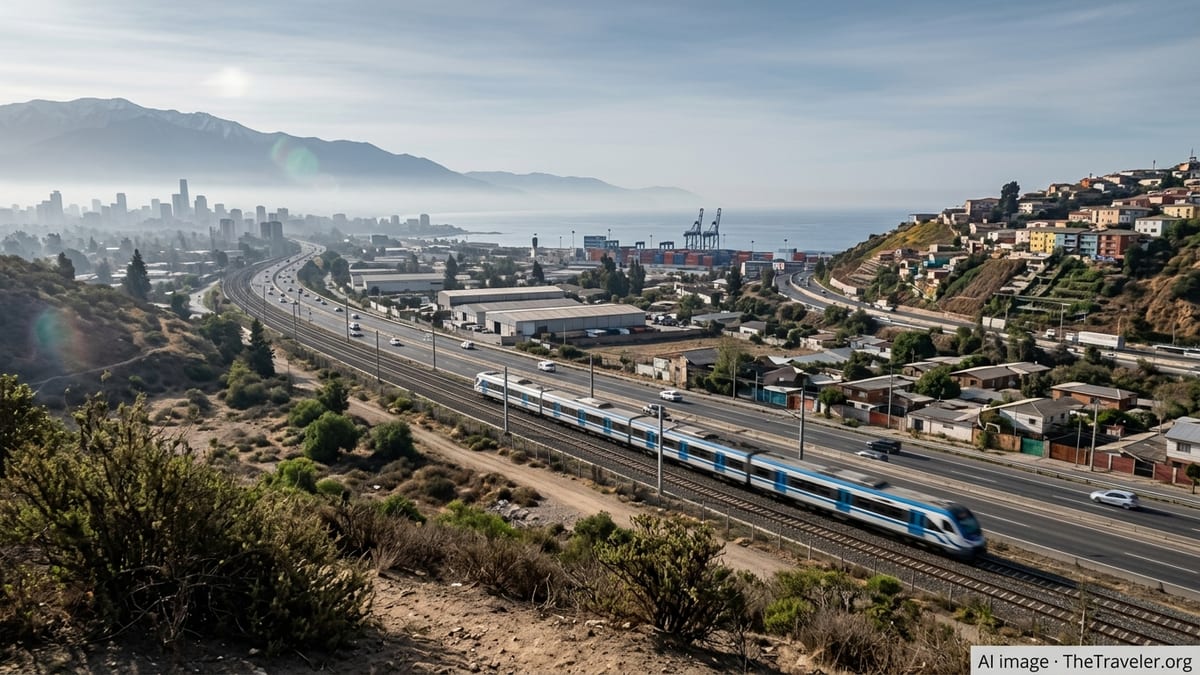
A flagship vision caught between two political eras
The idea of a fast rail link between the capital and the Pacific coast has circulated in Chilean planning circles for decades, but it gained renewed momentum under the outgoing government of Gabriel Boric. Publicly available planning documents show that authorities shifted away from earlier private high-speed proposals toward a medium-speed, mixed-use model intended to balance cost, demand and regional connectivity.
By 2025, the Ministry of Public Works had outlined a plan to tender a Santiago–Valparaíso railway that would pass through intermediate cities such as La Calera, emphasizing social and territorial integration over purely point-to-point speed. The line was presented as part of a broader “trains for Chile” agenda that also included upgrades on existing long-distance routes and new connections toward Concepción.
With Boric leaving office in March 2026 and Kast taking power on a platform skeptical of expansive state-led infrastructure, the rail corridor now sits at the intersection of two contrasting visions for Chile’s development. Supporters view the project as a backbone for a more sustainable and regionally balanced transport network, while critics highlight fiscal constraints and question whether projected ridership justifies the scale of investment.
The political transition has turned what was once framed as a near-inevitable next step in Chile’s rail revival into a test case of how far the new government is willing to go to continue policies it did not design.
From high-speed promise to a scaled-back proposal
The earliest modern proposals for a Santiago–Valparaíso rail link leaned heavily on the allure of European-style high-speed trains, with travel times of around 45 minutes frequently cited by private consortia seeking concessions. These concepts envisioned dedicated high-speed tracks and premium fares aimed at competing directly with private cars and intercity buses on the busy Route 68 corridor.
Over time, however, the government’s approach grew more cautious. Technical studies and public debates highlighted challenges such as complex mountain and coastal topography, the need for tunnels and viaducts, seismic risk, and the dense urban fabric at both ends of the line. Cost estimates escalated, and questions emerged over whether the project could achieve the passenger volumes needed to be considered socially and economically viable.
More recent official planning information indicates that authorities moved toward a medium-speed solution, with trains running significantly faster than today’s road traffic but below classic high-speed thresholds. Routing through La Calera and other intermediate areas was promoted as a way to spread benefits, stimulate secondary urban centers and support freight operations, even if it meant longer point-to-point times than early high-speed marketing suggested.
This recalibration reduced some technical and financial risks but also dulled the project’s symbolic power as a flagship high-speed corridor. As a result, incoming decision-makers inherit a plan that is less spectacular on paper but arguably more realistic, and therefore easier to either quietly downsize or cancel without a dramatic public rupture.
Warning signs and delays under Boric
Even before Kast’s victory, the Santiago–Valparaíso line was showing signs of strain. Regional media and specialist transport coverage pointed to slippages in the original timetable for launching tenders and finalizing the route, noting that ministries were still refining engineering and financial models well into 2025.
Debate intensified when firms that had previously promoted a faster, more direct high-speed alignment publicly questioned the government’s preferred option. Some analyses argued that the chosen route and service profile would struggle to achieve sufficient demand or time savings to be considered socially profitable, especially when compared with incremental improvements to existing bus and road infrastructure.
At the same time, broader rail policy remained in flux. The national rail operator continued to invest in other corridors, including upgrades on the Chillán–Santiago route, which has become a showcase for faster intercity trains. That success reinforced public appetite for better rail but also created a benchmark against which the Santiago–Valparaíso proposal would be judged.
By late 2025, the sense that the project was behind schedule, technically contested and politically exposed had already taken hold among transport watchers. Kast’s electoral win has now amplified those doubts into existential questions about whether the line will proceed at all in its current form.
Kast’s government weighs costs, priorities and pressure
Public reactions around Kast’s inauguration suggest that expectations for the project’s survival are mixed at best. Commentators in Chilean media and online forums have speculated that the new administration, facing budget pressures and closer ties with road transport interests, may be inclined to deprioritize an expensive new rail corridor in favor of highways and security-focused spending.
Some of the earliest signals have emerged from regional authorities linked to the new government, who have been quoted in coverage as casting doubt on the feasibility of the route as designed under Boric. Comments such as not seeing a clear future for the current alignment have been widely circulated, reinforcing perceptions that the project is now on precarious ground.
At the national level, the broader question is how Kast intends to handle the rail expansion framework inherited from his predecessor. Gabriel Boric publicly urged the incoming administration in early 2026 to preserve the core of Chile’s recent rail policies, arguing that long-term infrastructure strategies should transcend partisan cycles. Kast has not laid out a detailed alternative, leaving the Santiago–Valparaíso line caught in a policy vacuum.
The outcome will likely hinge on internal cost-benefit assessments and the government’s willingness to absorb short-term fiscal and political costs in pursuit of longer-term regional and environmental benefits. Without clear signals, uncertainty may push private partners, investors and municipalities to hedge their bets, complicating any eventual attempt to relaunch the project.
What is at stake for Chilean mobility and tourism
For residents and travelers, the fate of the Santiago–Valparaíso rail link carries consequences that go well beyond travel times on a single corridor. The current journey by road, often slowed by congestion and holiday traffic, can be unpredictable, affecting tourism flows to Valparaíso and the nearby resorts of the central coast as well as daily commuting patterns in the wider metropolitan region.
A modern rail line could reshape those dynamics, offering a more reliable, lower-emission alternative that connects airports, central business districts and port areas. Urban planners and tourism analysts have long argued that improved rail access would help Valparaíso leverage its cultural heritage and hillside neighborhoods more effectively, while easing pressure on road infrastructure that is costly to expand and maintain.
Conversely, if the project is shelved or indefinitely postponed, it may signal a broader retreat from rail as a central pillar of national transport policy. That could slow Chile’s progress toward decarbonizing mobility and limit options for travelers who increasingly compare Latin American destinations by the quality and sustainability of their transport networks.
In the months ahead, decisions taken in Santiago’s ministries will determine whether the Santiago–Valparaíso corridor becomes a showcase of renewed rail ambition or a cautionary tale of a mega-project that faltered at the threshold of political change.