

More news on this day
Dozens of abrupt flight cancellations at Sarasota Bradenton International Airport are stranding travelers and disrupting connections to major hubs in Atlanta, Miami, and Chicago, raising fresh concerns about how fragile U.S. air travel remains during a busy spring season.
Get the latest news straight to your inbox!
What Is Happening at Sarasota Bradenton International Airport?
Recent disruption reports indicate an unusual wave of cancellations from Sarasota Bradenton International Airport affecting services to Atlanta, Miami, and Chicago, three of the most important connecting hubs for travelers using the Gulf Coast gateway. Publicly available flight-tracking data over the past several days shows clusters of same-day cancellations on these routes, forcing passengers to scramble for alternate itineraries or abandon trips altogether.
The timing is particularly jarring for Sarasota, which has been expanding rapidly. A new concourse opened in early 2025, increasing terminal capacity and positioning the airport as a growing regional player. The current wave of cancellations underscores that local investments in gates and amenities cannot insulate travelers from larger system shocks when major hubs experience weather, crew imbalances, or network-wide schedule adjustments.
While Sarasota itself has not faced the extreme winter conditions seen in northern states, disruptions at upstream hubs can quickly cascade into Florida. When aircraft and crews do not arrive from Atlanta, Miami, or Chicago as scheduled, Sarasota-bound flights are pulled from the timetable, leaving planes out of position and passengers with few nonstop alternatives.
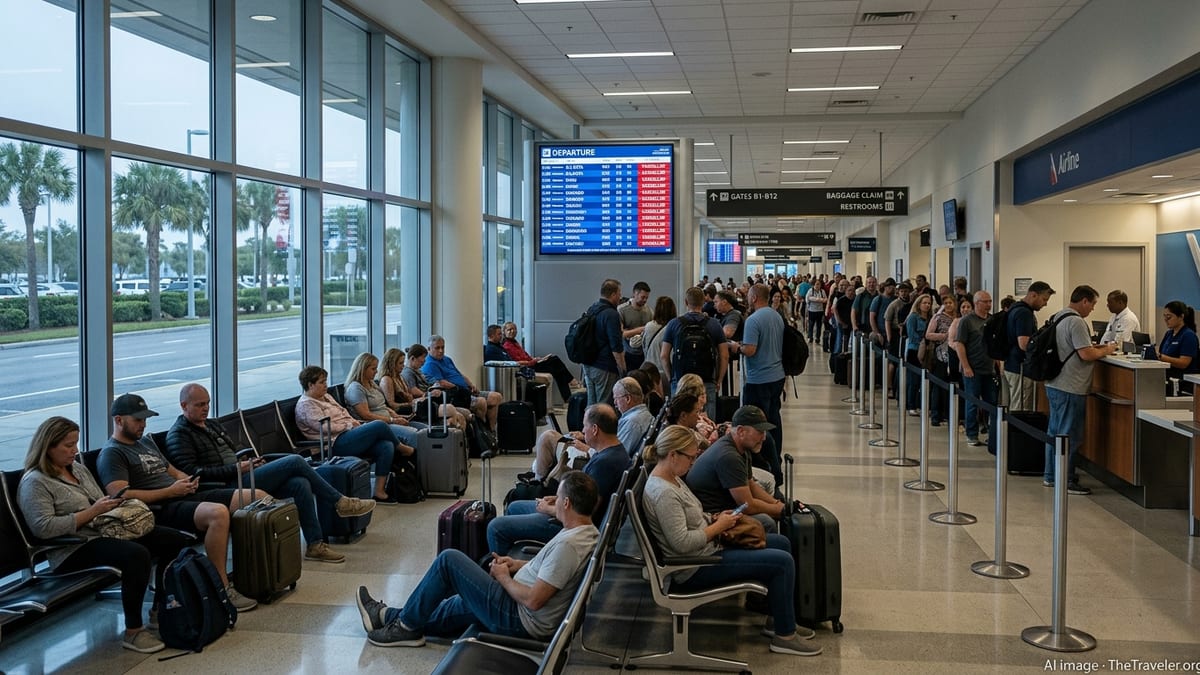
The result in recent days has been a series of crowded gate areas, longer customer-service lines, and a spike in same-day rental car demand, as some stranded travelers choose to drive to larger airports or to their final destinations rather than wait for available rebooking options.
Atlanta, Miami, and Chicago: Why These Cancellations Hit So Hard
The impact of canceled flights from Sarasota to Atlanta, Miami, and Chicago is magnified because these cities function as essential connecting points in the U.S. route network. Published schedules and airport data show that carriers use Atlanta as a primary connection point between the Southeast and the rest of the country, while Miami and Chicago link Florida to Latin America, the Midwest, and multiple cross-country routes.
When storms or operational issues disrupt operations at these hubs, bottlenecks form quickly. Recent national coverage has highlighted how winter storms sweeping through the Midwest and East can trigger thousands of cancellations and delays over a period of days, with Atlanta and Chicago repeatedly listed among the hardest-hit airports. Any Sarasota flight relying on aircraft or crews arriving from those hubs becomes vulnerable to last-minute cancellation if those upstream legs cannot operate.
Miami has also featured prominently in recent discussions of congestion and delay, with data-driven analyses flagging it among the more challenging U.S. airports for on-time performance. That means Sarasota passengers booked on tight connections through Miami may face missed flights even when their initial departure operates, and are then competing with others for limited remaining seats as airlines attempt to recover their schedules.
Because Sarasota is categorized as a smaller, non-hub airport, it typically has fewer daily frequencies to any single city compared with large coastal or inland hubs. This thinner schedule can make it harder to absorb disruptions: if the one or two remaining departures to a key city are full or also cancelled, travelers may not find a same-day alternative.
How Many Travelers Are Affected and How Long Could It Last?
Exact passenger counts for the latest cancellations are not yet publicly quantified, but it is clear from airline and airport data that even a modest number of scrubbed departures can affect hundreds of people at a smaller field like Sarasota. Single-aisle jets commonly used on routes to Atlanta, Miami, and Chicago can carry between 120 and more than 170 passengers. A handful of cancellations in each direction can therefore leave several plane loads of travelers seeking new options.
Recent national figures give a sense of scale. Flight-tracking services have documented more than a thousand U.S. cancellations on multiple days this week, with hundreds clustered at Atlanta and other major hubs. When that level of disruption spreads across the network, smaller spokes such as Sarasota quickly feel the ripple effects, particularly when aircraft and crews must be prioritized for higher-density routes.
As for how long the turmoil at Sarasota might persist, much depends on conditions at the major hubs and how quickly airlines can restore normal rotations for planes and crews. Historical patterns show that severe weather or large-scale operational issues can take several days to clear, even after skies improve. Aircraft may need to be repositioned, pilots and flight attendants must remain within duty-time limits, and backlogs of displaced travelers require additional capacity.
Travelers with Sarasota itineraries over the coming week should therefore expect some lingering unpredictability on routes to Atlanta, Miami, and Chicago, even if the concentration of cancellations begins to ease. Schedules may look normal on paper while still being vulnerable to day-of-travel adjustments as carriers work through their recovery plans.
What This Means if You Have an Upcoming Trip Through SRQ
For travelers with upcoming tickets through Sarasota, the latest wave of cancellations is a reminder of how fragile complex itineraries can be when hinging on a single hub connection. Trips that depend on tight transfers in Atlanta, Miami, or Chicago are especially exposed. If the first leg out of Sarasota is delayed or cancelled, the entire itinerary may unravel, often with limited same-day alternatives from a relatively small origin airport.
Publicly shared travel experiences in recent weeks show passengers across the country facing multi-day delays, overnight airport stays, and long customer-service queues after cancellations at key hubs. Those stories align with data from large disruption events in recent years, which indicate that once a network becomes imbalanced, some passengers are not rebooked until one or two days later, particularly when they are starting from smaller airports with fewer flights.
Travelers who can adjust departure times may find more resilience in morning flights, which often have better odds of leaving on schedule before daily delays ripple through the system. However, when cancellations are driven by weather or crew constraints at hubs, even early departures can be affected if the inbound aircraft never arrives.
Those with essential or time-sensitive trips may want to build in additional buffers, such as allowing a longer connection window at Atlanta, Miami, or Chicago, or, in some cases, considering alternate routings if they are available from Sarasota or nearby airports. While such choices cannot eliminate risk, they can reduce the impact of a single canceled segment.
Practical Steps to Reduce Your Risk of Being Stranded
Amid the current turmoil, there are several practical steps Sarasota travelers can take to lower their chances of being stranded and to respond more effectively if cancellations occur. The most immediate is to monitor flight status closely in the 24 hours before departure, using both airline apps and airport departure boards. Patterns of rolling delays into a hub such as Atlanta or Chicago can be an early indicator that downstream flights, including those from Sarasota, may be at heightened risk.
Passengers booking new trips in the coming days may wish to consider choosing itineraries with more than one daily option on their chosen route, where possible. If one departure is cancelled, a second frequency on the same day can offer a safety net, even if it is less convenient. Where nonstop options from Sarasota are limited, some travelers choose to drive to a larger airport within a few hours’ distance to gain access to more frequent service, though this comes with additional cost and time.
Travel insurance and flexible ticket policies can also play a role. Many airlines and third-party providers offer coverage or fare types that allow easier changes when disruptions occur. While terms vary, a flexible booking can make it easier to switch airports, alter dates, or reroute through a different hub if Sarasota’s links to Atlanta, Miami, or Chicago experience further disruption.
Ultimately, the recent wave of Sarasota cancellations highlights a broader reality of modern air travel: even a growing, well-equipped regional airport remains dependent on the stability of large hubs. As carriers and airports work through the latest operational snags, travelers passing through Sarasota may find that extra monitoring, flexibility, and contingency planning are their best defenses against a suddenly cancelled trip.