

More news on this day
After a stretch of turbulent travel seasons, Sarasota-Bradenton International Airport is confronting a surge in flight disruptions that has left many travelers wondering whether the fast-growing Gulf Coast gateway has quietly become one of Florida’s most frustrating airports.
Get the latest news straight to your inbox!
Record Growth Meets Rising Disruptions
Once a relatively quiet regional facility, Sarasota-Bradenton International Airport has transformed into a major entry point for Florida’s Gulf Coast. Publicly available data from airport and state reports indicates that passenger numbers have climbed sharply since the pandemic travel rebound, with Sarasota-Bradenton posting record monthly traffic through 2023 and 2024 as new low cost and leisure routes were added.
That surge in demand has coincided with a noticeable uptick in disruption. National analyses of Bureau of Transportation Statistics data show Florida among the five worst states for delays and cancellations over the most recent 12 month period measured, reflecting how quickly weather and congestion can ripple through the state’s busy, tourism focused aviation network.
Separate rankings of delay prone airports based on federal data place Sarasota-Bradenton in the middle of the national pack, with roughly one in five flights arriving late in the year ending in mid 2024. That rate is lower than at some of Florida’s largest hubs but high enough that, when combined with limited terminal space and tight peak schedules, even a modest operational hiccup can quickly be felt by passengers.
Local commentary and publicly available planning documents point to the same tension. A new terminal expansion and additional gates have added capacity, yet growth in flights has been so rapid that construction, gate changes and shifting traffic patterns continue to test the airport’s ability to move people smoothly through the building.
How SRQ Compares to Florida’s Other Trouble Spots
To understand whether Sarasota-Bradenton truly delivers the worst airport experience in Florida, it helps to compare it with the state’s larger hubs. Multiple nationwide delay and disruption studies over the past two years consistently single out Fort Lauderdale-Hollywood International, Miami International, Orlando International and Tampa International among the country’s most delay prone large airports, with disruption rates often topping 30 percent of flights in peak seasons.
By contrast, Sarasota-Bradenton typically does not appear in the top tier of national worst airport lists, in part because its overall traffic volume is lower than those mega hubs. Some rankings that analyze airports with at least 10,000 departures between late 2023 and late 2024 place Sarasota-Bradenton well below Florida’s biggest problem airports, with a lower share of delayed flights than Fort Lauderdale and Miami.
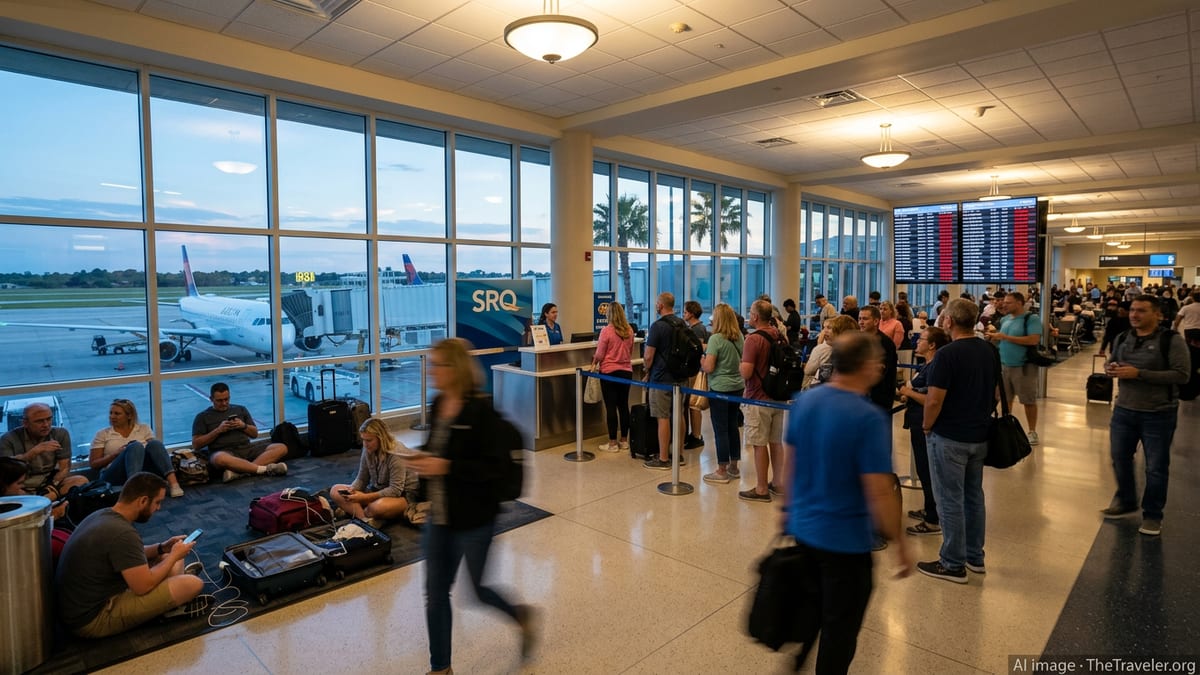
However, the passenger experience on the ground can tell a different story than pure statistics. Larger airports often have more dining options, more gate areas and greater flexibility to reassign aircraft during irregular operations. At a compact airport such as Sarasota-Bradenton, a wave of delays on a stormy afternoon or following a system outage can leave gate areas crowded, queues stretching through the terminal and limited options for passengers seeking to rebook or wait in comfort.
Seen through that lens, Sarasota-Bradenton may not be the most disrupted airport in Florida by percentage of delayed flights, but it can feel like one of the most stressful for travelers when disruptions hit during already compressed departure banks.
Weather, System Shocks and Structural Constraints
Florida’s weather remains a central driver of disruptions, and Sarasota-Bradenton is no exception. Thunderstorms during the long summer season, sea breeze interactions along the Gulf Coast and occasional tropical systems can slow or temporarily halt arrivals and departures, creating backlogs that spill into subsequent days. National reports on delay patterns indicate that Florida’s airports see some of the highest concentrations of weather related disruptions in the country.
The wider aviation system has also been rattled by high profile technology incidents. Major IT outages in 2024 affected airlines worldwide, triggering thousands of cancellations across the United States. When those industrywide events occur, smaller but fast growing airports such as Sarasota-Bradenton can struggle to accommodate stranded passengers, because their hotels, ground transportation networks and terminal amenities are geared toward normal seasonal peaks rather than sudden multi day waves of disrupted travelers.
Structural factors at the airport compound those pressures. Public finance and planning documents describe Sarasota-Bradenton as operating with a concentrated carrier mix and tightly scheduled banks of departures, particularly during winter and spring high season. When one carrier experiences equipment issues or crew shortages, the impact can cascade through the day’s operations, affecting not only that airline’s flights but also gate and baggage availability for others.
Unlike sprawling hubs that can spread operations across multiple concourses, Sarasota-Bradenton’s compact footprint means that any disruption is highly visible. Crowded boarding areas, stretched parking facilities and longer security lines during peak disruption windows feed into an overall impression among travelers that the airport is struggling to keep pace with its own growth.
Is SRQ Really Florida’s Worst Airport Experience?
Putting together national delay rankings, state level statistics and on the ground conditions suggests a nuanced picture. Measured strictly by the percentage of delayed and canceled flights, Sarasota-Bradenton does not currently rank as Florida’s worst performing airport. Larger operations at Fort Lauderdale, Miami and Orlando account for a higher share of disruptions and more severe national rankings, reflecting their heavier traffic and more frequent exposure to extreme weather and airspace congestion.
Yet travelers passing through Sarasota-Bradenton may still perceive their experience as among the worst in the state during bad days. Rapid passenger growth, a compact terminal undergoing expansion, limited redundancy in gates and infrastructure, and concentrated peak departure times can all amplify the impact of delays that would feel more manageable at a larger facility.
Analysts of federal aviation data note that even small changes in punctuality can be felt strongly at mid sized airports that have grown faster than their infrastructure. In that sense, Sarasota-Bradenton looks less like an outlier and more like a case study in how demand across Florida’s coasts has outpaced the ability of aviation systems to absorb weather, technology failures and staffing strains without visible disruption.
For now, Sarasota-Bradenton sits in a gray area. It is not clearly the worst airport in Florida by the numbers, but its combination of rapid growth and limited physical space means that when disruptions arise, the traveler experience can quickly feel as chaotic as that of the state’s most notorious hubs.
What Travelers Can Expect in Upcoming Seasons
Looking ahead to the next winter and summer travel seasons, industry forecasts and airport planning materials indicate that traffic through Sarasota-Bradenton is likely to remain strong. New and returning routes from low cost and leisure oriented carriers continue to target the Gulf Coast’s growing population and visitor base, while seasonal residents and vacation travelers keep demand elevated outside traditional holiday peaks.
Infrastructure projects at the airport are intended to ease some of the pressure. Additional gates, upgraded security lanes and expanded concessions space are being brought online in phases, which could improve the passenger experience once complete. In the near term, however, construction activity and shifting traffic patterns may create temporary bottlenecks precisely when airlines are operating at or near capacity.
Travel data specialists generally recommend that passengers using disruption prone airports build in extra time, avoid tight connections, monitor weather along the route and consider early morning departures, when schedules are less likely to have absorbed the day’s delays. For travelers heading to or from Sarasota-Bradenton, those strategies may be particularly valuable during peak winter and summer months, when both local storms and national aviation strains are most common.
Whether Sarasota-Bradenton ultimately sheds its reputation for rough travel days will depend on how effectively airport investments, airline scheduling and broader system improvements can absorb the next wave of demand. For now, the airport exemplifies the growing pains of Florida’s aviation boom, where record traffic and record disruptions increasingly travel hand in hand.