

More news on this day
Belgian investigators have opened a serious incident inquiry after an SAS Airbus A320neo attempting to depart Brussels Airport for Copenhagen instead began its takeoff roll on a taxiway at night, accelerating to more than 100 knots before the crew rejected the takeoff and brought the jet to a halt.
Get the latest news straight to your inbox!
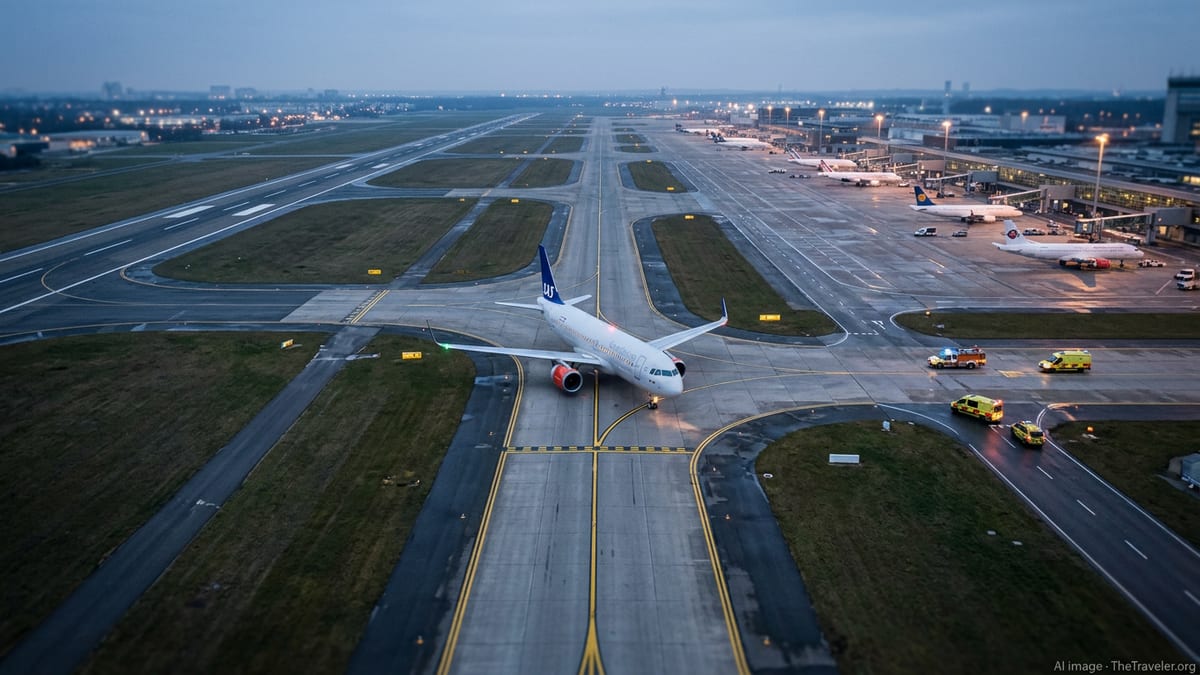
Nighttime Departure Turns Into Serious Ground Incident
The incident unfolded on the evening of 5 February 2026 at Brussels Airport, when SAS flight SK2590, also operating under the callsign SAS43M, prepared for a delayed departure to Copenhagen. The Airbus A320neo, registered SE-ROM, was cleared for takeoff from runway 07R but lined up instead on parallel taxiway E1.
According to data released in a preliminary report from the Belgian Air Accident Investigation Unit and corroborated by independent flight-tracking platforms, the aircraft began a normal takeoff roll on the taxiway and rapidly accelerated. ADS-B data indicates the jet reached more than 100 knots, with some analyses placing the peak speed around 107 knots and official figures in the investigation citing approximately 127 knots, or 235 kilometers per hour, before the crew initiated a high-speed rejected takeoff.
The aircraft came to a stop near the intersection of taxiways C1 and E1, on paved surface adjacent to the marked movement area. There were no injuries reported among the more than 130 people on board, and the aircraft was not damaged, but Belgian authorities classified the occurrence as a serious incident due to the high speed reached on a non-runway surface and the proximity of infrastructure beyond the taxiway’s end.
Brussels Airport operations continued, but the event has prompted close scrutiny from regulators and industry observers, given the potential consequences if the crew had not stopped in time on the shorter, narrower taxiway layout.
Investigators Probe Cockpit Decisions and Taxi Instructions
The preliminary investigation focuses on how a modern airliner, operated by a major carrier at a large international hub, progressed from a standard clearance to a high-speed takeoff attempt on the wrong pavement. Investigators are examining taxi instructions from air traffic control, cockpit briefings, and the crew’s situational awareness during the departure sequence.
Belgian officials report that the A320neo had originally been expected to depart from the full length of runway 07R. Running about 90 minutes late, the crew discussed the possibility of an intersection departure to save time. The tower later proposed such an intersection takeoff, and subsequent taxi clearances brought the aircraft toward the eastern side of the airfield where the runway and parallel taxiways run close together.
As the jet approached the departure area at night, the crew followed the cleared route but ultimately positioned the aircraft on taxiway E1 rather than on the runway. The preliminary report notes that the crew appears to have believed they were aligned with runway 07R when they advanced the thrust levers for takeoff, highlighting a breakdown in cross-checking of airport signage, lighting cues, and instrument references.
Investigators are analyzing cockpit voice and flight data recorders to reconstruct the precise sequence of callouts, checklist steps, and any confusion between the pilots as the aircraft lined up and began to accelerate. The role of fatigue, time pressure from the delayed schedule, and familiarity with Brussels Airport’s layout are all under review as potential contributing factors.
How the Rejected Takeoff Unfolded on Taxiway E1
Accounts from the preliminary report and industry analyses describe a dramatic few seconds on the taxiway. After receiving takeoff clearance, the captain, acting as pilot flying, advanced the engines to takeoff thrust and the aircraft began its roll along E1. Inside the cockpit, the first officer monitored acceleration and made the standard “100 knots” callout, a key cross-check during every takeoff.
At around this point, investigators say, the crew recognized inconsistencies between what they expected to see on runway 07R and what appeared ahead of them. The limited length of the taxiway, its narrower profile compared with a runway, and the lighting pattern prompted growing concern. Realizing the aircraft was not on the active runway, the pilots initiated a rejected takeoff while already well above the typical low-speed abort range.
Maximum wheel braking and reverse thrust were applied as the A320neo decelerated hard on the taxiway surface. Data in the preliminary report indicates that approximately 20 seconds elapsed from the start of the takeoff roll to the point where thrust was reduced and the abort was fully underway. The jet came to rest close to the paved edge near the taxiway intersection, with only a relatively short distance remaining before grass, fencing and airport fuel facilities.
Cabin reports from passengers shared with media outlets describe a sudden, forceful deceleration and the smell of hot brakes, but emergency services found no fire or structural damage. After inspections and coordination with authorities, the aircraft later repositioned and departed normally on a subsequent flight, while SK2590’s passengers were re-accommodated.
Technology, Human Factors and Runway Safety Systems
The Brussels event has renewed debate over cockpit technology designed to prevent so-called runway confusion events, including attempted taxiway takeoffs. The Belgian report notes that the SAS A320neo involved was not equipped with certain optional systems such as enhanced runway awareness and advisory tools or advanced takeoff surveillance functions, which can provide alerts if an aircraft is misaligned.
Runway safety specialists point out that such tools, while increasingly common, are not yet universal across airline fleets. In their absence, flight crews remain heavily reliant on traditional cross-checks, including careful verification of heading indications, runway identifiers painted on the pavement, edge and centerline lighting, and signage at holding points and entryways.
Human factors are also central to the inquiry. The combination of a night departure, schedule pressure after delays, and a complex intersection departure can all increase workload and the risk of confirmation bias, where pilots interpret cues in line with their expectations rather than what is actually in front of them. Training programs emphasizing sterile cockpit discipline during taxi and explicit verbal confirmation of runway alignment are likely to receive renewed attention in light of the Brussels case.
Air traffic control procedures are likewise under review. Investigators are looking at phraseology, timing of clearances, and whether alternative guidance or visual aids could have helped prevent the aircraft from entering the taxiway instead of the runway. While no controller error has been formally identified at this stage, the serious incident is expected to inform updates to tower practices and briefings at Brussels and possibly at other European hubs.
Implications for Brussels Airport and International Travelers
For Brussels Airport, the near-miss underscores the importance of clear surface markings and lighting on parallel taxiways and runways, particularly in areas where geometry and proximity can create visual ambiguity in darkness. Airport management has indicated it is cooperating fully with the investigation and will consider any safety recommendations that emerge, which could include additional signage, revised taxi routings or improved depiction of intersection departures in airport charts.
The incident is also a reminder to passengers that modern commercial aviation, while extraordinarily safe, still depends on layers of defenses, from cockpit training and technology to air traffic control and airport design. In this case, those layers ultimately prevented a tragedy, but only after the aircraft had reached speeds typical of a committed takeoff.
For travelers using Brussels as a gateway to Belgium and the wider region, there has been no reported impact on long-term operations or schedules. However, in the short term, crews and controllers are expected to be particularly vigilant about runway confirmation on night departures, and regulators may issue advisories aimed at reducing the risk of taxiway takeoff attempts globally.
The Belgian Air Accident Investigation Unit will continue its work in the coming months, with a final report expected to offer detailed findings and recommendations. Airlines, airports and safety bodies worldwide are watching closely, viewing the Brussels taxiway abort as a high-profile case study in how quickly a routine departure can escalate, and how critical rapid recognition and decisive action are in keeping passengers safe.