

More news on this day
Scandinavian Airlines is rolling out high-speed Starlink inflight WiFi across parts of its fleet, aligning with a fast-expanding group of carriers that see space-based broadband as central to winning premium travelers and reshaping onboard revenue models.
Get the latest news straight to your inbox!
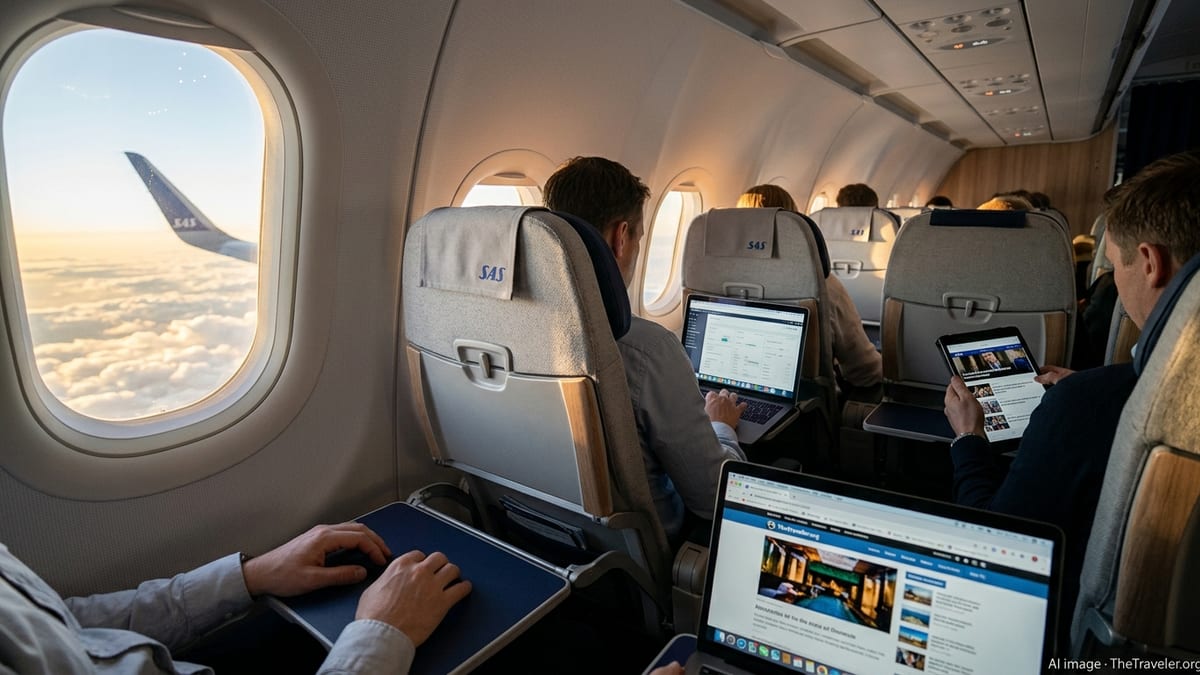
SAS Deepens Its Digital Overhaul With Starlink Rollout
Scandinavian Airlines has framed its adoption of SpaceX’s Starlink as a cornerstone of broader upgrades to its onboard experience. A recent SAS communication on network and product investments highlights the introduction of high-speed Starlink WiFi across short-haul aircraft, supported by aeroterminals designed to reduce drag and fuel burn compared with older antenna systems. Publicly available information indicates that the rollout is initially focused on aircraft where installation is technically straightforward and can be aligned with scheduled maintenance, limiting downtime.
The move follows months of anticipation among SAS frequent flyers. Online discussions in Scandinavian travel forums in March 2026 point to a phased launch, with Starlink-equipped aircraft offering enhanced connectivity and some tiers of free access tied to EuroBonus status or specific mobile operators in Denmark and Sweden. This structured access mirrors SAS’s long-standing strategy of using WiFi perks as a differentiator for business and loyal customers, but with far higher speeds than the airline’s legacy systems.
Industry data shows that SAS, once perceived as a late adopter in cabin technology, has accelerated digital initiatives since joining the SkyTeam alliance in 2024. Starlink fits into that trajectory, supporting app-based servicing, real-time operations data and more robust entertainment streaming. Analysts note that moving to a next-generation satellite platform also helps SAS limit fragmentation between its existing Viasat-equipped aircraft and new installations, easing maintenance and support costs over time.
For passengers, the most tangible change is performance. Starlink’s low Earth orbit constellation is designed to deliver home-like bandwidth with lower latency than traditional geostationary satellite systems, allowing video calls, cloud-based work and high-definition streaming across Europe’s dense air corridors and on longer sectors into North America.
United, IAG, Hawaiian, Alaska, Southwest and Etihad Shape a New Standard
SAS is not moving in isolation. Over the past 18 months, some of the world’s most influential airline groups have publicly committed to Starlink as they race to upgrade connectivity. United Airlines signed what it described in 2024 as one of the industry’s largest Starlink agreements covering both mainline and regional fleets, with subsequent company updates in early 2025 and 2026 indicating accelerated installations and a focus on free, high-speed WiFi for loyalty program members.
In Europe, International Airlines Group, parent of British Airways, Iberia, Aer Lingus, Vueling and Level, announced a multi-year partnership in late 2025 to deploy Starlink-powered WiFi on more than 500 aircraft. Coverage in European business media highlights expected download speeds comfortably supporting streaming and real-time collaboration tools, with free access on many routes positioned as a core pillar of IAG’s digital customer experience plans for the latter half of this decade.
Across the Atlantic, Hawaiian Airlines was among the first full-service carriers to publicize its intent to install Starlink on long-haul Airbus A330 and A321neo aircraft, targeting travelers on transpacific routes where traditional connectivity often struggles over vast oceanic stretches. Reports on the rollout emphasize the strategic importance of reliable broadband for leisure travelers booking premium cabins and for island residents who increasingly expect seamless connectivity when flying between Hawaii and the mainland United States.
North American competitors such as Alaska Airlines and Southwest Airlines have also been linked to Starlink upgrades in technology and aviation trade coverage, while Etihad Airways and other Gulf carriers have moved to LEO-based systems on select aircraft to complement or replace earlier-generation solutions. Collectively, these commitments are resetting passenger expectations: free or near-free WiFi, with enough capacity to work and stream without the frustrations associated with past inflight internet.
The Real Driver: Loyalty Economics and Ancillary Revenue
Observers might assume that the main goal of adopting Starlink is simply to fix slow inflight internet. While that is critical, airline disclosures and industry analysis suggest a deeper motivation: loyalty economics and the search for new digital revenue streams. United, IAG and others have increasingly framed connectivity not just as a cost center but as infrastructure for a wider ecosystem of personalized offers, ancillary sales and data-driven services.
With high-capacity, low-latency WiFi, airlines can push real-time upgrades, seat selection, buy-on-board catering, destination activities and co-branded credit card offers directly to personal devices throughout a flight. Marketing specialists note that the cabin effectively becomes an always-on digital storefront, where every connected passenger can receive tailored prompts based on route, fare class and frequent flyer profile. The better and more reliable the connection, the more likely passengers are to engage with those offers.
Free or bundled WiFi access is also emerging as a loyalty benefit in its own right. United has used Starlink-enabled connectivity as a headline perk for MileagePlus members, while European groups signal that elite tiers may enjoy premium speeds or expanded data allowances. For SAS, tying high-speed access to EuroBonus membership and select partners supports efforts to grow its customer base in key Nordic markets at a time of intensified competition from low-cost carriers.
Behind the scenes, airlines are increasingly measuring inflight WiFi engagement as part of customer lifetime value calculations. According to recent financial filings and investor presentations from major groups, connected passengers generate higher ancillary revenue over time and show greater propensity to book direct rather than through third parties. Starlink’s performance makes it more realistic for airlines to rely on those behaviors, converting bandwidth investments into long-term commercial gains.
Operational and Sustainability Pressures Behind the Technology Shift
In addition to revenue ambitions, operational and environmental factors are pushing airlines toward next-generation satellite connectivity. Starlink hardware has been developed with lower-profile aeroterminals that reduce drag compared with some earlier satellite antennas. Manufacturers and airlines argue that this can translate into incremental fuel savings, an important consideration as carriers face rising fuel costs and stricter climate disclosure requirements in Europe and beyond.
Reliable broadband also supports real-time data flows between cockpit, cabin and ground operations. Publicly available documentation from large airline groups describes ambitions for enhanced predictive maintenance, dynamic rebooking, more accurate arrival updates and live weather optimization, all of which rely on stable, high-bandwidth links. By leveraging Starlink, carriers such as SAS, United and IAG can consolidate multiple data channels into a single, resilient backbone, improving efficiency while reducing the need for legacy systems.
There are, however, technical and regulatory challenges. In recent months, media and specialist aviation outlets have reported temporary suspensions or adjustments to Starlink service on certain aircraft types at individual airlines following concerns about interference with onboard systems. While such issues are typically resolved through equipment modifications and additional testing, they underscore that integrating new satellite technology into complex fleets is a multi-year process, not a simple software update.
Environmental advocates also caution that the climate benefits of marginal fuel savings must be weighed against the emissions impact of operating large satellite constellations and the broader growth in air travel. Airline groups respond that digitalization, including better connectivity, is one of the tools available to optimize operations while longer-term solutions such as sustainable aviation fuel and new aircraft designs scale up.
What Passengers Can Expect Next From Inflight Connectivity
For travelers, the next phase of the inflight WiFi transformation will likely feel less like a discrete product launch and more like a gradual normalization. As Starlink and similar systems are installed across more aircraft, passengers on SAS, United, IAG airlines, Hawaiian, Alaska, Southwest and Etihad can expect fewer dead zones, faster logins and a shift away from time-limited or device-limited pricing models on many routes.
Travel technology commentators anticipate that airlines will increasingly integrate connectivity into their mobile apps, enabling passengers to move seamlessly from airport to aircraft without switching platforms. Features such as live seat maps, in-app food ordering, and synchronized entertainment libraries are already appearing on select carriers and will become more compelling as bandwidth constraints ease.
At the same time, airlines will continue to navigate questions about etiquette and cabin atmosphere. With high-quality video and voice over IP technically feasible at 40,000 feet, several carriers, including United, have reiterated restrictions on voice calls to preserve a quiet cabin, even as they encourage streaming and messaging. Balancing always-on connectivity with passenger comfort is likely to remain a recurring topic as technology advances.
For SAS and its peers, the adoption of Starlink is therefore less about a single innovation and more about a structural shift. High-speed, low-latency WiFi is becoming as fundamental to the travel proposition as seat pitch or onboard catering. The airlines moving earliest and most aggressively to embrace that reality are gambling that passengers will reward them not just with satisfaction scores, but with deeper loyalty and higher long-term revenue.