

More news on this day
Hundreds of passengers in Denmark, Norway, and Sweden faced major disruption today after Scandinavian carrier SAS delayed 119 flights and cancelled 26 services, stranding travelers at Nordic hubs and rippling delays across popular routes to Paris, Stockholm, Berlin, London, and other European cities.
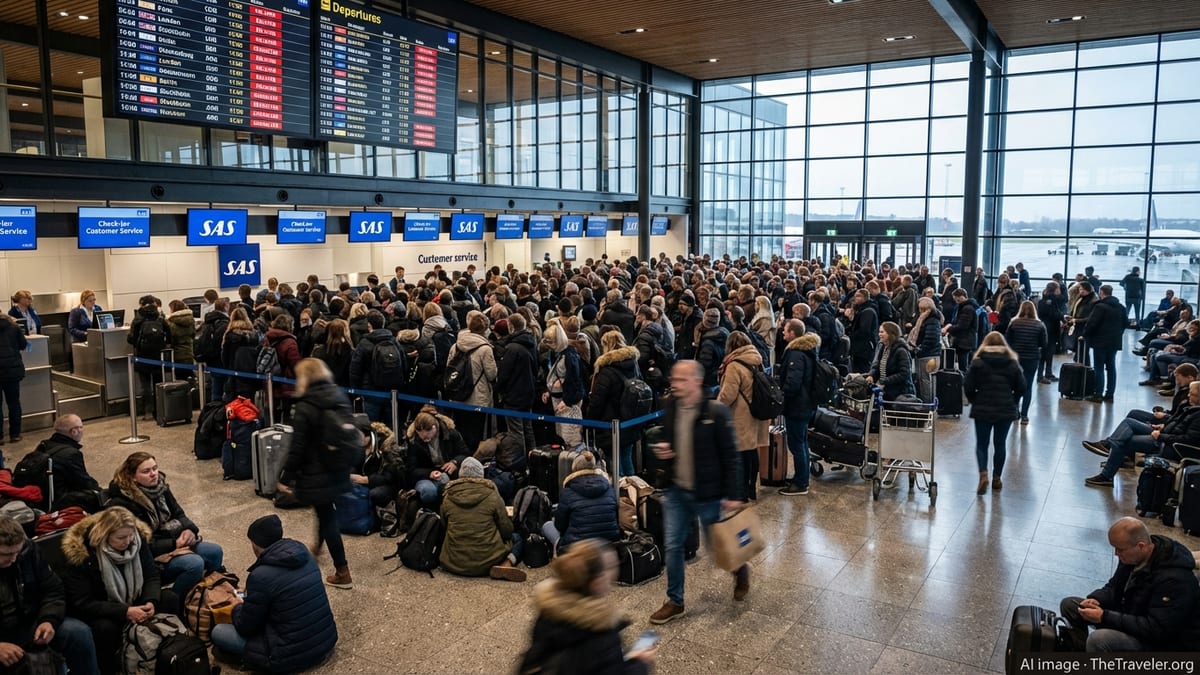
Nordic Hubs Hit as SAS Operations Falter
The latest operational disruption hit SAS services hardest at Stockholm Arlanda, Copenhagen Kastrup, and regional Norwegian airports, where check-in halls and departure lounges quickly filled with stranded travelers. The majority of the 26 cancellations affected short-haul intra-European routes, but knock-on effects were felt on connecting services to major capitals including Paris, Berlin, and London.
At Stockholm Arlanda, SAS was among the most heavily impacted carriers, with multiple morning and afternoon departures scrubbed or pushed back by several hours. Similar scenes unfolded in Copenhagen, the airline’s largest hub, where passengers formed long queues at customer service desks in search of rerouting options and hotel vouchers.
In Norway, where SAS serves a dense network of domestic routes feeding into international services, delays to early regional flights quickly cascaded into missed connections. Travelers bound for onward flights to cities such as London and Paris reported being rebooked via alternative hubs or asked to return the following day.
Operational data showed SAS facing particular strain on routes linking Scandinavian hubs with Western European gateways, amplifying the impact for business travelers and holidaymakers at the tail end of the winter travel season.
Paris, London, Berlin and Other Key Routes Disrupted
The interruption to SAS schedules reverberated across Europe’s busiest business and leisure corridors. Flights between Copenhagen and London Heathrow, Stockholm and Berlin, and Scandinavian capitals and Paris Charles de Gaulle were among those delayed or cancelled, forcing passengers into crowded transfer zones and long rebooking lines.
Travelers heading for meetings, short breaks, and school-holiday trips reported waiting hours for updates as departure boards repeatedly revised estimated take-off times. Some passengers who had already boarded were asked to disembark when delays extended beyond crew duty limits, compounding frustration.
At major European hubs including London and Paris, where SAS operates a relatively small but strategically important schedule, delays arriving from Scandinavia risked missed long-haul connections on partner airlines. Airport staff said hotel availability around key transfer airports tightened quickly as stranded travelers sought overnight accommodation.
Airports in Berlin and other German and Dutch cities also reported disrupted SAS arrivals and departures, with ground handlers warning that late-evening rotations could be particularly vulnerable if incoming aircraft remained out of position.
Passengers Face Long Queues and Uncertain Plans
Across affected airports in Denmark, Norway, and Sweden, passengers described a day dominated by queues and uncertainty. With many SAS services departing full at this time of year, rebooking options were limited, especially for groups and families needing to travel together.
Parents traveling with children reported difficulty obtaining clear estimates of new departure times, complicating decisions on whether to wait at the gate or leave the terminal in search of rest options. Business travelers, meanwhile, expressed concern about lost meetings and non-refundable accommodation at their destinations.
Several passengers recounted spending hours in line at customer service desks only to be told that remaining seats were scattered across late-night or next-day departures. Others were offered itineraries involving additional connections through secondary airports, lengthening total journey times significantly.
While some travelers praised individual staff members for their efforts under pressure, many noted that communication via apps and airport announcements lagged behind the rapidly changing operational picture, leaving them reliant on gate agents for the latest information.
Weather, Capacity and Network Strain Behind Latest Chaos
The latest wave of disruptions comes amid a broader period of strain on European aviation, where winter weather, tight airport capacity, and complex crew scheduling have repeatedly combined to upend timetables. In Scandinavia, fluctuating temperatures and wintry conditions have added de-icing requirements and occasional runway constraints to an already stretched network.
Analysts note that large hub-and-spoke structures such as SAS’s operations in Copenhagen and Stockholm are particularly vulnerable when early delays cascade through the day. A single aircraft arriving late from one city can result in multiple subsequent flights departing behind schedule, leaving little slack when airports are already operating close to capacity.
Recent days have seen a succession of disruption events across European carriers, with SAS among several airlines facing clusters of cancellations and delays at key hubs. Industry observers warn that, without additional spare capacity in aircraft and crews, airlines remain exposed to further system-wide shocks when weather or technical issues arise.
While no single factor has been confirmed as the dominant cause of today’s SAS disruption, the pattern mirrors recent episodes where a combination of challenging weather, crew availability, and congested airspace has left passengers bearing the brunt of operational fragility.
What Stranded SAS Passengers Can Do Next
For passengers caught up in today’s disruption, the immediate priority is confirming new travel arrangements. SAS is expected to offer rebooking on the next available flight on its own services, and where possible on partner airlines, although capacity constraints may mean travelers face extended waits before securing a seat.
Under European passenger-rights rules that apply to flights departing from EU and EEA airports, eligible travelers whose flights are significantly delayed or cancelled may be entitled to meals, refreshments, and hotel accommodation, as well as financial compensation in some circumstances. Passengers are advised to keep boarding passes, booking confirmations, and receipts for any out-of-pocket expenses.
Experts recommend using a combination of tools to manage disruption: monitoring airline apps and airport displays for live updates, approaching gate staff for route alternatives, and considering nearby airports if practical. Those with time-sensitive commitments may also explore rail options on shorter intra-European routes where high-speed train links exist.
With SAS’s network concentrated in Scandinavia and key European hubs, the ripple effects of today’s delays and cancellations may continue into the evening schedule and potentially into tomorrow’s first wave of departures. Travelers with upcoming flights are being urged to check their status before leaving for the airport and to allow extra time in case of ongoing congestion at check-in and security.