

More news on this day
Scandinavian airline SAS is confronting a fresh wave of disruption as renewed conflict in the Middle East, shifting airspace restrictions and sharply higher fuel prices converge to upend travel plans across its network, underscoring how geopolitical turmoil far from Northern Europe is reshaping global aviation.
Get the latest news straight to your inbox!
Geopolitics Turn a Regional War into a Network-Wide Shock
Publicly available flight-tracking data and airline advisories show that renewed hostilities across parts of the Middle East have prompted widespread airspace closures and reroutings, affecting carriers that neither originate nor terminate most flights in the region. For SAS, whose long-haul routes connect Scandinavia to Asia and other global hubs, detours around conflict zones are substantially changing operating conditions.
Industry analyses of recent disruptions indicate that large portions of airspace over or near active conflict areas have been classified as no-go zones or subject to strict risk assessments. While some corridors remain technically open, many carriers are opting for conservative routings that add distance and time. This has a knock-on effect on crew scheduling, aircraft utilization and connection banks, amplifying the disruption well beyond the immediate region.
Aviation insight material prepared by SAS in late 2024 already flagged that broader geopolitical instability, including tensions in Asia and the Middle East, was eroding network resilience by forcing longer routings. Those structural vulnerabilities have been thrown into sharper relief by the latest escalation, turning a regional war into a global aviation event and increasing the likelihood of large-scale schedule adjustments.
Although the precise tally of cancelled and rerouted flights continues to evolve, operational updates and schedule data point to hundreds of SAS services being affected over the current disruption window. Across a broader period that includes rolling timetable cuts and tactical cancellations tied to fuel costs and airspace restrictions, the cumulative impact approaches one thousand flights removed from the schedule, either temporarily or for an extended season.
Fuel Costs and Detours Push an Already Stressed Airline
The conflict-related airspace closures are intersecting with a surge in global fuel prices that has been particularly punishing for European carriers. Public energy market data over recent weeks has pointed to higher crude benchmarks and increased volatility, driven in part by worries over supply routes through the wider Middle East. For airlines, jet fuel is one of the largest operating expenses, and even relatively small price movements can quickly erode margins.
For SAS, the problem is compounded when conflict-related detours lengthen flight times. Longer routings require additional fuel uplift, which magnifies the financial impact of each leg. Internal risk disclosures published by the company in earlier years have consistently warned that conflicts, sanctions and oil market shocks could simultaneously reduce demand and increase costs, a scenario that closely resembles the current environment.
Recent schedule changes across Scandinavia suggest that SAS has responded with a combination of tactical cancellations and aircraft reassignments. Reports circulating among travelers in Norway describe large clusters of domestic services being consolidated or removed, with passengers rebooked onto remaining departures. While each individual change is framed as a short-term adjustment, the pattern points to a carrier attempting to preserve cash and protect its most commercially critical routes.
Analysts following the airline note that SAS has already been undergoing a complex financial restructuring and ownership transition, including its move toward joining the SkyTeam alliance. The added stress of fuel spikes and war-driven disruption risks narrowing the room for maneuver, potentially forcing deeper capacity cuts if conditions do not stabilize.
Passenger Chaos from Scandinavia to the Gulf
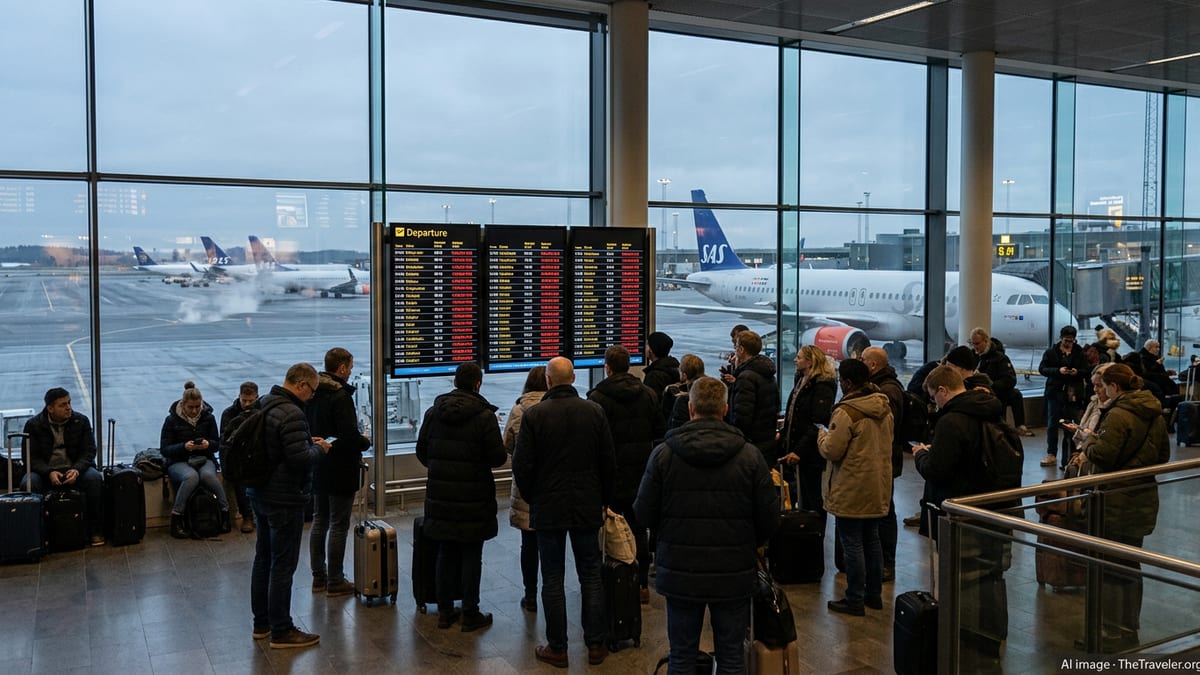
For passengers, the effect of these macroeconomic and geopolitical forces is felt most acutely at the airport. Social media posts and traveler accounts in recent days describe abrupt cancellations, lengthy rebooking queues and confusion over which services are still operating on time. While SAS and other carriers are relying heavily on digital notifications, many affected travelers report learning of changes only after arriving at the terminal.
Connections through major hubs are particularly vulnerable. Scandinavia’s role as a gateway between Northern Europe and Asia means that any disruption to onward traffic via the Middle East can ripple back into regional feeder flights. When partner or competitor airlines suspend or curtail operations through Gulf or Levantine hubs, SAS must reassess the value of maintaining associated feeder capacity, sometimes opting to ground flights when transit flows disappear.
Travelers whose itineraries intersect with conflict-adjacent airspace are facing extended journey times, last-minute reroutings via alternative hubs and uncertainty over return options. Guidance shared by consumer advocates emphasizes the importance of monitoring airline apps, verifying flight status before leaving for the airport and understanding the difference between rights under European passenger-protection rules and the separate conditions laid out in carrier contracts of carriage.
In Scandinavia’s key business and leisure markets, the cumulative effect is a sense of fragility around international travel plans. Even journeys that do not pass directly over the Middle East are now at higher risk of disruption, simply because aircraft and crews are more tightly scheduled and network buffers have been absorbed by ongoing detours and cancellations.
Network Retiming and Capacity Shifts Across SAS Routes
Schedule data released by SAS and major airports across Scandinavia shows that the airline has begun reshaping its network in response to the latest turmoil. Some long-haul flights have been retimed to avoid the most congested periods in alternative air corridors, while certain off-peak frequencies appear to have been quietly withdrawn in order to concentrate resources on higher-yield departures.
Within Europe, the carrier is selectively trimming short-haul capacity on routes where alternative transport options exist or where demand has softened in the face of travel uncertainty. Publicly available airport timetables in Norway and Sweden point to clusters of cancellations on thinner domestic and regional services, offset by relative stability on key trunk routes linking major Nordic capitals.
Aviation consultancy commentary suggests that SAS is also using wet-lease arrangements and partner capacity to plug gaps where possible, particularly on routes that remain strategically vital but have become more costly to operate due to detours. Third-party operators can sometimes provide smaller or more fuel-efficient aircraft, helping the airline maintain a presence in key markets without bearing the full financial burden of operating every sector with its own fleet.
However, such workarounds have limits. If airspace closures persist and fuel prices remain elevated, the cost of preserving breadth in the network may become unsustainable. In that scenario, observers expect more pronounced seasonal cuts and the deferral of planned expansion into new destinations, as SAS prioritizes operational resilience over growth.
What Travelers Can Expect in the Coming Weeks
With the conflict in the Middle East still evolving and energy markets unsettled, forecasts suggest that volatility in airline schedules is likely to continue through the coming weeks. For SAS customers, this means that even confirmed bookings may be subject to change as the carrier recalibrates its operations in response to shifting geopolitical and cost pressures.
Consumer organizations advise travelers to build additional buffers into itineraries that rely on tight connections, particularly when routing to or from Asia or Africa via European hubs. Flexible tickets, travel insurance products that explicitly address war-related disruption and careful review of refund and rebooking policies are emerging as important tools for managing risk.
Industry observers also highlight that airlines, including SAS, are under pressure to communicate disruption more clearly and proactively. Greater transparency about the reasons behind cancellations, the likely duration of temporary suspensions and the options available to affected passengers may help rebuild trust at a time when many travelers feel increasingly vulnerable to forces beyond their control.
For now, Scandinavia’s flagship carrier remains operational but constrained, navigating a complex landscape where a war thousands of kilometers away, fluctuating fuel markets and lingering financial challenges intersect. How effectively SAS manages this turbulent period may shape not only the summer travel season for Nordic passengers, but also the longer-term role of the airline in an increasingly fragmented global aviation system.