

Hundreds of air travelers across Europe, the United States and the Middle East faced severe disruption on Monday as SAS, Iberia, Air Algérie and British Airways canceled at least 20 flights and delayed 69 more, snarling traffic at major hubs from London and Madrid to New York, Boston, Washington D.C. and key Nordic and Middle Eastern gateways.
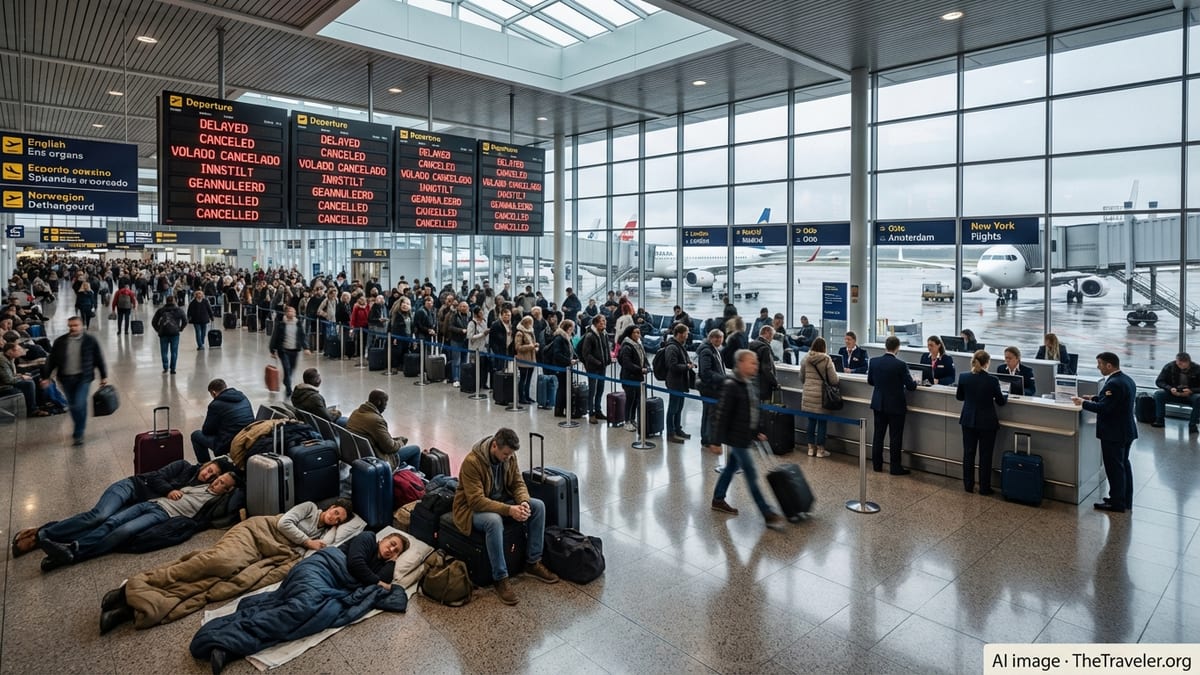
Waves of Cancellations Hit Key Routes on Both Sides of the Atlantic
The latest disruption unfolded across several time zones, with flight-tracking data and airport operational updates showing scattered but consequential cancellations and delays involving SAS, Iberia, Air Algérie and British Airways. The four carriers, which collectively move tens of thousands of passengers each day across Europe, North America and North Africa, scrubbed or pushed back flights serving the United Kingdom, Spain, Norway, Sweden, the Netherlands, the United States mainland and Caribbean, and parts of the Middle East.
While the total of 20 outright cancellations and 69 delays is modest compared with major storm or strike scenarios, the disruption fell heavily on long-haul and connecting itineraries. Passengers reported missed onward connections at hubs such as London Heathrow, Oslo Gardermoen, Madrid Barajas and Amsterdam Schiphol, as well as at U.S. gateways including New York, Boston, Washington D.C. and San Juan, where transatlantic and regional links are tightly timed.
Operational planners at the affected airlines contended with lingering winter weather in parts of northern and western Europe, airspace congestion and rotational knock-on effects from earlier disruption days, where hundreds of European flights were delayed or canceled as storms and strong winds swept across Spain, France, the Nordics and the Low Countries. Similar systems have already forced ground stops and large-scale schedule cuts in recent weeks, leaving carriers with thinner buffer capacity across their networks.
In practical terms, the cancellations and delays left passengers facing long queues at ticket counters, rebooking challenges during a busy February travel period and uncertainty over when they would reach their final destinations. Families traveling for winter holidays, business travelers heading to conferences and diaspora communities shuttling between Europe, North America and North Africa were among those affected.
Airports from London and Madrid to Oslo and Amsterdam Under Strain
In Europe, the heaviest visible impact was concentrated at airports that act as major hubs or focus cities for the affected carriers. London, Manchester and other British airports reported disrupted British Airways operations, while SAS’s Scandinavian network felt pressure in Oslo, Stockholm and across Norway and Sweden. Iberia’s core operations at Madrid and Barcelona were also affected, compounding a period of heightened volatility at Spanish airports that have been contending with strong winds, snow and heavy rain in recent weeks.
Amsterdam and other northern European gateways, which play a critical role in connecting U.S. and Middle Eastern travelers to secondary European destinations, were similarly hit by delays. Even when flights were not canceled, rolling delays on arrivals and departures narrowed connection windows for passengers traveling onward to smaller cities in Scandinavia, the Iberian Peninsula and central Europe, raising the risk of missed flights and overnight layovers.
At ground level, the effect was visible in crowded departure halls and check-in areas, temporary lines forming at transfer desks and customer service counters, and growing clusters of passengers around flight information boards. Travelers at some hubs described gate changes with little notice and departure times that slipped in 15 to 30 minute increments over several hours, a pattern typical when airlines are trying to work aircraft and crews back into position.
In the United Kingdom, where British Airways remains the dominant carrier at London Heathrow and London City, even a handful of cancellations can reverberate across the network, particularly during busy morning and evening banks. With extra flights already operating in recent weeks to absorb pressure from rail disruption and other travel issues in parts of Europe, airlines had little slack to absorb additional shocks to the system.
U.S. East Coast and Caribbean Connections Face Knock-On Delays
The latest wave of disruption also rippled across the Atlantic, with travelers in New York, Boston, Washington D.C. and San Juan reporting delays on flights operated or codeshared by the affected European carriers. Transatlantic services between major U.S. gateways and London, Madrid and key Scandinavian hubs are closely integrated with European feeder routes, meaning a delayed inbound aircraft or crew from Europe can cascade into late departures from American airports.
At New York-area airports, winter operations have already been under strain amid repeated bouts of snow, rain and low cloud this season. Even when runways and taxiways remain open, air traffic control can impose flow restrictions that cause knock-on delays for transatlantic flights. For carriers like British Airways, Iberia and SAS, whose schedules rely on tight overnight rotations between Europe and the U.S. East Coast, any delay in one direction can push aircraft and crew out of sync for the next day’s departures.
Boston and Washington D.C., important business and political centers with strong links to Europe, were also affected, with some passengers redirected through alternative hubs or rebooked for next-day flights when connections could not be held. In San Juan, Puerto Rico, where transatlantic and regional links feed Caribbean leisure and cruise traffic, delays on European services created uncertainty for travelers trying to meet embarkation times or onward connections to neighboring islands.
Airlines typically prioritize maintaining long-haul intercontinental services and will sometimes cancel shorter regional segments to free up aircraft and crew. As a result, passengers booked on intra-European or feeder routes into major hubs often feel the biggest impact, even when flights across the ocean are still operating. That dynamic appeared to play out again in this latest round of disruption.
Middle East Links Disrupted Amid Broader Regional Volatility
The Middle East, a crucial bridge between Europe, Africa, Asia and the Americas, also saw disruption linked to the cancellations and delays. Although the bulk of today’s schedule changes involved European and transatlantic routes, several affected services were due to connect onward through Middle Eastern hubs, where flight schedules have remained fragile amid security tensions, weather episodes and temporary airspace restrictions.
In recent days, airports across the Gulf and the Levant have recorded hundreds of delays and dozens of cancellations, with carriers forced to reroute or reschedule services to avoid restricted airspace and cope with heightened security checks. For passengers originating in or transiting through the Middle East on itineraries involving SAS, Iberia, Air Algérie or British Airways, even small timing changes on European legs can cause missed onward connections and overnight stays.
Regional travel agents and airline call centers reported increased call volumes from passengers trying to rebook itineraries that threaded together multiple carriers across Europe and the Middle East. Complex tickets that combine legacy flag carriers with low cost or regional airlines are particularly vulnerable in such situations, as the protections and rebooking obligations differ depending on whether itineraries are on a single ticket or separate bookings.
For airports already managing heightened security postures, extended passenger dwell times caused by delays can add pressure to terminal operations, from security screening lanes to transit counters and baggage systems. Today’s disruptions, while limited in raw numbers, underscored how tightly coupled Europe-to-Middle East travel has become, with small schedule shocks in one region quickly echoing in the other.
Passengers in Sweden, Norway, the UK and Spain Report Long Waits
In Scandinavia, SAS passengers in Norway and Sweden were among those most visibly affected. Social media posts and local reports described lines at customer service desks in Oslo and Stockholm as travelers sought rerouting options after cancellations on short-haul routes and delays on services to major European hubs. With winter weather still active across parts of the Nordic region, de-icing operations and lower visibility added further operational complexity.
Spanish travelers and international visitors in Madrid and other Iberian airports also faced disruption linked to Iberia’s cancellations and delays. Spain’s aviation system has been under repeated pressure from strong winds, snow and heavy rain this winter, with earlier alerts from meteorological services warning of conditions likely to affect flight operations and road and rail links. One stranded passenger at Madrid described departure boards where a rolling series of Iberia and partner flights showed delays of up to two hours, complicating plans for business trips and family visits across Europe and Latin America.
In the United Kingdom, travelers reported confusion as some British Airways flights were canceled outright while others operated close to schedule but with limited spare seats, making same-day rebooking difficult. Manchester, a growing hub for both full-service and low-cost carriers, saw pockets of disruption as well, particularly for travelers connecting onto British Airways or partner flights through London.
Passengers at Dutch airports, including Amsterdam, experienced similar uncertainty. With many transatlantic and Middle Eastern services relying on tight European connections, Dutch travelers found that even flights still operating were subject to last-minute gate changes and minor delays that, in aggregate, made the day feel chaotic for those navigating unfamiliar terminals or traveling with children.
Air Algérie’s Network Under Scrutiny as Europe and North Africa Interlink
Air Algérie’s role in the current disruption drew particular attention from travelers moving between Europe, North Africa and the Middle East. The Algerian flag carrier has been expanding its European footprint, including service from the United Kingdom and potential growth to cities such as Manchester, as part of broader efforts to modernize its fleet and route network. That expansion has raised expectations among passengers for more reliable and flexible service, especially during peak travel periods.
Recent schedule adjustments and route changes, including plans to shift some UK operations between London airports and to deepen capacity on select European routes, have made Air Algérie an increasingly important connector for Algerian diaspora communities as well as business and leisure travelers. However, today’s cancellations and delays highlighted ongoing challenges in balancing that growth with robust operational resilience, particularly in winter when both European and North African weather can disrupt flying conditions.
Travelers impacted by Air Algérie’s changes reported difficulties securing real-time information on new departure times and rebooking options. Some noted that limited payment options and legacy booking systems can complicate efforts to modify itineraries online or through mobile apps, forcing passengers to rely on call centers or in-person ticket offices at a time when those channels are already under strain.
For Algeria’s tourism industry and for regional hubs that rely on steady traffic from the airline, even a relatively small number of cancellations can have outsized effects. Tour operators, hotels and ground transport providers often build schedules and staffing plans around predictable arrival and departure patterns; when those patterns shift unexpectedly, the impact ripples far beyond the airport terminal.
Rules on Compensation and Passenger Rights Vary by Route
The patchwork of cancellations and delays across Europe, the U.S. and the Middle East once again pushed passenger rights frameworks into the spotlight. In the European Union, the United Kingdom and some neighboring jurisdictions, consumer protection rules require carriers to provide assistance, rebooking or refunds when flights are canceled or heavily delayed, and to pay compensation in certain circumstances when the disruption is within the airline’s control.
Under these regimes, passengers on eligible flights operated by SAS, Iberia, Air Algérie or British Airways may be entitled to meal vouchers, hotel accommodation if an overnight stay becomes necessary, and financial compensation if the airline cannot demonstrate that extraordinary circumstances such as severe weather or air traffic control strikes were the primary cause of the disruption. The exact entitlements vary depending on flight distance, length of delay and point of departure.
On routes involving the United States and Middle Eastern countries, the rules differ significantly. U.S. regulations place fewer obligations on airlines to provide financial compensation for delays, although carriers typically offer rebooking and may provide hotel rooms or meal vouchers in cases of extended disruption. In the Middle East, passenger rights frameworks vary widely by country and carrier, leaving many travelers reliant on individual airline policies rather than standardized regional protections.
Consumer advocates urged passengers to keep detailed records of their experiences, including boarding passes, receipts for extra expenses and screenshots of delay notifications, in case they later seek reimbursement or compensation. They also recommended that travelers familiarize themselves with the specific rights applicable to their itinerary, noting that multi-leg journeys spanning several regions can create a complex mix of protections and obligations.
Airlines and Airports Urge Travelers to Build in Extra Time
As operations gradually stabilized through the day, airlines and airport authorities across the affected regions emphasized the importance of early check-in, flexible planning and close monitoring of flight status during what has already been a turbulent winter for global aviation. They warned that even as today’s disruption is resolved, the underlying drivers, from volatile weather systems to tight aircraft and crew availability, are likely to persist over the coming weeks.
Carriers advised passengers to use official apps and text or email alerts to track schedule changes, rather than relying solely on static departure boards or third-party travel websites. For those with tight connections in hubs such as London, Madrid, Oslo or Amsterdam, industry experts recommended considering longer layovers or, where possible, booking itineraries on a single ticket with one primary carrier or alliance to maximize protection in the event of missed connections.
Airport managers, particularly in northern Europe, reiterated that de-icing procedures, runway inspection requirements and air traffic flow controls can add time to normal operations, even on days when the weather appears calm from the terminal windows. They encouraged passengers to arrive well ahead of departure time and to be prepared for contingencies, including the possibility of re-routing through alternative hubs if bottlenecks emerge.
For the hundreds of passengers stranded today across Europe, the U.S. and the Middle East, the experience served as another reminder that, despite ongoing efforts to improve resilience after the pandemic, international air travel remains highly vulnerable to cascades of disruption. With winter far from over and peak spring travel on the horizon, both airlines and travelers may need to brace for further turbulence in the weeks ahead.