

More news on this day
Hundreds of travellers across Denmark, Norway, Sweden and wider Europe have been left stranded or facing severe disruption after regional carrier SAS Link delayed 22 flights and cancelled 15 more, snarling traffic through key hubs including Geneva, Oslo, Brussels and Stavanger during an already fragile winter travel period.
Regional Disruptions Ripple Through Major European Hubs
The latest disruption involving SAS Link comes at a time when Europe’s air network is already under strain from winter weather and high traffic volumes. Fresh operational data for this week indicates that SAS Link has been responsible for 22 delayed and 15 cancelled services, a concentrated shock that has nonetheless had outsized impacts on tightly timed regional schedules.
Oslo Gardermoen and Stavanger Sola in Norway, together with Brussels and Geneva, have emerged as flashpoints as delayed departures and missed arrival slots triggered knock-on delays across Scandinavia and onward into continental Europe. Passengers reported being held on board aircraft awaiting new departure times, or stuck in terminal queues as ground staff attempted to rebook connections amid rolling schedule changes.
The disruptions follow a broader pattern seen this month across European aviation, where weather systems and capacity bottlenecks have led to waves of cancellations and delays involving SAS and other carriers. Recent figures show SAS Link among a cluster of airlines that have recorded multiple cancellations and double-digit delays in Norway, the wider Nordic region and at airports such as Amsterdam and Geneva, compounding travel headaches for passengers already dealing with a volatile winter season.
While the raw numbers for SAS Link may appear modest compared with the hundreds of delays logged by some larger flag carriers, the airline’s role as a connector between secondary cities and major hubs means that each cancelled or delayed flight can disrupt long‑haul itineraries, business schedules and leisure trips far beyond Scandinavia.
Oslo, Bergen and Stavanger Bear the Brunt in Norway
Norway has been among the hardest hit by the latest round of irregular operations. At Oslo Gardermoen, more than a hundred flights across multiple airlines were reported delayed in a single day, with SAS Link and other SAS-branded services featuring prominently in the statistics. In parallel, airports in Bergen and Stavanger saw over a dozen cancellations and scores of delays in recent updates, illustrating how quickly localised issues can escalate into a nationwide disruption.
At Stavanger Sola, a key hub for both domestic traffic and the country’s offshore energy sector, SAS Link was associated with multiple cancellations and delays, affecting both commuters and oil and gas workers rotating to and from North Sea platforms. Even a handful of cancelled departures in such a specialised market can mean missed crew changes offshore, extra hotel nights onshore and significant logistical costs for employers.
Oslo’s status as a central transfer point for Scandinavian and European routes has amplified the impact. Delayed SAS Link arrivals have resulted in missed onward flights for travellers headed to destinations across Europe and beyond, while cancellations have forced passengers onto later services or alternative carriers, where seats are often scarce at short notice during the busy winter period.
Norwegian authorities and airport operators have urged passengers to verify flight status before travelling to airports and to anticipate longer processing times at check-in and security when irregular operations are underway. Airport staff in Oslo and Stavanger have faced long shifts, managing rebookings and assisting stranded travellers with accommodation and meal arrangements as schedules continue to adjust.
Denmark and Sweden See Knock-On Effects at Key Gateways
Although much of the most visible disruption has centred on Norwegian airports, travellers in Denmark and Sweden have also felt the consequences. Copenhagen Kastrup and Stockholm Arlanda, the principal hubs for SAS and its regional partners, have experienced a wave of delayed arrivals and departures tied to late‑running feeder flights from Norway and other parts of the network.
In Denmark, SAS Link’s delays have translated into missed domestic and regional connections for passengers attempting to reach smaller cities or transfer to long‑haul services. Even when Copenhagen has not recorded high numbers of outright cancellations, the modest regional delays have pushed tight connection windows beyond their limits, leaving travellers to queue at transfer desks in search of new itineraries.
Sweden has seen a similar pattern. Stockholm Arlanda, which handles heavy winter traffic to ski destinations and key business centres, has absorbed late‑arriving SAS and SAS Link aircraft, with consequent delays on outbound legs. Swedish passengers connecting from Oslo, Bergen or Stavanger through Arlanda have reported unexpected overnight stops when onward flights to other European capitals departed before their delayed regional services touched down.
For Scandinavian airports already coping with broader weather-related challenges and capacity constraints, the incremental burden of 22 SAS Link delays and 15 cancellations has been enough to tip some peak periods into outright congestion, reinforcing how sensitive the regional system remains to operational shocks.
Geneva, Brussels and Other European Hubs Caught in the Chain
Outside Scandinavia, Geneva and Brussels have been among the most heavily affected by the current wave of disruptions linked to SAS Link and other European carriers. Geneva, a crucial winter gateway for ski tourism in Switzerland and neighbouring France, has seen significant numbers of delays in recent days, with SAS-affiliated services among those arriving late and disrupting carefully planned transfer schedules for holidaymakers.
Brussels has faced its own turbulence, as flight‑tracking data reveals a pattern of cancellations and delays affecting multiple airlines and routes. SAS Link operations feeding Scandinavian traffic into and out of the Belgian capital have been part of a wider tapestry of irregular services that have left passengers stranded or forced onto multi‑stop routings at short notice.
In both cities, the problems have not been confined to SAS Link alone. Recent data sets point to widespread issues for European carriers including KLM, easyJet, Air France, Iberia and others, as winter storms and airspace congestion triggered more than a thousand delays and dozens of cancellations in a single day across Finland, Norway, France, Italy, Sweden and additional markets. Within this broader context, SAS Link’s 22 delayed and 15 cancelled flights may represent a relatively small proportion of total disruptions, but for travellers on those routes, the consequences have been no less severe.
The disruption has radiated outward to other hubs such as Amsterdam and Helsinki, where late‑running arrivals and missed departure slots have forced airlines to reshuffle schedules, juggling aircraft and crews in an attempt to restore order. As a result, incidents originating on SAS Link’s regional network have sometimes contributed to secondary delays on long‑haul services operated by partner carriers.
Passengers Face Long Queues, Missed Connections and Overnight Stays
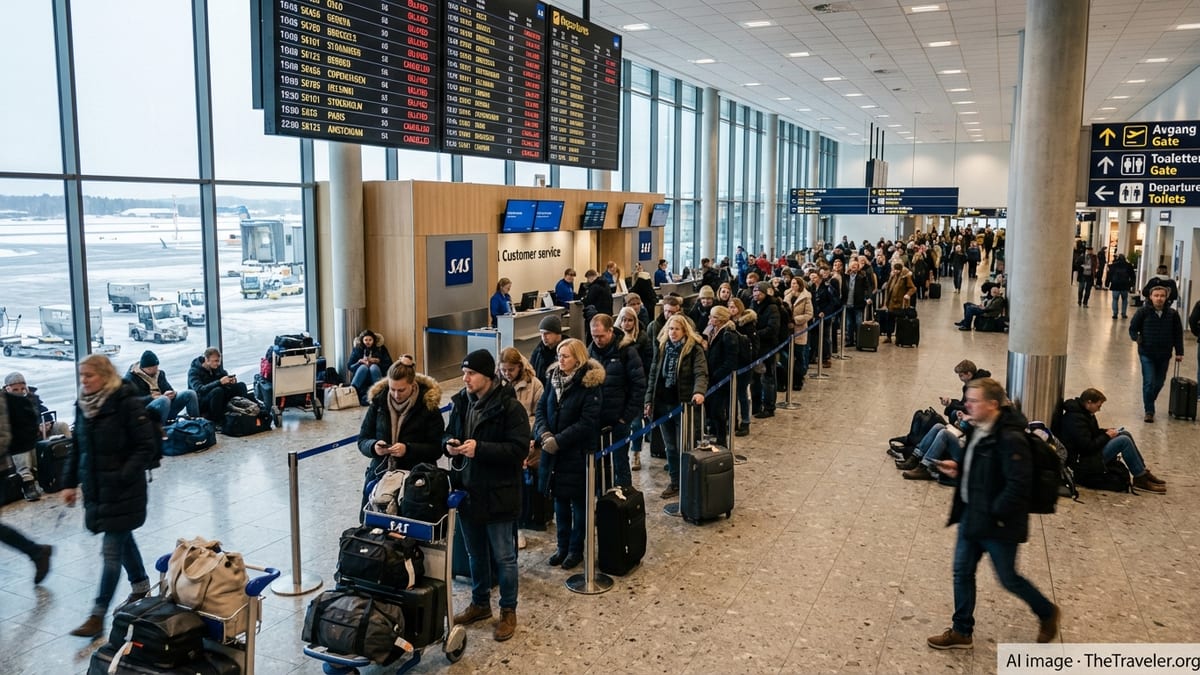
For travellers caught up in the latest SAS Link disruptions, the statistics translate into very personal stories of missed meetings, lost holidays and unexpected expenses. At Oslo, Bergen and Stavanger, queues have formed at airline customer service counters as passengers seek rebooking options, compensation information and basic assistance such as meal vouchers and hotel arrangements.
With many affected flights serving regional or leisure destinations where alternative services are limited, some passengers have been forced to wait many hours, or even until the following day, for a seat on the next available departure. Those travelling onward from Geneva, Brussels or Oslo to long‑haul destinations such as North America or southern Europe have frequently seen carefully constructed itineraries collapse when a single delayed SAS Link flight caused them to miss an intercontinental connection.
In terminal buildings across Scandinavia and Europe, scenes of travellers sleeping on benches, recharging phones near scarce power outlets and huddling around flight information screens have become familiar during this period of disruption. While airports have made efforts to provide extra staff and clearer announcements, passengers have sometimes complained of confusing or inconsistent information as airlines adjust schedules in real time.
Families with young children, elderly passengers and travellers with reduced mobility have been among the most vulnerable, often requiring additional support in rebooking and navigating unfamiliar airports. For many, the frustration has been heightened by the perception that weather and operational issues are now a recurring feature of winter travel rather than a rare exception.
Airlines Cite Winter Weather and Operational Strain
Airlines across Europe, including SAS and SAS Link, have pointed to a combination of winter weather, tight schedules and air traffic control constraints as key factors behind the spikes in delays and cancellations. Severe conditions have hampered operations at major hubs in recent days, with heavy snow, ice and freezing temperatures affecting runways, de‑icing capacity and ground handling services.
Industry data from this month documents hundreds of delays and more than a hundred cancellations in a single day across countries such as the Netherlands, the United Kingdom, Germany, Spain, Italy, Belgium and Austria. At Amsterdam Schiphol and Frankfurt, in particular, airlines including KLM, Lufthansa, SAS and others have struggled to maintain schedules as winter storms forced them to slow operations for safety reasons.
Within this challenging environment, regional carriers like SAS Link are especially vulnerable. Their aircraft and crews cycle rapidly between short sectors, meaning that a minor delay on an early‑morning departure can cascade across multiple flights later in the day. Limited spare aircraft and crew capacity in the depths of winter mean that any technical issue or weather‑related hold can quickly result in a cancellation when staff are unable to remain on duty beyond regulated working hours.
SAS has also reiterated long‑standing advice to travellers to allow generous connection times and to avoid scheduling late‑evening onward travel by train or bus that depends on tight flight arrival windows. The company’s published conditions of carriage highlight that delays can be caused by force‑majeure events such as severe weather, in which case the airline’s liability for secondary costs is limited, particularly if passengers have not left sufficient buffer time between modes of transport.
What Stranded Travellers Can Expect in Terms of Support
Under European air passenger regulations, travellers affected by significant delays or cancellations may be entitled to assistance and, in some circumstances, financial compensation. For those impacted by the latest SAS Link disruption, the level of support depends on the length of delay, the route, and whether the underlying cause is deemed to be within the airline’s control.
Where cancellations or long delays are not the result of extraordinary circumstances, airlines operating within or from the European Union are required to offer rebooking on the next available flight, or a refund, along with care such as meals and hotel accommodation when necessary. In practice, passengers report that airlines including SAS and SAS Link have arranged overnight stays and meal vouchers for those forced to wait for replacement services, particularly at major hubs such as Oslo, Copenhagen and Stockholm.
However, when disruptions are linked to severe weather or other force‑majeure events, cash compensation may not apply, even though airlines must still provide basic care and rebooking options. This distinction has often been a point of tension between carriers and travellers, especially during winter when meteorological conditions are a frequent trigger for widespread schedule changes.
Consumer advocates in the Nordic countries have urged passengers caught up in the current disruptions to keep all receipts related to additional expenses and to document their delays carefully, including boarding passes and any written communication from airlines. Such records can prove vital when submitting claims or complaints, particularly in cases where there is disagreement over whether weather, staffing or technical factors are primarily to blame.
Outlook: Continued Volatility as Winter Season Peaks
With February’s winter weather still bearing down on Europe and air traffic levels remaining high, experts warn that travellers should brace for further volatility in the weeks ahead. The cluster of SAS Link delays and cancellations, along with broader disruptions involving major European airlines, underscores the fragility of a system that is still balancing tight staffing and capacity margins with strong demand.
Airports and carriers in Scandinavia and across the continent are working to refine contingency plans, from boosting de‑icing capacity and ground staffing to improving real‑time communication with passengers via apps and terminal displays. Yet many of the underlying constraints, including air traffic control restrictions and the basic unpredictability of winter storms, remain outside airline control.
For travellers planning journeys through hubs such as Oslo, Copenhagen, Stockholm, Geneva, Brussels and Amsterdam, the latest SAS Link incident serves as a reminder to build extra time into itineraries, particularly when connecting to long‑haul flights or onward rail services. While most flights continue to operate broadly on schedule, even a limited cluster of 22 delays and 15 cancellations has demonstrated how quickly Europe’s highly interconnected network can unravel.
As the season progresses, the aviation sector will be under pressure to show that it can absorb such shocks more effectively. For now, hundreds of travellers in Denmark, Norway, Sweden and beyond are living the reality of a winter in which a single delayed regional flight can cascade into a full‑scale travel ordeal.