

More news on this day
Thousands of passengers were left stranded across Saudi Arabia on March 9 as a fresh wave of cancellations and delays rippled through major hubs including Jeddah, Riyadh and Dammam, with regional and international airlines scrapping more than 100 flights and delaying over 200 amid ongoing airspace disruptions in the Gulf.
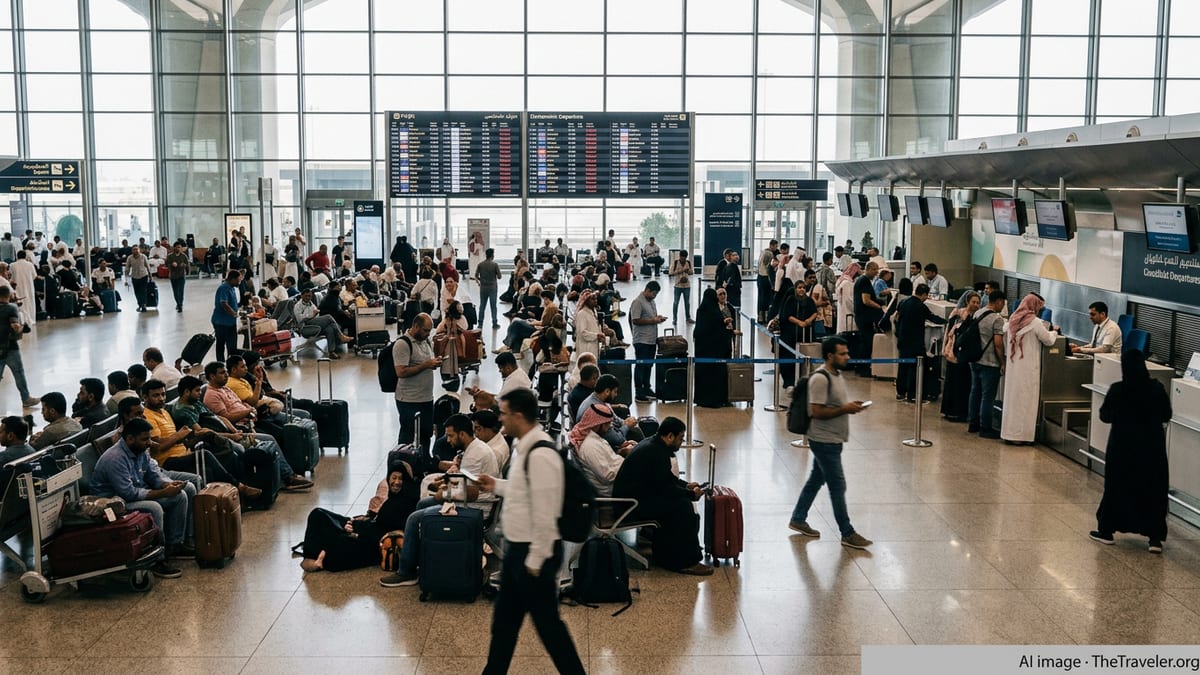
Saudi Hubs Struggle Under New Wave of Disruptions
Operational data from Saudi Arabia’s main gateways showed King Khalid International Airport in Riyadh, King Abdulaziz International Airport in Jeddah, King Fahd International Airport in Dammam and Prince Mohammad bin Abdulaziz International Airport in Medina absorbing the brunt of the latest turmoil. Across the four hubs, at least 105 flights were cancelled and around 226 delayed in a single 24 hour period, according to figures shared by aviation data providers and local travel industry sources.
At King Khalid International, 81 flights were cancelled and 172 delayed, leaving departure halls crowded with families camped on the floor, business travellers queuing at airline counters and long lines at security as schedules were repeatedly revised. In Jeddah, King Abdulaziz International recorded 37 cancellations and 189 delays, while King Fahd International saw 38 cancellations and 62 delays. Medina’s international airport reported 15 cancellations and 41 delayed departures and arrivals.
Airport authorities stressed that runways and terminals remain open, with disruptions tied largely to regional airspace closures and airline decisions to suspend or reroute services. However, the concentration of cancelled and late-running flights at Saudi Arabia’s busiest hubs has turned what are normally smooth transfer points into bottlenecks for travellers attempting to reach or transit the Gulf.
Qatar, Gulf, Saudia and IndiGo Among Hardest Hit Carriers
The latest figures underscore how carriers across the region and beyond continue to grapple with the fallout from last month’s sudden shutdown of key Gulf and Levant air corridors. Flag carriers such as Qatar Airways, Gulf Air and Saudia, along with major Indian low cost operator IndiGo and several European and Asian airlines, all reported cancellations or lengthy delays on routes touching Saudi airports.
Qatar Airways, already operating a sharply reduced schedule because of constraints around Doha and neighboring airspace, scrubbed additional services into Riyadh and Jeddah, while some remaining flights faced extensive rerouting and late arrivals. Gulf Air’s network into Dammam and Medina also came under pressure, with a number of rotations pulled as the Bahraini carrier concentrated on essential services and rescue flights.
Saudi national carrier Saudia, one of the few airlines still operating a comparatively broad long haul network in the region, has been forced to trim frequencies and retime departures on several routes to the United Arab Emirates, Qatar, Bahrain and beyond. IndiGo, which had already suspended many Gulf flights at the height of the crisis, continued to cancel or delay services into Jeddah and Dammam, leaving large numbers of South Asian workers and pilgrims stranded or facing extended layovers.
Smaller regional carriers, including low cost operators flynas and flyadeal, also reported knock on effects as aircraft and crews were left out of position by previous days’ disruptions, further constraining the availability of spare capacity to move passengers stuck in Saudi transit hubs.
Passengers Face Long Waits, Patchy Communication and Uncertain Options
For travellers caught in the middle of the disruption, the statistics translated into hours and in some cases days of waiting inside crowded terminals. At King Abdulaziz International Airport in Jeddah, passengers described departure boards filled with rolling delay notices, with some flights pushed back repeatedly before ultimately being cancelled.
Families heading for Umrah reported sleeping on terminal benches overnight as they tried to secure rebookings, while expatriate workers on tight visa timelines expressed concern about overstaying or missing connections onward to their home countries. At King Fahd International in Dammam, local tour operators said they were scrambling to arrange hotel rooms for stranded groups as nearby properties quickly filled.
One frequent complaint was inconsistent communication. Some airlines sent text messages or app alerts only minutes before scheduled departure times, while others directed passengers to their websites even as those struggled under heavy traffic. With call centers overwhelmed, many travellers resorted to queuing in person at ticket counters, where staff themselves were waiting for updated operational guidance.
Airport announcements in Riyadh and Jeddah repeatedly urged passengers not to travel to the airport before confirming their flight status directly with airlines, yet many travellers said they still arrived early, hoping their flights would be among the few operating roughly on schedule.
Airports and Governments Race to Manage the Crisis
Airport operators and government agencies in Saudi Arabia moved to reinforce frontline services as the crisis deepened. King Khalid International in Riyadh and King Abdulaziz International in Jeddah both issued formal travel advisories over the weekend and into March 9, warning of “possible disruptions” linked to evolving regional conditions and urging travellers to verify bookings before setting out.
Inside terminals, additional staff were deployed to information desks and security checkpoints in an attempt to manage crowds and direct passengers toward airline help points. Some airports set up dedicated zones for vulnerable travellers, including the elderly and families with young children, to rest away from the busiest concourses.
Foreign governments also stepped in to support their nationals. Pakistan’s diplomatic missions announced round the clock assistance desks at key Saudi airports, while consular officials from several South and Southeast Asian countries coordinated with local authorities and airlines to prioritize seats for stranded labourers and pilgrims on any available outbound flights.
Despite these measures, officials privately acknowledged that as long as large sections of regional airspace remain restricted and major Gulf hubs operate on skeleton schedules, Saudi Arabia’s own airports will continue to experience irregular operations, with little warning when further cancellations become necessary.
Outlook: Prolonged Disruptions Likely as Airlines Rebuild Schedules
Aviation analysts said the cluster of 105 cancellations and 226 delays across Saudi hubs on March 9 was part of a broader pattern of instability that began after February 28, when multiple Gulf states moved to restrict airspace as regional tensions escalated. Since then, thousands of flights to and from the wider Gulf have been cancelled, leaving airlines facing an intricate puzzle of crew duty limits, aircraft positioning and regulatory approvals.
Even where airspace has partially reopened, airlines are proceeding cautiously, adding back only a fraction of their usual frequencies to avoid overcommitting capacity that could again be disrupted at short notice. This measured approach has left carriers such as Qatar Airways, Saudia, Gulf Air and IndiGo with limited flexibility to accommodate all stranded passengers, particularly at peak times for religious and labour travel.
Industry observers warn that travellers planning to transit Saudi Arabia or the wider Gulf in the coming days should be prepared for continued uncertainty, potential last minute changes and extended journey times as aircraft are rerouted around closed corridors. Flexible tickets, travel insurance and a willingness to accept alternative routings via more distant hubs such as Istanbul or European gateways may prove essential for those needing to travel urgently.
For now, scenes of crowded terminals and anxious passengers at King Abdulaziz, King Fahd, King Khalid and other Saudi airports underscore how fragile the region’s aviation network remains. With no clear timeline for a full normalization of airspace, both airlines and travellers are bracing for a prolonged period of disruption across one of the world’s most strategically vital air corridors.