

More news on this day
Saudi Arabia is moving into 2026 with a sharpened focus on cultural and heritage tourism, unveiling new attractions, digital visa tools and heritage-led giga projects intended to welcome a growing wave of international visitors.
Get the latest news straight to your inbox!
Heritage Tourism Surges as Vision 2030 Targets Take Shape
Recent figures indicate that heritage and historical sites in Saudi Arabia drew around 6.5 million visitors in 2024, underscoring how rapidly culture-focused travel is expanding within the kingdom. Publicly available information shows that this segment already represents a multibillion-dollar market, with research projecting the value of Saudi heritage tourism to climb from just over 5 billion dollars in 2024 to well above 8 billion dollars by 2033. The data highlights a steady appetite among both domestic and international travelers for archaeological sites, historic districts and traditional arts experiences.
Analysts note that this growth is closely tied to Vision 2030, the state-led transformation program that places tourism and the creative economy at the center of economic diversification. Policy documents and market reports emphasize that cultural heritage, from UNESCO-listed desert tombs to centuries-old port quarters, is being positioned not just as a preservation priority but as a primary driver of new visitor spending. The result is a network of projects that combine restoration with contemporary hospitality, event programming and public spaces.
Published coverage from regional business outlets describes how government-backed investment is increasingly directed into mixed-use cultural districts. These areas are designed to layer museums, galleries and performance venues alongside hotels, restaurants and retail, making heritage environments active urban neighborhoods rather than static historic zones. For global travelers planning 2026 itineraries, this means more walkable, programmed districts where traditional architecture and modern amenities sit side by side.
AlUla and Diriyah Anchor a New Cultural Map
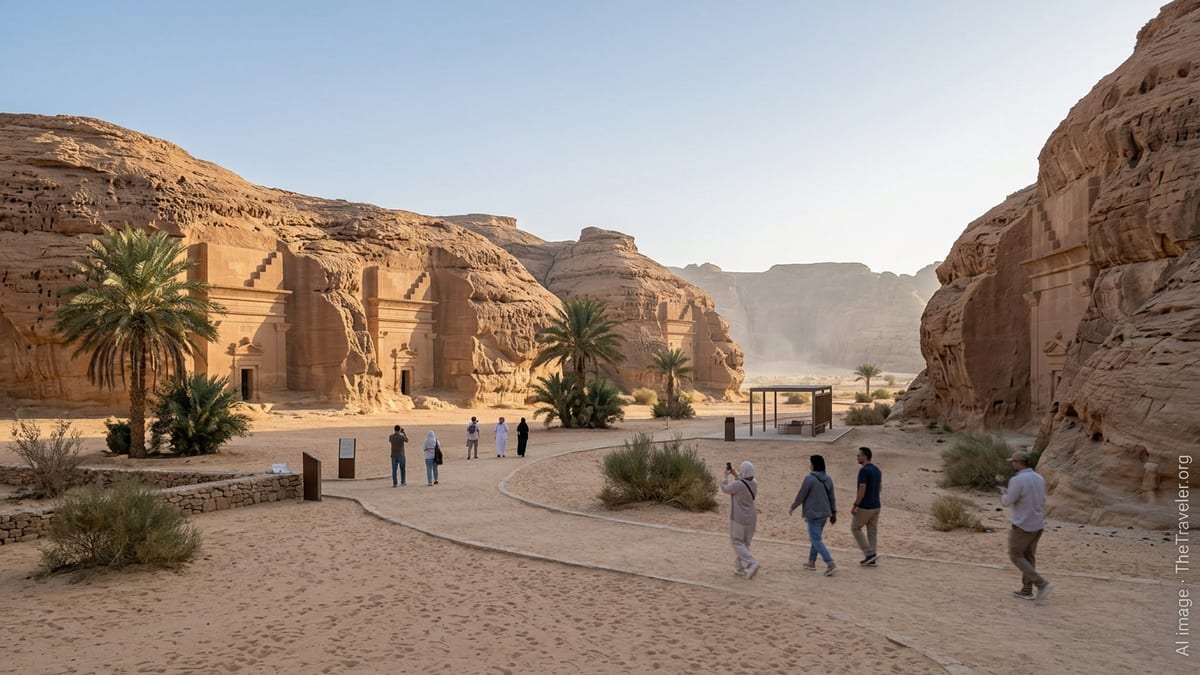
Among the highest-profile destinations in this cultural tourism push are AlUla in the northwest and Diriyah on the edge of Riyadh. AlUla, already known for the Nabataean site of Hegra and dramatic sandstone landscapes, is being framed as a vast open-air museum where archaeology, land art and contemporary culture intersect. International arts media report that the 2026 AlUla Arts Festival has expanded its program of installations and exhibitions, helping to cement the oasis as a recurring stop on the global art circuit.
In AlUla, permanent site-specific works by Saudi and international artists are taking root across a 65-square-kilometer valley, while plans continue for future museums and cultural institutions tied to themes such as incense routes and astronomy. An emerging observatory initiative and heritage-focused museums are intended to extend visitor stays beyond day trips, adding stargazing, interpretation centers and educational programming to the destination’s desert experiences.
Diriyah, sometimes described in planning documents as the birthplace of the Saudi state, is undergoing an intensive redevelopment that combines mud-brick Najdi architecture with new hotels, museums and outdoor venues. Recent urban sustainability reporting on Riyadh notes that the historic district is being integrated into a larger mixed-use master plan with public squares, cultural streetscapes and hospitality clusters. By 2026, more segments of Diriyah’s restored streets and new cultural attractions are expected to open progressively, giving visitors easier access to the adobe palaces, fortresses and traditional markets that anchor the site’s 300-year narrative.
New Museums and Cultural Venues Reshape Urban Experiences
Jeddah and Riyadh are emerging as key cultural gateways, with new museums and event spaces reshaping the visitor experience in both cities. In Jeddah’s historic Al Balad district, the recently opened Red Sea Museum occupies a landmark waterfront building and focuses on maritime history, trade and coastal culture. Regional travel industry coverage highlights the museum as a cultural anchor for the old port, complementing the neighborhood’s coral-stone architecture and traditional houses.
In Riyadh, a wave of cultural initiatives is gathering around large-scale urban parks and repurposed industrial zones. Reports on the King Salman Park project describe plans for a Museum of World Cultures and a Royal Institute of Traditional Arts, embedded within one of the world’s largest urban park developments. Together, these institutions are expected to offer visitors everything from global ethnographic collections to academies dedicated to Saudi crafts, performing arts and heritage conservation.
At the same time, creative districts such as the JAX area in Riyadh are expanding their calendars of biennales, festivals and contemporary art exhibitions. Recent cultural reporting from international newspapers points to events like the Diriyah Contemporary Art Biennale as examples of how Saudi organizers are seeking to blend local traditions with global artistic dialogues. For travelers, this means that a visit in 2026 is likely to coincide with an active roster of temporary shows and performances layered on top of permanent heritage sites.
Digital Visas and Travel Infrastructure Lower Barriers
A significant factor enabling Saudi Arabia’s tourism ambitions is the modernization of entry procedures. Since launching its electronic visa system for tourism in 2019, the kingdom has progressively widened eligibility, with official and industry advisories noting that visitors from more than 60 countries can now access streamlined online applications. In late 2025, authorities introduced an upgraded instant e-visa platform that, according to travel and migration services coverage, can issue multi-entry visas in minutes for eligible applicants.
Looking ahead to 2026, a new initiative known as “Visa by Profile” is expected to further simplify access for many travelers. Announced at a tourism summit in Riyadh, the system will allow partner banks and credit card issuers to pre-verify customer data, enabling instant issuance of tourism visas linked to traveler profiles. Public statements around the program describe it as a first-of-its-kind approach intended to encourage short-notice leisure trips by reducing paperwork and uncertainty for potential visitors.
These digital reforms are unfolding alongside more targeted adjustments around major religious events and specific nationalities, reflecting a balance between open tourism and crowd management. Industry observers suggest that by 2026 the practical outcome for most international leisure travelers will be faster processing, clearer fee structures and more predictable entry rules, which could make it easier to incorporate Saudi Arabia into broader regional itineraries across the Gulf.
Giga Projects and Entertainment Offer a Broader Tourism Mix
While heritage is a central pillar of Saudi Arabia’s tourism push, it is being complemented by large-scale leisure and entertainment projects that are expected to be fully operational or entering new phases in 2026. One prominent example is Six Flags Qiddiya City near Riyadh, which opened to the public at the end of 2025 and is being marketed as a next-generation theme park destination backed by the Public Investment Fund. Recent coverage notes that the park’s launch is closely tied to Riyadh Season and other entertainment initiatives aimed at both residents and international visitors.
Temporary immersive attractions, such as the Beast Land concept in Riyadh, and expanding comedy, music and film festivals are also adding variety to the country’s cultural calendar. The Red Sea International Film Festival in Jeddah, which has consolidated its presence in a purpose-built cultural venue in the historic district, is drawing growing attention from filmmakers and cinephiles. Together, these events signal an effort to frame Saudi Arabia not only as a destination for religious and heritage travel but also as a year-round hub for popular culture.
Observers point out that these giga projects and festivals often incorporate Saudi and regional narratives into design, programming and branding. Theme parks reference local landscapes, festivals spotlight regional artists, and new hospitality concepts emphasize traditional Saudi welcome rituals. As 2026 unfolds, this blending of large-scale entertainment with heritage storytelling is likely to shape how first-time visitors encounter and remember the kingdom.