

More news on this day
Saudi Arabia is moving to cushion its tourism and aviation sectors from the fallout of escalating Iran-United States confrontation by introducing targeted visa waivers and procedural flexibilities for select foreign nationals, aiming to keep passenger flows moving even as missile and drone attacks unsettle air corridors across the Gulf.
Get the latest news straight to your inbox!
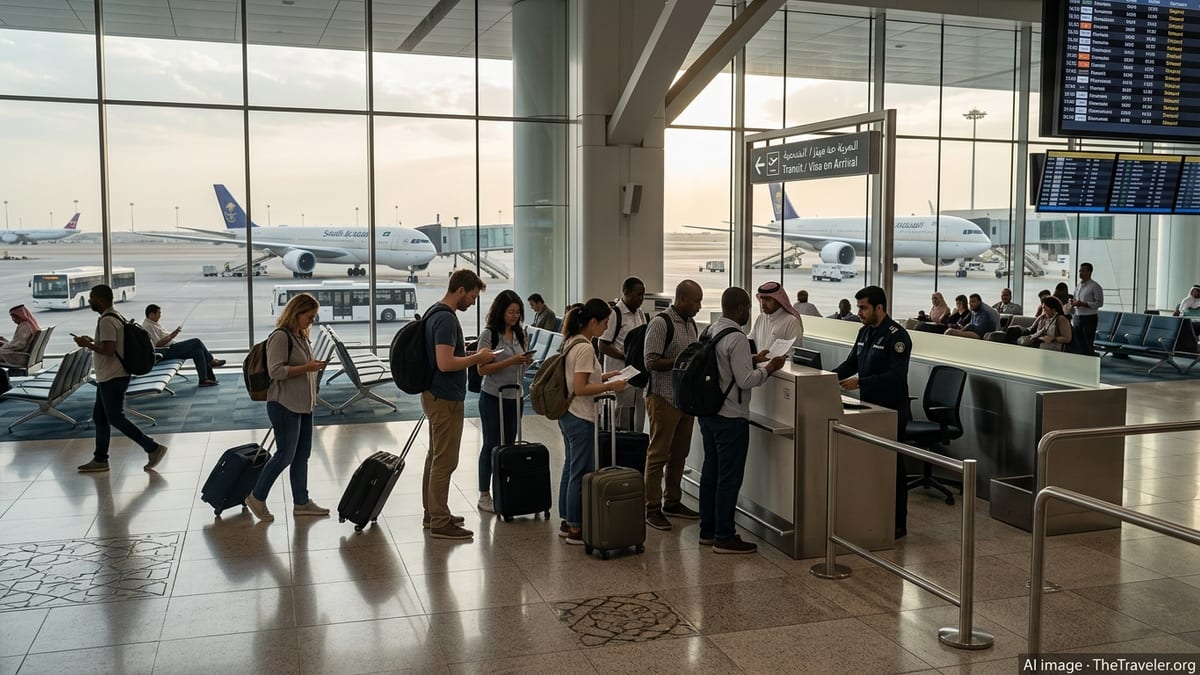
Visa Waivers Positioned as Shock Absorber for Gulf Travel
Publicly available information from regional travel advisories and airline notices indicates that Saudi authorities have introduced a set of temporary visa exemptions and relaxed entry rules for certain nationalities most affected by rerouted flights and suspended connections through the Gulf. These measures appear designed to ensure that the country can continue to function as a reliable hub for long-haul passengers while neighboring airspaces are periodically disrupted by the expanding Iran-US confrontation.
According to published coverage in regional business media and aviation monitoring services, the policy mix includes waiving advance visa requirements for eligible short-stay transit passengers, expanding visa-on-arrival options, and easing conditions for holders of valid visas from key partner regions such as the Schengen Area, the United States, and select Asian states. In practice, this means that travelers stranded by diversions or cancellations are more easily able to enter the kingdom for short stopovers, hotel stays, or rebooking assistance.
Industry data suggests that Saudi Arabia’s move builds on its broader pre-conflict strategy of opening up to international visitors, including its e-visa platform and prior visa waivers for holders of certain US, UK, and Schengen visas. The latest adjustments, however, are more explicitly framed around continuity of travel amid regional security turbulence, with an emphasis on maintaining confidence among airlines and tour operators that rely on Saudi gateways.
Travel analysts note that these waivers function as a kind of policy buffer, allowing the country to absorb redirected traffic from more exposed hubs while signaling that, despite proximity to the conflict, it intends to remain operational and accessible to foreign nationals.
Escalating Regional Conflict Raises Stakes for Air Connectivity
The visa changes come against the backdrop of an intensifying regional conflict that has drawn in military assets and infrastructure across the Gulf. Open-source reporting and security assessments describe a pattern of Iranian missile and drone attacks on sites linked to US and allied interests in several Gulf states, as well as retaliatory actions tied to earlier US and Israeli strikes on Iranian territory.
Reports from international news agencies and human rights organizations highlight incidents involving drone and missile interceptions over major cities, strikes near critical ports and energy installations, and repeated warnings about risks to civilian infrastructure. The prospect of miscalculation in crowded air corridors has prompted some airlines to alter routings around the Strait of Hormuz and adjacent airspace, adding time and complexity to traditional Europe-Asia and North America-Asia routes.
These disruptions have direct implications for Saudi Arabia’s ambitions to position itself as a global aviation and tourism hub. With airline schedules already strained by longer flight times and slot constraints at alternative airports, a flexible entry regime becomes a practical tool for managing delays, diversions, and unplanned overnight stays, while reassuring carriers that contingency plans can be implemented quickly.
Regional observers suggest that as long as the Iran-US confrontation continues to produce unpredictable episodes of missile and drone activity, Gulf states with large, modern airports will face pressure to show that they can keep passengers moving. In this context, Saudi Arabia’s visa waivers can be seen as part of a broader competition to provide stability in an unstable neighborhood.
Balancing Security Concerns With Tourism and Investment Goals
Saudi Arabia has spent the past several years investing heavily in tourism, entertainment, and large-scale development projects under its economic diversification agenda. Publicly available policy documents and official statements describe tourism as a central pillar of plans to reduce dependence on oil revenues, with ambitious visitor and spending targets for the coming decade.
The current regional crisis risks undermining those goals by reviving traveler concerns about security in the wider Middle East. Travel industry reporting indicates that some source markets have seen a rise in itinerary changes or postponements for trips that include multiple Gulf destinations, particularly where travelers fear becoming stranded by airspace closures or sudden escalations involving US and Iranian forces.
By simplifying entry for certain foreign nationals and clarifying procedures for transit passengers, Saudi Arabia is working to project an image of predictability even as it navigates a fast-moving security environment. According to tourism and aviation analysts quoted in regional coverage, providing clear, generous rules for stranded or rerouted travelers can reduce the likelihood of negative headlines about passengers sleeping in terminals or facing complex paperwork at short notice.
At the same time, the authorities must continue to balance these openness measures with heightened security screening and coordination with international partners. The expanded visa channels do not remove the possibility of additional checks; instead, they appear to focus on reducing bureaucratic friction for travelers who already meet baseline requirements and who are more likely to be collateral victims of wider geopolitical tensions than security threats themselves.
Impact on Airlines, Transit Hubs, and Traveler Behavior
Airlines operating in and around the Gulf have been forced in recent weeks to adjust flight paths, schedules, and contingency plans as the Iran-US confrontation has spilled over into military activity near key trade and energy corridors. Aviation tracking platforms show shifts in traffic patterns away from some high-risk areas, with additional reliance on alternative routes over the Red Sea and other corridors less directly exposed to missile and drone activity.
For Saudi airports, especially major hubs serving long-haul traffic, the new visa flexibilities reduce operational friction when flights are diverted or when crews reach duty-time limits due to extended routings. Travel operations specialists note that visa-on-arrival or waiver provisions can simplify hotel accommodation, crew rest, and rebooking for affected passengers, making it more likely that airlines will treat Saudi facilities as preferred diversion points.
From a traveler perspective, publicly available booking and search data reported by industry analysts suggest a nuanced picture. While some tourists and corporate travelers remain wary of the broader region, others appear willing to continue transiting through Saudi Arabia if airlines and travel platforms can clearly communicate entry options in the event of disruption. Transparent information on who qualifies for waivers or expedited visas is therefore emerging as a key factor in sustaining demand.
Tour operators focusing on Saudi destinations report, according to trade media, that clients are increasingly asking detailed questions about visa rules, cancellation policies, and contingency plans rather than cancelling outright. This shift underscores how visa regimes, once seen as purely bureaucratic, have become central to crisis-era travel decision-making.
Saudi Arabia Signals Role as Regional Stabilizer for Travel
Saudi Arabia’s recalibrated visa policies also carry a diplomatic and symbolic dimension. By presenting itself as an accessible, functioning transit and tourism hub amid turmoil, the kingdom is seeking to reinforce its image as a stabilizing economic force even as it confronts direct security risks tied to the Iran-US confrontation.
Commentary in regional policy forums and economic analyses points out that maintaining open channels for business travelers, pilgrims, and tourists is not only a commercial imperative but also part of Saudi Arabia’s broader effort to position itself as a central node in global trade, logistics, and connectivity. Visa waivers for foreign nationals affected by flight disruptions sit alongside other steps, such as infrastructure investments and coordination with airlines, in this emerging narrative.
Analysts caution that the durability of these measures will depend on how the conflict evolves and whether additional attacks further restrict airspace or affect critical infrastructure. However, they also note that the current moment provides a real-world test of Saudi Arabia’s ability to translate its long-term tourism and aviation ambitions into crisis management tools that deliver tangible benefits for travelers.
If the visa waivers and related flexibilities succeed in limiting disruption for foreign nationals caught up in the regional turbulence, they may become a template for how large transit hubs respond to future geopolitical shocks, not only in the Middle East but across other volatile regions as well.