

More news on this day
Saudi Arabia has introduced a package of emergency visa relief measures for visitors stranded by the spiraling US–Israel–Iran conflict, positioning the kingdom and its Gulf neighbors as critical transit and shelter hubs while airspace closures and flight cancellations ripple across the wider Middle East.
Get the latest news straight to your inbox!
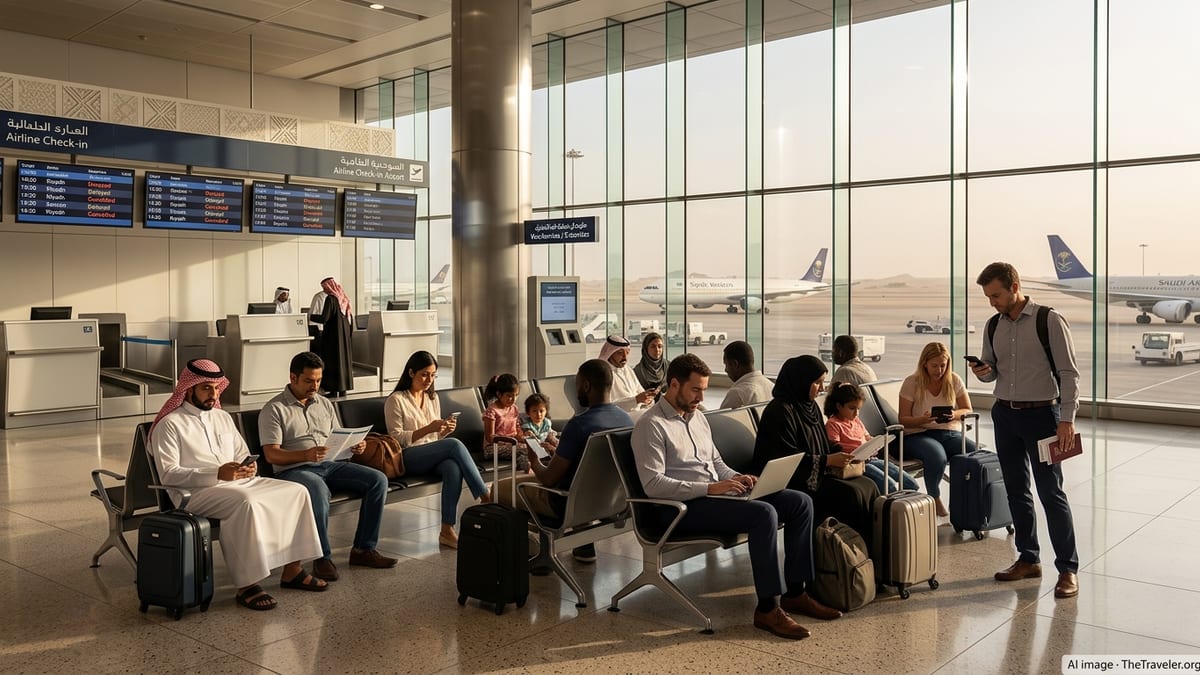
Emergency Visa Extensions for Travelers Caught by Flight Chaos
Publicly available information from consular advisories and traveler reports indicates that Saudi Arabia has moved to ease the pressure on foreign visitors who suddenly find themselves unable to leave the region. As airlines reroute or suspend services around Iranian and Israeli airspace, the kingdom has activated special provisions allowing stranded tourists and business travelers to extend their stay without incurring typical overstay penalties.
Comments shared by travelers and expatriates online in recent days describe a system of emergency visa extensions designed to cover those whose return flights were canceled or indefinitely delayed as the conflict escalated. These accounts suggest that visitors on tourist, business, family visit, and certain transit visas are being permitted to regularize their stay through simplified digital procedures rather than in-person visits to security offices.
The changes build on earlier reforms that extended the standard validity of single entry visit visas and loosened some requirements for short-term stays. The current relief is more targeted, focusing on those who can demonstrate that their onward journeys were disrupted by the regional aviation crisis. In practice, this has allowed many visitors to remain in hotels or with family inside the kingdom while they wait for alternative routes to open.
Travel industry analyses note that by preemptively waiving fines and creating a clear path to legal extensions, Saudi authorities are seeking to avoid a wave of inadvertent immigration violations. The approach reduces pressure on overstretched airports and consular services, while reassuring visitors that they will not be penalized for an emergency entirely beyond their control.
Transit Flexibility as GCC Hubs Shoulder the Load
The Gulf states have become pivotal connectors for long haul travel between Europe, Asia, and Africa, and the current conflict has underscored the strategic role of Saudi Arabia and its neighbors. Flight disruption trackers and airline advisories show that carriers have rerouted around contested airspace, with some itineraries now funneled through Gulf airports that remain operational and relatively secure.
Reports from regional travel forums point to a growing number of travelers using Saudi Arabia as a backup transit option after flights via Israel, Iran, or nearby corridors were suspended. In this context, emergency visa relief has taken on a broader function. By making short term stays and visa-on-arrival style solutions easier to obtain for stranded passengers, the kingdom is helping to maintain at least a partial flow of people out of conflict-adjacent zones.
Within the Gulf Cooperation Council, several states have highlighted similar policies, combining visa flexibility with hotel and basic welfare support for delayed passengers. Travel experts interviewed in international media coverage argue that this soft coordination amounts to an informal safety net across GCC states, preserving the region’s reputation as a reliable aviation crossroads even as the war in Iran disrupts traditional east–west air routes.
For travelers, the practical impact has been the ability to piece together multi segment journeys using the few remaining available routes. In some cases, passengers have traveled overland between Gulf states to access outbound flights, relying on relaxed entry or transit rules to legally cross borders, spend nights in local accommodation, and continue their trips when seats become available.
Aligning Crisis Response With Vision 2030 Tourism Goals
Saudi Arabia’s emergency visa measures are also being interpreted through the lens of its long term Vision 2030 economic diversification strategy. The plan, outlined in government policy documents, places tourism and hospitality at the center of efforts to reduce dependence on oil, with ambitious targets for international arrivals and major investments in new destinations across the Red Sea coast and the interior.
Analysts reviewing recent policy steps note that the current crisis is an early test of how a more tourism dependent Saudi Arabia handles geopolitical shocks. Rather than retreating behind stricter entry controls, the kingdom has opted for a more service oriented approach, using temporary visa relief to protect visitors already in the country and to signal reliability to future travelers and airlines.
Travel industry commentary has drawn parallels with other tourism focused states that have used flexible immigration responses during natural disasters or sudden conflicts to maintain traveler confidence. In Saudi Arabia’s case, the measures appear designed not only to resolve immediate humanitarian and logistical problems but also to reinforce a narrative of the kingdom as a predictable and rules based destination even in turbulent times.
Observers say the move dovetails with earlier steps, such as expanding e visa availability and easing some bureaucratic requirements for selected nationalities. While those reforms were framed around growth in leisure and religious tourism, the latest relief underscores that crisis preparedness is now a core component of the country’s emerging travel ecosystem.
GCC Coordination and the Quest for Regional Stability
The emergency visa measures are unfolding as Gulf governments work to manage the broader economic and security fallout from the US–Israel–Iran confrontation. Economic research published in recent weeks highlights how shipping interruptions in the Strait of Hormuz, higher insurance costs, and lower regional confidence are weighing on trade, energy exports, and tourism across the GCC.
Foreign ministers from Arab and Islamic countries have held high profile meetings in Riyadh to discuss de escalation efforts, while local media coverage emphasizes a shared Gulf interest in keeping civilian travel routes as safe and predictable as possible. Within that context, aligning visa policies to protect stranded visitors has emerged as an area where governments can act quickly and visibly.
Public statements and expert commentary suggest that GCC states are informally coordinating humanitarian and mobility measures, even where their political messages on the conflict differ. Some are offering state funded hotel stays and meal support, while others focus on rapid repatriation or temporary access for those trying to exit the war affected zone. Saudi Arabia’s decision to use emergency visa extensions and transit flexibility fits into this wider mosaic.
Regional travel consultants argue that such coordination is not only about projecting compassion, but also about risk management. By making it easier for stranded travelers to remain in legal status and move in a controlled way between Gulf states, authorities can reduce the likelihood of chaotic border crossings, irregular stays, and secondary crises that might further unsettle an already volatile region.
What Stranded Travelers Should Watch in the Days Ahead
For individual travelers, the situation remains fluid. Aviation advisories warn that schedules can change at short notice, and travelers attempting to route through the Middle East are being urged by airlines and travel insurers to monitor updates closely. Within Saudi Arabia, traveler accounts indicate that online platforms are the primary channel for activating emergency visa relief, although processing times and specific documentation requirements may vary.
Specialists in travel risk management recommend that visitors stranded in the region keep digital copies of flight cancellation notices, original itineraries, and proof of accommodation ready, as these can help demonstrate eligibility for visa extensions under emergency rules. Those who have crossed into or out of Saudi Arabia overland within the GCC perimeter are also being advised to retain evidence of border movements to avoid confusion when air links resume.
While the precise duration of Saudi Arabia’s emergency measures has not been formally defined in publicly available guidance, regional analysts expect visa relief to remain in place as long as substantial numbers of travelers are unable to depart safely. If de escalation efforts around Iran bear fruit and key air corridors reopen, normal visa rules are likely to be phased back in, potentially with a short transitional window to help visitors regularize their departure.
Until then, Saudi Arabia’s approach offers at least some predictability for those caught in the middle of a fast moving conflict. For travel planners, airlines, and tourism investors watching from afar, the episode will serve as a case study in how a rapidly expanding Gulf tourism hub balances its long term ambitions with the hard realities of regional security crises.