

More news on this day
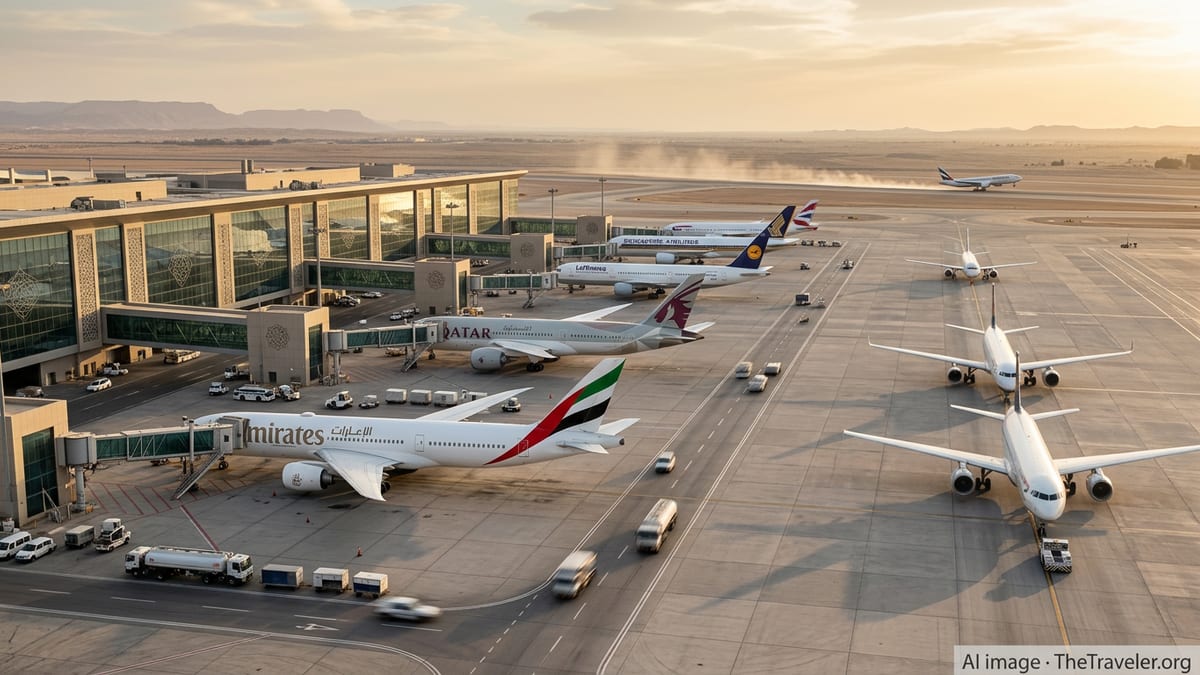
Major airports across Saudi Arabia, the United Arab Emirates, Oman and Qatar are pressing ahead with limited passenger services even as much of the Middle East’s airspace remains restricted following Iran’s recent missile and drone strikes, creating a fragile lifeline for stranded travelers and airlines rerouting between Europe, Asia and Africa.
Saudi Arabia Keeps Airspace Largely Open as Regional Pressures Mount
Saudi Arabia has emerged as one of the few relatively stable aviation corridors in the Gulf, with its airspace officially open and major hubs including Riyadh, Jeddah and Medina continuing to handle commercial flights. Security analysts report only a partial closure in Saudi airspace along sectors bordering Iraq and the Persian Gulf, a restriction that has not halted scheduled services from the country’s primary airports.
While Saudi airspace is now heavily used as a reroute corridor between Europe and Asia, operations remain under tight risk management. Airlines are flying longer, more southerly routings across Saudi territory to avoid high‑risk zones, adding flight time and fuel burn but preserving vital connectivity between continents. Aviation security bulletins continue to flag the risk of further drone and missile activity, prompting operators to adjust routings day by day.
Local reports indicate that a growing number of international carriers are quietly rebuilding their Saudi schedules after initial suspensions, though frequencies remain below normal and many routes are operating only several times a week. Seat availability is tight, with airlines prioritizing passengers who were previously stranded or whose journeys were canceled during the first wave of regional airspace closures.
For travelers, Saudi airports are now among the most viable options for escaping the Gulf region or making onward connections. However, fluctuating flight times, rolling delays and short‑notice schedule changes mean passengers are being urged to remain flexible, allow long connection windows and stay in close contact with their airlines.
UAE Airports Operational but Constrained by Airspace Closures
In the United Arab Emirates, Dubai International and Abu Dhabi International remain technically open, but their role as global mega‑hubs has been sharply curtailed by overlapping airspace restrictions and safety assessments. In recent days, several Gulf carriers have confirmed that while scheduled operations into and out of Dubai continue on a limited basis, many flights to key destinations remain suspended and dozens of aircraft are parked on the ground.
Major UAE airlines have issued rolling updates to passengers stating that their flight programs are operating at reduced capacity. Some long‑haul services have been reinstated with altered routings that avoid closed or high‑risk flight information regions, resulting in longer flight times and irregular departure waves. Others remain canceled outright while carriers await clearer guidance from regulators and military authorities.
Smaller UAE airports are playing a modest supporting role, with a handful of regional and low‑cost carriers operating truncated networks. However, constraints on overflight permissions and the continued closure or restriction of neighboring airspace have limited the extent to which the UAE can function as the primary diversion hub it has been during previous regional crises.
Travelers connecting through the UAE are facing particularly complex itineraries, often requiring last‑minute rebooking via Saudi Arabia, Oman or non‑Gulf hubs such as Istanbul or Cairo. Airlines are broadly waiving change fees and offering refunds for heavily disrupted routes, but hotel costs and on‑the‑ground logistics are frequently falling on passengers.
Oman’s Muscat Becomes a Resilience Hub Amid Patchy Gulf Operations
Oman’s airspace remains officially open and Muscat International Airport has quietly become a critical resilience hub for airlines seeking safe, predictable routings in and out of the Gulf. Security assessments describe Omani airspace as one of the most dependable remaining options for carriers running relief flights and high‑priority commercial services, with Muscat now handling an outsized share of rerouted traffic.
Oman Air has nevertheless been forced to temporarily suspend flights to several key Gulf and regional cities in response to neighboring airspace closures, while simultaneously adding capacity on routes that remain viable. The carrier has introduced additional services to certain Asian and European destinations where demand from displaced passengers is strongest, even as its near‑term schedule continues to evolve on an almost daily basis.
For international travelers willing to re‑route, Muscat offers one of the more straightforward paths out of the region. Passengers are increasingly flying into Oman from secondary airports that still have clearance to operate, then connecting onward to long‑haul destinations. Travel advisers caution that while Muscat is comparatively stable, schedule volatility remains high and same‑day changes are not uncommon.
On the ground, Muscat’s terminals have seen a noticeable increase in transit passengers with longer layovers, as airlines pad schedules to accommodate air traffic congestion and potential last‑minute airspace changes. Airport authorities have so far reported no significant security incidents, but contingency plans are in place should regional tensions escalate further.
Qatar and Regional Carriers Edge Back With Highly Limited Flights
Qatar, which initially shut its airspace amid the first wave of Iranian strikes and regional retaliatory action, has begun a cautious re‑opening under special contingency procedures. Aviation authorities in Doha have authorized designated emergency routes with limited operational capacity, allowing a narrow band of passenger evacuation and cargo flights to resume while standard commercial schedules remain largely suspended.
Qatar Airways is now operating a small but growing list of flights on these approved corridors. Services are being prioritized for repatriation, essential travel and critical cargo, and many flights are departing with their tracking transponders temporarily disabled as a security precaution. Seats are scarce and frequently reallocated as the airline responds to shifting risk assessments and military activity in the wider Gulf region.
Elsewhere in the Middle East, regional and international carriers are gradually testing the waters with selective resumptions. Some European and Asian airlines have reintroduced flights into Saudi Arabia and Oman while keeping services to the UAE and Qatar on hold or heavily curtailed. Others are opting to avoid the Gulf entirely, routing through alternative hubs and adding hours to traditional Europe‑Asia journeys.
Industry groups stress that this is not a return to normal operations but a tightly controlled restart designed to relieve the most urgent passenger backlogs and restore a minimum level of connectivity. Airlines are explicitly warning customers that all schedules in the region remain subject to sudden change, including same‑day cancellations should security conditions deteriorate.
What Travelers Need to Know Before Flying Through the Region Now
For travelers with imminent plans involving the Middle East, the key message is to treat any itinerary as provisional. With airspace closures and military activity shifting day by day, even flights that appear confirmed can be rescheduled, rerouted or canceled at short notice. Experts advise avoiding nonessential travel through the region wherever possible and, if travel is unavoidable, building in extensive buffers for connections and onward plans.
Passengers already in the Gulf are being encouraged to consider Saudi Arabia and Oman as primary exit points, given their relatively open airspace and functioning hubs. However, limited seat availability and high demand mean that reaching these airports from surrounding countries can still be challenging. Land borders between some Gulf states, including the UAE and Saudi Arabia, remain an option in certain cases, but travelers should verify local entry rules and security advisories before attempting overland routes.
Those who must book new tickets are being urged to favor airlines with flexible change policies and to look at routings via secondary hubs in Turkey, Egypt or southern Europe if direct Gulf connections are unavailable. Insurance providers are updating policy guidance as the situation evolves, and travelers should confirm whether disruption related to the current conflict is covered before departure.
With aviation authorities in Europe and elsewhere extending conflict‑zone advisories for parts of Middle Eastern airspace, industry observers expect the current pattern of limited, carefully managed flights through Saudi Arabia, the UAE, Oman and Qatar to persist in the short term. A broader recovery in Gulf connectivity is likely to depend on a clear de‑escalation in the Iran conflict and a sustained period without further attacks on regional infrastructure.