

More news on this day
Regional airspace closures across parts of the Middle East are causing rolling flight disruptions for travelers bound to, from, or over Saudi Arabia, turning the kingdom into both a vital corridor for diverted routes and a source of confusion for passengers trying to keep trips on track.
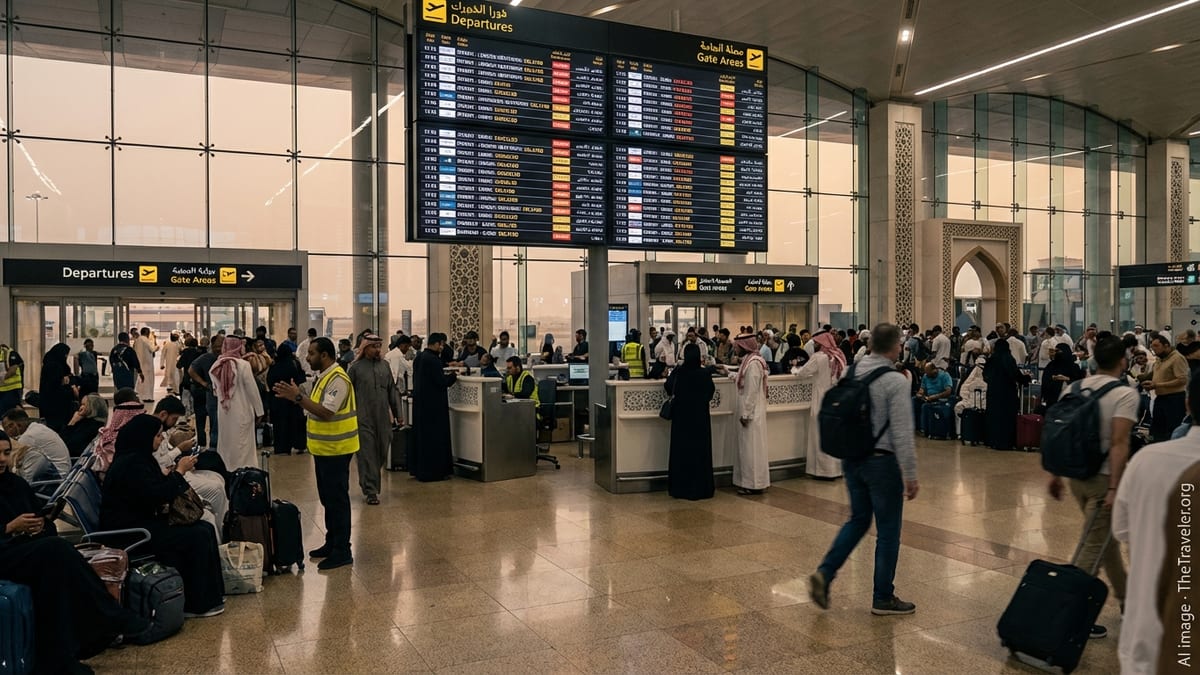
Saudi Airspace Stays Open As Neighbors Shut Down
While Iran, Iraq, Israel, Qatar, Bahrain, Kuwait and parts of the United Arab Emirates have imposed full or partial airspace closures in recent days following a sharp escalation in regional tensions, Saudi Arabia’s skies remain formally open and its main airports operational. That has allowed many long-haul carriers to reroute East West traffic over the kingdom, even as schedules buckle under the strain of diversions and extended flight times.
Riyadh, Jeddah and Dammam are absorbing a growing share of displaced traffic normally funneled through hubs such as Dubai, Abu Dhabi and Doha, where flight cancellations and ground stops have stranded hundreds of thousands of passengers, according to aviation and travel industry reports. Airlines that once overflew Iran, Iraq or Israel are now threading narrower corridors over Saudi territory or skirting the region entirely via the Red Sea and Caspian routes.
Saudi aviation authorities insist operations inside the kingdom remain safe, but acknowledge that rerouted overflights and the fast-changing status of neighboring airspace are creating knock-on delays. Longer routings mean extra fuel stops, altered crew rosters and late arriving aircraft, all of which are rippling through timetables, even on flights that never leave Saudi airspace.
Alerts From Saudi Airports and National Carrier
Saudi airports have moved into a heightened advisory posture as the disruption widens. Major gateways in Riyadh, Jeddah and Dammam have issued coordinated travel alerts urging passengers whose journeys involve affected countries to confirm flight status directly with airlines before heading to the terminal. The message is clear: do not assume your flight is operating just because the departure board still lists it.
Saudia, the kingdom’s national airline, has temporarily suspended or adjusted a range of regional routes as part of a wider safety response. Recent notices indicate suspensions on services linking Riyadh with key Gulf and Levant cities including Amman, Kuwait, Dubai, Abu Dhabi, Doha and Bahrain, as well as some longer haul sectors, at least through the coming days. The carrier’s emergency coordination center is monitoring conditions with regulators and air traffic control as new advisories are issued.
Passengers booked on Saudia and other airlines operating into Saudi Arabia are being contacted through the details attached to their reservations when flights are canceled or rerouted. However, with call centers and online channels under heavy pressure, many travelers are still arriving at airports unaware of overnight changes. Airport operators are therefore stressing the need to check multiple times on the day of departure and to build in extra time for check in and security.
Southern Saudi Airports Closer to Conflict Zones
Beyond system-wide delays, travelers are being warned to pay particular attention to their choice of Saudi airports. Aviation safety advisories highlight several southern airports, including Abha, Jizan, Najran and Khamis Mushait, as lying within a broader flight information region where emergency security protocols can be activated at short notice because of proximity to conflict zones near the Yemeni border.
When such protocols are triggered, Saudi air traffic control can order immediate rerouting or temporary groundings of civilian flights transiting the southwest of the country, with little warning to passengers. International travel analysts are urging visitors to avoid using southern airports as connection points wherever possible and instead route through the main northern hubs of Riyadh, Jeddah or Dammam, which are farther from active flashpoints and better equipped to handle large-scale disruptions.
The concern does not only affect passengers whose tickets show a landing in the south. Overflights that traverse the same airspace may also be rerouted in real time, potentially adding 30 to 60 minutes to journey times and increasing the risk of missed onward connections in Europe, Asia or North America. For travelers piecing together complex itineraries, leaving more cushion between connecting flights has become a practical necessity.
What Travelers With Upcoming Saudi Itineraries Should Expect
For those with imminent travel plans involving Saudi Arabia, industry experts say the coming days are likely to remain volatile. Airlines are publishing rolling waivers that permit free date or routing changes on tickets touching the Gulf or Levant, but conditions differ widely by carrier and fare type. Some low cost and basic economy tickets may not be fully refundable even when flights are canceled, although rebooking flexibility is increasing as the disruption drags on.
Passengers should prepare for longer door to door journeys. Flights that once used the shortest great circle routes across Iran or Iraq may now divert via Saudi Arabia and the Red Sea, sometimes requiring technical fuel stops in secondary European or Mediterranean airports. That, in turn, can push arrivals into late night or early morning windows, complicating ground transport and hotel check in.
Travelers connecting via Saudi hubs are also being advised to reconfirm transit rules for any alternative routings they accept. Sudden switches to different connection points may introduce new visa or passport validity requirements, especially if overnight stays or terminal changes are involved. Those who booked through online travel agencies rather than directly with airlines may need to work through both parties to resolve complex rebookings.
Practical Steps for Managing Disrupted Journeys
Seasoned travel advisers stress that, in the current climate, information and documentation are a traveler’s best assets. Keeping airline apps installed and notifications enabled, monitoring airport social media channels and saving digital copies of boarding passes and booking confirmations can help when negotiating last minute changes at crowded service desks.
Experts recommend treating all itineraries touching the Gulf, Iran, Iraq, Israel or nearby airspace as provisional, even when ticketed and confirmed. Building flexibility into plans, such as avoiding same day onward rail tickets or nonrefundable hotel nights immediately after long haul arrivals, reduces the financial impact if flights arrive hours late or get diverted to alternate airports in Saudi Arabia or beyond.
For those already overseas, travel insurance with strong trip interruption and delay coverage can prove especially valuable, although policies vary on how they define covered security events. Passengers are urged to read fine print, keep receipts for added expenses like meals and accommodation, and obtain written proof of delays or cancellations from airlines whenever possible.
Despite the turmoil, aviation regulators emphasize that safety remains the overriding priority guiding every reroute and closure decision. For travelers using Saudi Arabia as a gateway through this unsettled period, that means accepting additional uncertainty and time in transit in exchange for reduced exposure to the most volatile skies in the region.