

More news on this day
Saudi Arabia is facing a renewed wave of air travel disruption as more than 60 flights operated by Gulf Air, Qatar Airways, KLM and other major carriers are cancelled or rerouted, affecting key hubs in Jeddah, Riyadh, Dammam and Medina just as regional security tensions intensify.
Get the latest news straight to your inbox!
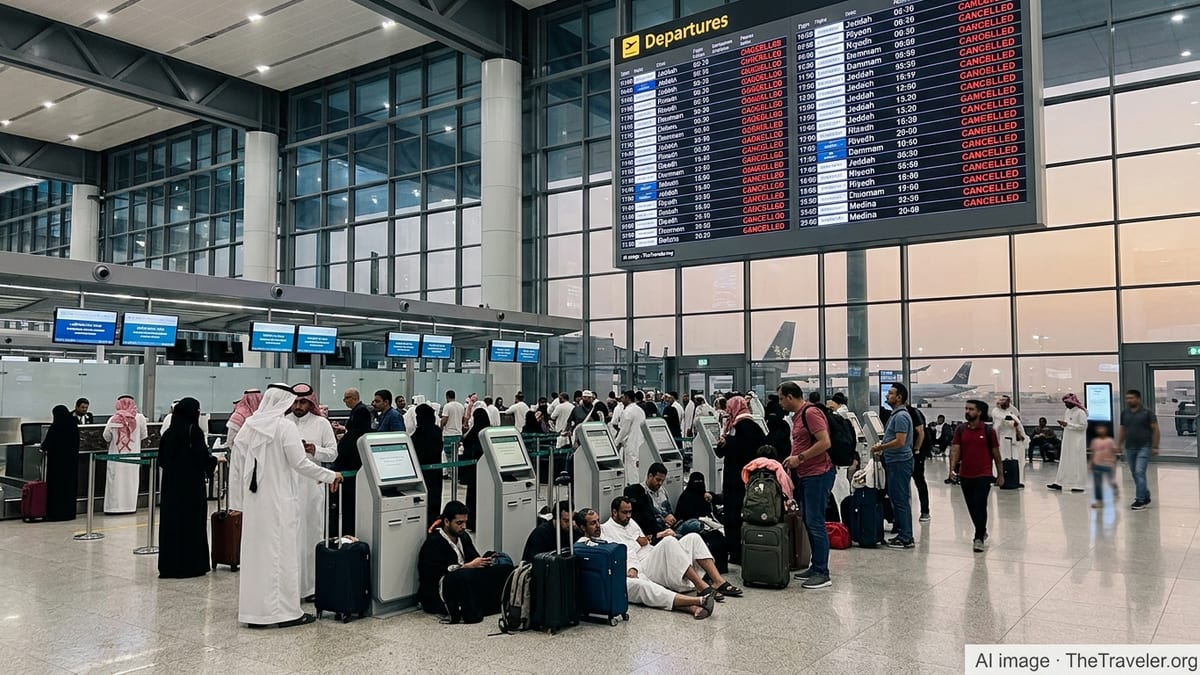
Regional Security Crisis Spills Into Saudi Skies
The latest round of cancellations comes amid a fast-moving security crisis across the Gulf, with airspace restrictions, missile interceptions and drone incidents reshaping traffic patterns over the region. Publicly available information on recent Iranian strikes and related military activity has led airlines to reassess routings through or near Saudi airspace, adding a new layer of volatility to an already fragile schedule environment.
Riyadh’s King Khalid International Airport has been operating with reduced capacity, with security briefings and specialist travel advisories describing limited flights, delays and cancellations linked to regional airspace closures and ongoing interception operations. Jeddah’s King Abdulaziz International Airport remains open but continues to face a heightened risk of last-minute changes as airlines navigate shifting no-fly zones and tactical route bans.
Industry data and operational bulletins show that Saudi Arabia has become a key diversion corridor as carriers avoid higher-risk airspace to the north and east. At the same time, that role as a potential alternative gateway has exposed Saudi hubs to knock-on delays and rolling schedule adjustments whenever security conditions tighten elsewhere in the Gulf.
The result for passengers is a patchwork of partial operations, with some flights running close to schedule while others are cancelled with little notice. Travel forums and airline communication channels reflect growing frustration from travelers attempting to connect through Saudi airports or transit between Saudi cities and major hubs in Europe and Asia.
Gulf Air, Qatar Airways and KLM Trim Schedules Into Saudi Hubs
Gulf Air, the national carrier of Bahrain, has extended a period of flexible cancellations across much of March, a step that reflects the scale of disruption on its regional network. Publicly accessible notices and customer communications highlight that flights into key Saudi destinations such as Dammam and Riyadh remain vulnerable to late operational changes as the airline reshapes rotations around restricted airspace.
Qatar Airways, which has already been operating on a significantly reduced schedule under emergency conditions from Doha, continues to trim or consolidate flights that would normally overfly sensitive corridors or connect through congested Gulf bottlenecks. Travelers report multiple successive cancellations on itineraries involving Saudi gateways, with some rebooked departures pushed back into late March or beyond and limited availability on alternative routings.
KLM has adjusted its operations to avoid Iranian, Iraqi and adjacent airspace, a move that has knock-on effects for long-haul flights into the wider region. Scheduling information and independent aviation analysis indicate that the carrier is rerouting or suspending certain services touching Saudi Arabia, including flights that typically combine Riyadh and Dammam on a single rotation. These changes translate into outright cancellations on some days and extended journey times on others.
Other international airlines are also recalibrating their exposure. Regional and European carriers have already paused or sharply reduced services to several Middle Eastern cities, and capacity into Saudi Arabia is being cut back as aircraft and crews are reassigned to more predictable routes. Taken together, operational data suggest that more than 60 flights involving Saudi destinations have been cancelled or heavily modified in the latest scheduling wave.
Jeddah, Riyadh, Dammam and Medina See Uneven Operations
Across Saudi Arabia’s main international gateways, the impact of the new disruption varies by airport. Jeddah, the country’s busiest Red Sea hub, continues to handle a substantial volume of international traffic, but patterns of delays and short-notice cancellations have become more frequent as airlines wait longer before committing to flight plans through congested corridors.
Riyadh’s King Khalid International has been more directly affected by the proximity of recent security incidents and the sensitivity of the airspace around the capital. Operational summaries shared in risk advisories describe the airport as functioning with limited flights and a continuing risk of schedule volatility through at least the end of March, particularly on routes that would normally link Riyadh with other high-risk points in the region.
Dammam, an important gateway for the Eastern Province and the wider Gulf, has seen particular strain from European and regional carriers that are consolidating services. Analysts tracking air traffic in the Middle East note that flights connecting Dammam with major European hubs have experienced a mix of cancellations and reroutings as operators seek to avoid the most constrained airspace segments while still maintaining essential links.
Medina, a key religious destination, remains on the flight maps of several carriers but with reduced frequencies. Earlier suspensions by some Asian airlines on routes to Jeddah and Medina underlined how quickly religious and seasonal travel flows can be disrupted when security concerns intersect with complex, time-sensitive itineraries.
Knock-On Effects for Transit, Tourism and Events
The latest cancellations arrive at a critical period for Saudi Arabia’s tourism and events calendar, with the country seeking to expand visitor numbers and promote new attractions in Jeddah, Riyadh and other cities. Reduced connectivity, particularly from established Gulf and European hubs, risks dampening short-term demand from travelers who rely on smooth, multi-leg itineraries.
Transit passengers are among the hardest hit. Many itineraries into or through Saudi Arabia depend on tight onward connections via Doha, Manama, Dubai or Abu Dhabi, and the disruption to one leg can strand travelers far from their final destination. Public reports from travelers attempting to rebook indicate that available seats on remaining services are limited and fares have risen sharply on some corridors.
Saudi Arabia is also indirectly affected by disruptions centered in neighboring states. The closure and partial reopening of Qatari airspace and adjustments at major hubs such as Dubai have redirected flows across the region, complicating planning for airlines that use Saudi cities as either primary destinations or alternates when nearby airports reduce capacity.
Short-notice cancellations linked to security reviews are especially challenging for tour operators and event organizers. Packages built around fixed dates for sporting fixtures, cultural festivals or religious travel are difficult to reconfigure at pace, which raises the risk of last-minute changes, fragmented journeys and, in some cases, trip abandonment.
What Travelers Should Watch in the Coming Days
Travel risk analysts expect aviation disruption across the Gulf to continue in the near term as security forces and aviation regulators adjust to evolving military dynamics. Airlines are likely to keep reviewing schedules into Saudi Arabia on a rolling basis, with adjustments concentrated on flights that traverse or approach sensitive airspace zones.
Publicly available guidance from carriers operating in the region stresses the importance of flexible planning. Many airlines, including Gulf Air and Qatar Airways, have expanded their waiver policies during this period, allowing date changes or cancellations without standard penalties on affected tickets. However, the most flexible options are often limited to a specific booking window and may not guarantee like-for-like replacement flights if capacity remains tight.
Travelers heading to or connecting through Jeddah, Riyadh, Dammam or Medina in late March are being advised by industry bulletins and travel advisories to monitor airline notifications closely, check flight status repeatedly in the 24 hours before departure and consider contingency options such as alternative routings or different Gulf gateways where feasible.
While Saudi airports remain operational and some carriers continue to run near-normal schedules on selected routes, the broader picture for the region is one of heightened uncertainty. For now, Saudi Arabia’s role as both a destination and a strategic transit point ensures that any new flare-up in regional tensions is quickly reflected on departure boards from Riyadh to Medina.